

Magazine
The Tanks Were Closing In: Then Everything Changed
Surrounded and outnumbered, two soldiers turned to Tehillim. What happened next is a powerful reminder of the strength of prayer.
- Naama Green
- | Updated
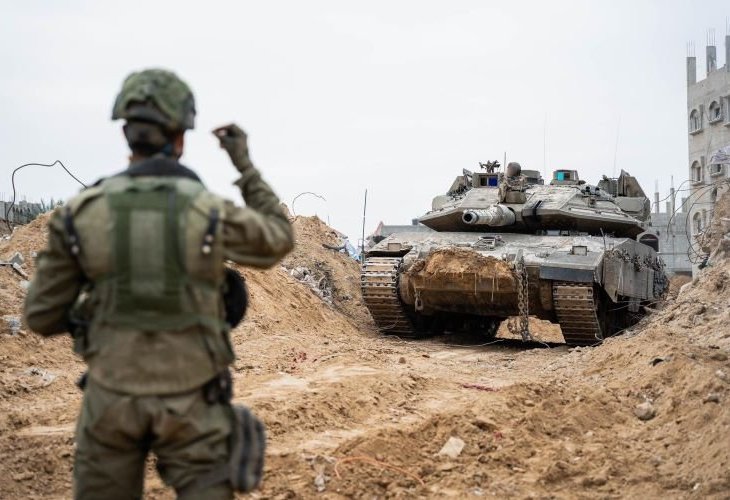 Operations in Gaza, archive (Photo: IDF Spokesperson's Unit)
One of the clearest illustrations of the power of prayer in wartime, and the salvation that can follow, appears in the book Hillel from the Jetty Outpost by Menachem Michelson.
It was the third day of the Yom Kippur War. Hillel Onsdorfer and Ari Gesner, religious IDF soldiers, were stationed at the northern position of the Jetty Outpost near the canal. From their position, they overlooked the entrance from the land side. The Egyptians were heavily shelling the area.
“This is no simple story,” Hillel later said. “Look how many dead and wounded we had.”
The situation was desperate. Only 15 able-bodied soldiers remained in the outpost.
“Maybe we should say Tehillim?” Hillel suddenly suggested.
Turning to Prayer
They began reciting Tehillim. At first, each one said the chapters quietly. Then they found a rhythm. One would read aloud while the other followed silently, eyes scanning the battlefield. Then they would switch.
As they prayed, the attacks intensified. Egyptian forces launched repeated attempts to infiltrate the outpost from multiple directions. The soldiers fought them off with determination.
At the same time, Egyptian units that had crossed into Sinai began advancing toward the outpost from the direction of the Pgisha–Lexicon junction.
A Moment That Changed Everything
During one of the turns, as Hillel was reciting a chapter of Tehillim, Ari suddenly shouted, “Hillel! Come here, quickly! Look!”
Hillel ran over and froze. A convoy of tanks and trucks was heading straight toward them. There was nothing in its path to stop it. Within minutes, it would reach the outpost.
In that moment, both men understood the reality. These could be their final minutes.
Hillel decided to say one more chapter of Tehillim, perhaps the last of his life. He looked ahead, estimated how long the convoy would take, and began to recite slowly, word by word.
For the first time, he felt the full meaning of prayer. Every word came from deep within his heart:
“May Hashem answer you on the day of trouble… May He send you help from the sanctuary…”
“We Invoke the Name of Hashem”
As he reached the final verses, his voice grew stronger. With deep emotion, he cried out:
“Some trust in chariots and some in horses, but we invoke the name of Hashem our God. They have bowed and fallen, but we have risen and stand upright. Hashem, save!”
At that exact moment, a deafening explosion shattered the air.
Before their eyes, the lead tank and the truck behind it were blown into the air. Flames erupted as they crashed back down. Within seconds, chaos spread through the entire convoy. Vehicles began turning around, trying to escape.
Then, something even more astonishing happened.
Heavy fire suddenly rained down on the convoy, not from the outpost, but from the Egyptian side across the canal. Tank after tank and truck after truck went up in flames as the convoy returned fire toward its own forces.
A Stunning Realization
Hillel and Ari could hardly believe what they were seeing. The convoy was Egyptian, and the fire attacking it was also Egyptian.
Later, the explanation became clear. After crossing the canal, Egyptian forces had planted mines along the road to block Israeli reinforcements. It appears that either the units forgot or there was a breakdown in communication. The convoy had driven directly onto its own mines.
Those across the canal mistook the explosions for an Israeli attack and opened fire. The convoy, thinking it was under attack, returned fire in confusion.
“They have bowed and fallen, but we have risen and stand upright,” Hillel cried out again.
Overcome with emotion, he and Ari embraced and burst into tears, this time tears of relief.
A Message for Today
This powerful story reminds us of the strength of prayer, especially in times of danger and uncertainty.
Psalm 20, which Hillel recited in those critical moments, has long been a prayer for salvation:
“Some trust in chariots and some in horses, but we invoke the name of Hashem our God… Hashem, save! May the King answer us on the day we call.”
Even in the most desperate moments, when everything seems lost, a heartfelt prayer can open the door to unexpected salvation.
The question remains for each of us: in times of challenge, where do we place our trust?

