

Raising Children
Will Our Spiritual Struggles Confuse Our Children?
A thoughtful look at how children learn resilience, values, and faith through real-life challenges
- Noa Harel
- | Updated
As baalei teshuvah, we naturally experience ups and downs in our service of God. I try to strengthen and stand by my husband, but in the midst of all this I am deeply worried: how does this instability affect our children? Won’t it confuse them? Doesn’t it harm their education and the personal example we are trying to provide?
* * *
As baalei teshuvah, and by the very choice you made to live a life of Torah and mitzvot, you have already demonstrated a sincere desire and genuine appreciation for this path. At the same time, there are challenges. Reality is full of distractions, and you are describing a very natural situation in which it is not always possible to feel steady in the spiritual direction you wish to establish in your home.
A good piece of advice for every baal teshuvah is to remain closely connected to a rabbi with a clear and grounded outlook, someone who can accompany, guide, and support you during times like these.
At the same time, it is important to remember that the Master of the Universe created this reality for you and for your children with precise divine providence. Even within the waves, between the rises and the falls, there is learning taking place. Children do not need perfection in order to learn and grow.
There is a common view regarding “personal example,” which assumes that it is only our actions that communicate a message. But this view is only partial. Children learn truth. They know us deeply. When a father experiences ups and downs, the child does not necessarily see failure — rather, the child sees a struggle: a struggle for values, for faith, and for inner truth.
The child learns that even when things are difficult, we do not give up. He sees what his father is fighting for, what pains him, what brings him joy, what he is willing to work for, and what he is prepared to sacrifice. All of this, and much more, serves as a powerful personal example and a clear direction for the child, even when the father himself is in the midst of a battle.
More than that, the child learns from the respectful way the mother relates to the father. He understands that respect is not given because father is perfect, or because father is a righteous person, but simply because he is father. It is a form of respect without conditions.
In life itself, there is always a natural distinction between the world of adults and the world of children, and we, as parents, understand that we teach through values, not merely through imitation of actions.
For example, if a parent smokes, does that mean a child should also be allowed to smoke? Our bedtime as adults is usually later than that of our children. When I, as a mother, wash the dishes and my children do not, I do not say, “Well, I gave a personal example.” We understand that children do not simply copy actions; rather, they absorb the deeper messages behind them.
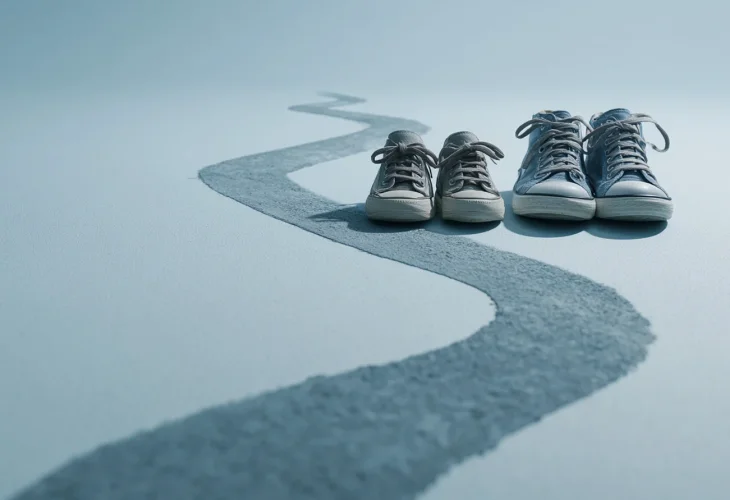
The same is true in serving God. The child understands that there is a process, that there are struggles, and that there is a constant aspiration toward what is good — even if the road is not always straight and free of difficulty.
In fact, specifically a home like this, where children encounter the less “smooth” side of life, prepares them for real life more than anything else, because, truthfully, life is never completely smooth.
Noa Harel is a parenting instructor, couples counselor, and advisor in personal awareness.

