

Raising Children
Chanukah and the Sacred Mission of Raising Children in Faith
How the light of the Chanukah candles reveals a timeless Jewish approach to parenting, education, identity, and spiritual growth
- Rabbi Yisrael Azulai
- | Updated
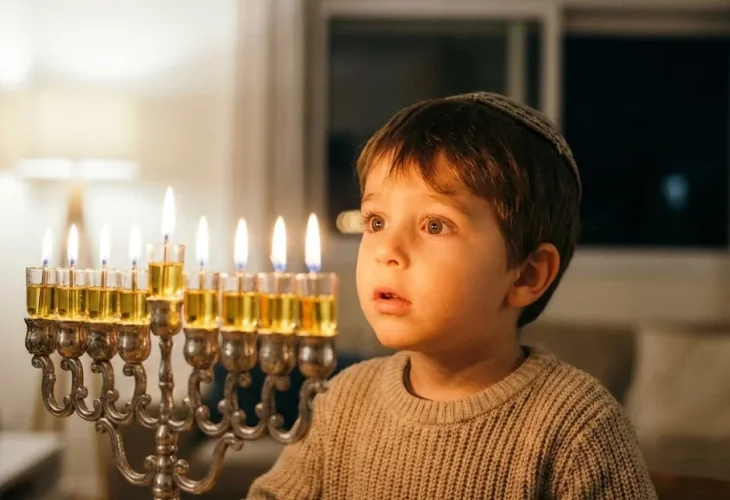
When the righteous Rabbi Meir of Premishlan would light the Chanukah candles and reach the words, “These lights are sacred, and we have no permission to use them, only to gaze upon them,” he would immediately begin to weep.
He would say: these sacred lights are the children whom the Holy One, blessed be He, has entrusted to us. They are holy, and we are not permitted to “use” them for our own purposes, but rather to look upon them with reverence and care.
From the very first moment a husband and wife marry, they naturally long and pray for the blessing of children. Then, when the first child is born, the entire home is filled with light and joy — much like the radiance of Chanukah itself.
There is one essential principle every parent must know and build upon: our children are not our possessions. Chazal teach that children are a trust from God, placed in our hands for safekeeping. We are charged with raising this sacred trust according to His guidance, not merely according to our own opinions or personal worldview. This is the deeper meaning of the phrase, “These lights are sacred, and we have no permission to use them.”
The True Meaning of Education
The Hebrew letters of Chanukah can be read as an allusion to chinuch Hashem — education in the way of God.
For this reason, the festival of Chanukah invites us to reflect deeply on the sacred mission of educating our children and students. Every parent, teacher, and educator must remain focused on the true goal of education that nurtures a child’s connection to God, values, and inner purpose.
Today, many people invest in pedagogy, rules, and moral instruction, yet not always in true education.
Real education means bringing hidden potential into reality, identifying the goodness already present within the child and giving it space to grow, and helping each child reach their destination through their own strengths, while being guided by values, character, and faith.
Education must not focus solely on intellectual achievement, but must also nurture emotional and spiritual development.
A child who knows they are precious in the eyes of their parents, teachers, and above all in the eyes of God — a child raised in an environment of love, acceptance, and support, will be far better equipped to face life’s challenges, develop healthy confidence, and choose the right path.
Becoming a Light for Our Children
Chanukah reminds us of the lights kindled by the sages of Israel — beacons of spirit and hope during dark and difficult times.
In the same way, every parent and educator must strive to become a source of light for their children: to illuminate their path and guide them toward lives of meaning, holiness, and purity.
Education is not merely a social responsibility or an academic task. It is a sacred calling, a mission entrusted to us by God.
Like the Chanukah candles, our children are holy. They are a sacred deposit placed in our care, and we must honor that trust faithfully. We are called to raise them with love, responsibility, and spiritual commitment, and to equip them with the tools to stand confidently in the modern world while carrying a living and vibrant Jewish soul.
They must grow with spiritual pride and a strong Jewish identity, never feeling the need to hide it.
In this way, we do not only light the Chanukah candles in the menorah, but we kindle the light within the hearts of our children and, through them, bring light to the entire world: faith, hope, love, values, and respectful speech between people — qualities so deeply needed in society today.
Every Child Is Unique
It is important to remember that every child is unique and special in their own way.
Parents and educators must be sensitive to each child’s distinct needs and respond with gentleness and patience, understanding that education is a gradual process that unfolds over time.
Just as the Chanukah candles do not burst forth in full brilliance all at once, but begin with one candle and increase day by day, so too education does not happen in a single moment. The flame itself rises slowly until it stands on its own.
So it is with a child. True education is built through small, steady steps.
Children learn primarily by observing the behavior of their parents and teachers, by absorbing the atmosphere of the home and the community in which they grow.
For this reason, we must strive to live lives filled with honesty, love, patience, and respect for others, so that our children can see these values embodied and naturally aspire to adopt them.
Building a Compassionate Society
Education must also include a strong social dimension. Children should be taught how to be good friends, help others, respect differences, and become part of a caring and supportive community.
In this way, we build a generation capable of strengthening society on foundations of brotherhood and unity — foundations without which no strong and faithful nation can endure.
Each day of education is an opportunity to strengthen the inner light within every child, to remind them that they are sacred and significant, and to accompany them on a path where they can fulfill their potential, serve God, and contribute positively to society.
Eight Guiding Principles for Education
The eight days of Chanukah may also hint to eight beautiful principles for raising children in the way of God:
1. Love of Torah
Encourage children to love Torah learning as a way to understand God’s path and connect to the moral and spiritual foundations of life.
2. Patience, Perseverance, and Personal Example
Just as the candles are lit day after day, education requires patience and consistency. Never give up on a child, even during times of struggle. Above all, children imitate what they see — personal example is the secret of Jewish education.
3. Joy and Vitality
Teach children to rejoice in what they have and create an environment filled with warmth, laughter, and life. Joy opens the heart to learning and growth and protects against despair.
4. Respect for Others
Cultivate love and respect for every person, even those who are different, because every human being is created in the image of God.
5. Serving God from the Heart
Guide children to serve God from genuine love and feeling, not through pressure or force. For example, instead of lecturing them about how to say Birkat Hamazon, let them see you reciting it with joy, intention, and sincerity.
6. Strengthening Faith
Teach children to trust in God’s power, especially in difficult times, and to understand that everything happens under His providence.
7. Giving and Kindness
Instill within them the value of giving, helping others, and working for the good of the community.
8. History and Tradition
Teach children the stories of Torah, the festivals, and Jewish tradition with life and inspiration, so that their hearts are ignited, rather than treating it as another academic subject.

