

Behind the News
IDF Nearing Control of Hezbollah’s Last Major Border Stronghold in Bint Jbeil
As forces encircle on Bint Jbeil, Israeli officials say the battle could mark the end of major fighting in southern Lebanon
- Brian Racer
- | Updated
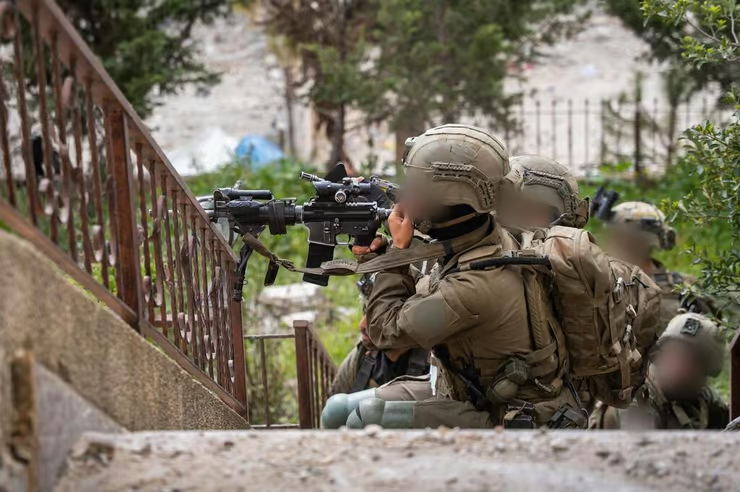 (IDF Spokesperson)
The IDF said Monday that its operation in Bint Jbeil is expected to conclude in the coming days, after troops encircled the town, launched a surprise entry into its center, and killed more than 100 Hezbollah terrorists. According to Israeli estimates, fewer than 50 fighters remain in the area, and once the battle ends, no further major ground engagements are expected in southern Lebanon.
The assessment marks a turning point in the campaign. Israeli officials say the fighting is shifting from large-scale ground operations to a new phase focused on clearing remaining weapons, conducting limited engagements with residual Hezbollah forces, and maintaining a longer-term security posture along the border. The shift comes following the ceasefire that began last week, after which the IDF has reduced strikes in Beirut and other deeper Hezbollah strongholds, focusing instead on preventing immediate threats such as active rocket fire.
The battle itself has been led by Division 98, with forces from the Givati Brigade, the Paratroopers Brigade, and commando units including Maglan operating in and around Bint Jbeil. The IDF says it isolated the town, surrounded it from multiple directions, and entered at a time and location that caught Hezbollah fighters off guard, leading to close-range combat in dense urban terrain.
Brig.-Gen. Guy Levi, commander of Division 98, linked the current operation to the town’s symbolic role in Hezbollah’s history. “Bint Jbeil, the year is 2,000. [Nasrallah] here once spoke, boasting about webs and spiders. Today, that man is gone, the field is gone, and his words mean nothing.”
Israeli officials say Hezbollah fighters in Bint Jbeil have relied on decentralized tactics, operating in small teams from within civilian structures. Launchers were often stored inside homes or basements, briefly deployed for attacks, and then concealed again. The approach has led to extremely close encounters, sometimes at distances of just meters, contributing to what the IDF describes as slow but aggressive fighting.
The military also said Hezbollah used the Bint Jbeil Governmental Hospital and surrounding facilities for military purposes, including storing weapons, conducting surveillance, and launching attacks. According to the IDF, around 20 terrorists were killed in the hospital area after troops identified hostile activity there.
“The IDF views with severity the cynical use by the Hezbollah terrorist organization of civilian infrastructure, including medical institutions, for military purposes, while endangering patients, medical staff, and civilians,” the military said in a statement.
Bint Jbeil is considered one of Hezbollah’s most important strongholds near the Israeli border. Located about 4 kilometers (2.5 miles) from Israel, it is the largest Shiite town in the area and has served as a key source of rocket fire toward northern Israeli communities in recent fighting. The town also carries symbolic weight as the site where Hezbollah leader Hassan Nasrallah delivered his “spider web” speech following Israel’s withdrawal from southern Lebanon in 2000.
Israeli officials have acknowledged that the IDF did not fully neutralize Bint Jbeil during operations in 2024, allowing Hezbollah to further entrench its infrastructure there. The current offensive is partly aimed at correcting that gap, with more focused intelligence and a concentrated effort on one of the last major Hezbollah hubs south of the Litani River.
If the town is fully cleared, the IDF says it will remove a key forward base used for attacks near the border and leave no remaining major strategic targets in southern Lebanon. However, Hezbollah is still believed to possess significant rocket capabilities in areas north of the Litani River, limiting the overall impact on its broader arsenal.
The IDF estimates that several more days of fighting are needed to complete operations in Bint Jbeil. Afterward, the military is expected to continue clearing weapons and infrastructure in the region for an extended period, while preparing for possible limited clashes with remaining fighters and shaping a long-term security presence that may depend on future negotiations with Lebanon.
Levi emphasized the broader context of the operation, saying, “Bint Jbeil, the year is 2026. Our forces control the space, destroying terrorist infrastructure and killing dozens of terrorists. Behind us are the residents of the north whom we protect, before us are the national days that remind us why and for what we are fighting.”

