

Israel News
From the Ghetto to El Malei Rachamim: Judge Menachem Ne’eman’s Journey
At Yad Vashem’s state ceremony, the 88-year-old Holocaust survivor and former deputy president of the Haifa District Court led a moving El Malei Rachamim. In a heartfelt interview, he recalls his father risking beatings to bring home potatoes for Passover—and credits Hashem for his family’s survival.
- Yuval Aviv
- | Updated
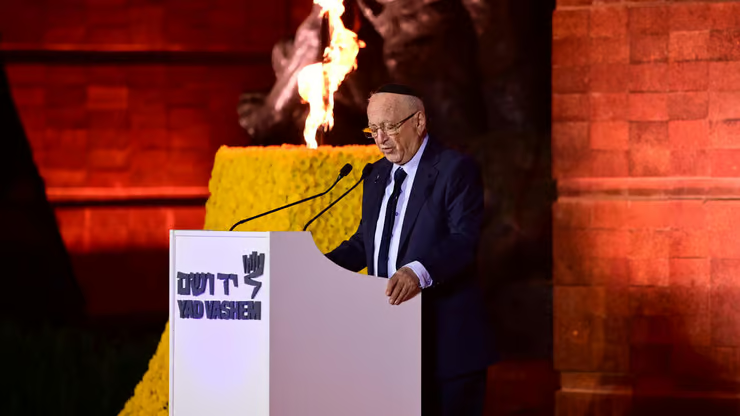 Holocaust survivor Menachem Ne’eman during "<i>El Malei Rachamim</i>" (Photo: Rafi Ben Hakon, Yad Vashem)
Holocaust survivor Menachem Ne’eman during the prayer "El Malei Rachamim" (Photo: GPO)
Former deputy president of the Haifa District Court, Menachem Ne’eman, last night (Monday) delivered an especially moving El Malei Rachamim during the official state opening ceremony for Holocaust Remembrance Day, held at Yad Vashem’s Warsaw Ghetto Square.
Ne’eman, 88, was born in 1938 in Briaza, Romania, and grew up in Câmpulung Moldovenesc, the youngest child of Frida and Moshe Neumann, with two brothers and two sisters. At the end of 1941, his family was deported in a cattle car to the town of Ataki in Romania, and from there was transferred across the Dniester River to the Shargorod ghetto in Ukraine.
In an interview with ynet, he described one of his earliest childhood memories from the Holocaust: "The memory is the crossing. I’m holding some small item, and my father and mother and my sisters are holding a few things, and we immediately, as we cross the Dniester River, are forced to sell those things to get some slice of bread".
Ne’eman said that even in the harsh conditions of the ghetto, his father made sure on Passover that they would not eat chametz: "We ate potatoes that my father obtained during his forced labor. He pulled potatoes and beets from the ground. It was forbidden to put anything in your pocket; anyone who put something in a pocket would immediately be given lashes, and he did it out of self-sacrifice for the family—and he was whipped".
Ne’eman’s older brother perished in Auschwitz together with his grandmother, after being sent to Hungary. Ne’eman himself survived together with the rest of his family: "This is exactly when I think of the kindnesses that Hashem bestowed on our family—that under those conditions, when all of us had 41.5-degree fevers, we survived. All of us, except for the eldest brother who perished in Auschwitz".
He added: "When I think about those kindnesses—that the other four children, and our parents, managed to survive and return—that is an immense kindness that shaped my faith and all of my conduct throughout my life".
After the war, Ne’eman had to help support his family already as a child: "My father sent me to families to sing in order to receive a donation, and that is how we tried to get by," he said. Later, his father chose to move to Israel, despite offers to go to the United States: "Although he was a VizhnitzHasid, my father said, 'I’m not going to the United States, I’m going to Eretz Yisrael'. He knew that all we would get here was a tent in a transit camp, and in 1950 there was snow across the country and our tent blew away, and I was taken again to the hospital with a very severe throat infection, and again I thought we would not survive, and again we suffered. I always feel — 'Until now Your mercy has helped us and Your kindness has not forsaken us".

