

Wonders of Creation
Decoding the Human Brain: Google's Groundbreaking Mapping Project
Google's AI team, in collaboration with Harvard neuroscientists, has charted a cubic millimeter of the human brain, resulting in a staggering 1.4 petabyte data file
- Hidabroot
- | Updated
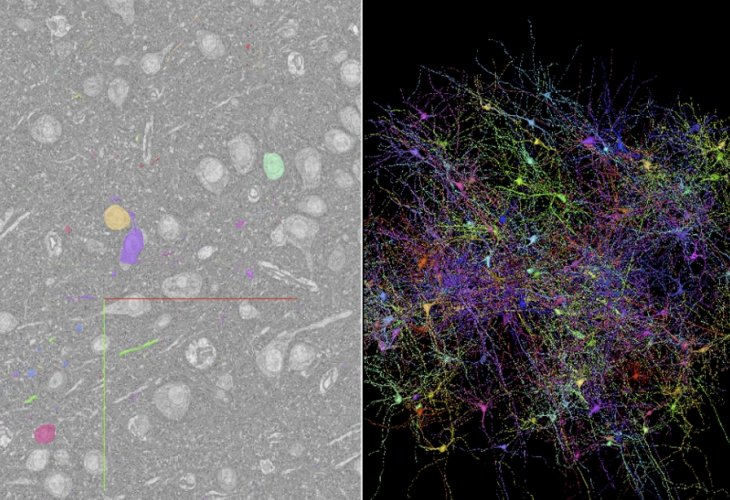
The study of the human brain is one of the most complex, fascinating, and important fields occupying researchers around the world. The brain is an extraordinary biological machine, unlike anything else in nature, and scientists have spent many years trying to understand how it works.
For a long time, researchers have been working to map the human brain in order to decode its activity and structure. Now, in a groundbreaking achievement, brain researchers working together with scientists from Google have succeeded in mapping the brain — or more precisely, one cubic millimeter of human brain tissue.
The result is astonishing in both its detail and its scale.
From a Fruit Fly to the Human Brain
At the beginning of 2020, researchers from Google published a map of approximately half of a fruit fly’s brain. But the current project is on an entirely different scale.
The new dataset released by the team weighs no less than 1.4 petabytes, and all of this was created from just one cubic millimeter of human brain tissue. To put that in perspective, this is roughly 1,400 terabytes of data generated from a piece of tissue about the size of half a grain of rice.
This dataset is called H01, and it has been made openly available to the public so that neuroscientists, data scientists, and anyone interested in the brain can study it.
The map was created at an extraordinary resolution of about 3 nanometers, allowing researchers to examine cells and their connections at an almost unimaginable level of detail.
How the Brain Was Mapped
To create this map, the researchers collaborated with a hospital in Boston, where a small piece of cerebral cortex tissue was obtained during surgery performed on patients with epilepsy.
Scientists from Harvard University and Google used one of these tissue samples and cut it into more than 5,000 ultra-thin slices, each approximately 30 nanometers thick. An electron microscope was then used to create the initial scan.
The result was staggering: approximately 225 million two-dimensional images of brain tissue sections, which the Google team later combined into a single three-dimensional model using artificial intelligence and machine learning.
The Scale of the Discovery
To create this enormous database, the team required thousands of cloud processing units (TPUs).
In addition to reconstructing a 3D model of nearly every cell in the tissue sample, the researchers also cataloged approximately 150 million synapses — the connections between brain cells — within that tiny fragment alone.
The map contains roughly:
57,000 cells
150 million synapses
230 millimeters of blood vessels
all within just one cubic millimeter of tissue.
Artificial Intelligence and Human Verification
Although much of the mapping was carried out through machine learning and advanced computer processing, not everything was left entirely to automation.
About 100 cells from the mapped tissue were also manually checked by human experts to ensure that the reconstruction was accurate and reliable.
This combination of AI analysis and human verification has made the dataset one of the most important resources for future brain research.
New Discoveries and Future Research
According to the researchers, the mapping process has already revealed previously unknown types of cells and unusual neural structures.
Beyond the discoveries already made, the H01 dataset is expected to serve as a foundational resource for studying the cerebral cortex for years to come.
Because the data was labeled using advanced neural networks and self-learning AI systems, researchers can now analyze specific regions far more easily and continue uncovering how the human brain is organized and how it functions.
This achievement represents one of the most extraordinary scientific milestones in modern neuroscience.

