

World News
At Auschwitz, Survivors of Today’s Attacks Join Holocaust Memory in Urgent Warning
March of the Living brings together terror survivors, Holocaust survivors and police leaders, highlighting both rising antisemitism and a growing global response
- Brian Racer
- | Updated
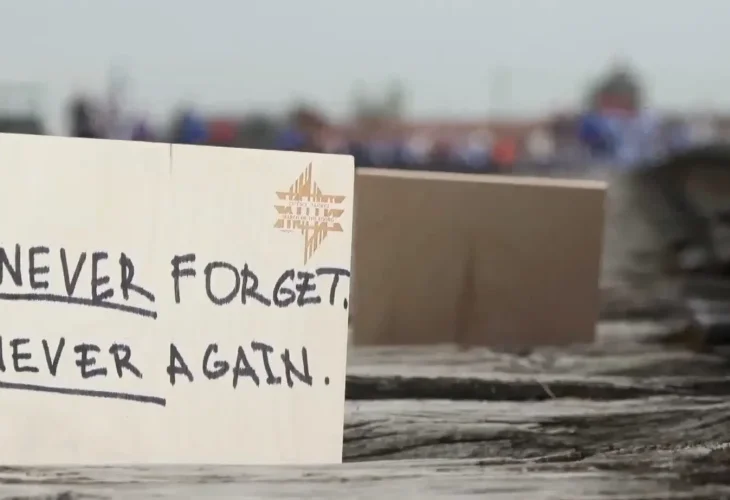
Thousands gathered Tuesday at Auschwitz-Birkenau for the annual March of the Living, where participants warned that antisemitism is no longer only a matter of history but a present-day global threat.
The event, held on Holocaust Remembrance Day, brought together Holocaust survivors, survivors of recent antisemitic attacks, and international delegations, signaling a shift from remembrance to urgency. Organizers and participants said the scale and spread of antisemitism since October 7 has transformed this year’s march into a warning about what they see as a growing and evolving danger.
“We are standing here in the place where 1.1 million people were systematically murdered. Since October 7, antisemitism has spread everywhere, on a scale we have never known. We know how this ends,” said Revital Yakhin Krakowski, chief executive of March of the Living in Israel.
That warning was reinforced by the presence of survivors of recent attacks in the United States, the United Kingdom and Australia, who stood alongside Holocaust survivors at the site where more than one million Jews were murdered. Their participation underscored what many described as a direct line between past persecution and current violence.
“My father didn’t make it because he was a Jew,” said a survivor of the Bondi Beach attack in Sydney, referring to the December shooting that killed 15 people during a Chanukah gathering. “It starts with the Jews but it doesn’t end with the Jews.”
Others described how antisemitism has evolved rather than disappeared. Abby Talmud, who survived a shooting attack in Washington, said: “Antisemitism has not disappeared. It has simply changed form. Anti-Zionism is antisemitism.”
Participants also spoke of a continuing sense of insecurity. Survivors recounted fleeing gunfire, hiding during attacks and losing family members, describing experiences that, for many, have reshaped their sense of safety in their home countries.
“History is warning us. The bell is already ringing,” said Paul Goldenberg, who heads a delegation of international police officers attending the march. “The Holocaust did not begin with mass murder, but with the dehumanization of Jews and the erosion of democratic values.”
Goldenberg said law enforcement agencies are increasingly treating antisemitism as a global challenge requiring cooperation across borders. “We are here to protect our communities, our synagogues and our children, everywhere in the world,” he said.
Holocaust survivor Nate Leipciger, 98, warned that the patterns he witnessed as a child are re-emerging. “Antisemitism, as you know, has existed for centuries. Its form may change, its language may evolve, but its consequences are always the same: tragic,” he said.
Some speakers framed the current wave of antisemitism as part of a broader geopolitical dynamic. Sylvan Adams, a senior figure in the fight against antisemitism, said: “Antisemitism begins with the Jews, but ultimately targets the entire free world.” He added: “At the push of a button, Ayatollah Khamenei can achieve what took Hitler years.”
According to data presented at the event, antisemitic incidents have surged in recent years, including more than 9,300 reported cases in the United States in 2024, an all-time high.
The message that emerged from Auschwitz was both a warning and a commitment. As participants walked the route from the camp to Birkenau, they framed “Never again” not only as a memory of the past, but as a responsibility to confront and counter antisemitism in the present.

