

Magazine
Krakow’s Jewish Revival: A Yemenite Rabbi’s Mission
In post-Holocaust Krakow, a Yemenite rabbi is guiding Jews back to their roots, sparking a quiet revival of faith, identity, and connection.
- Michal Arieli
- | Updated
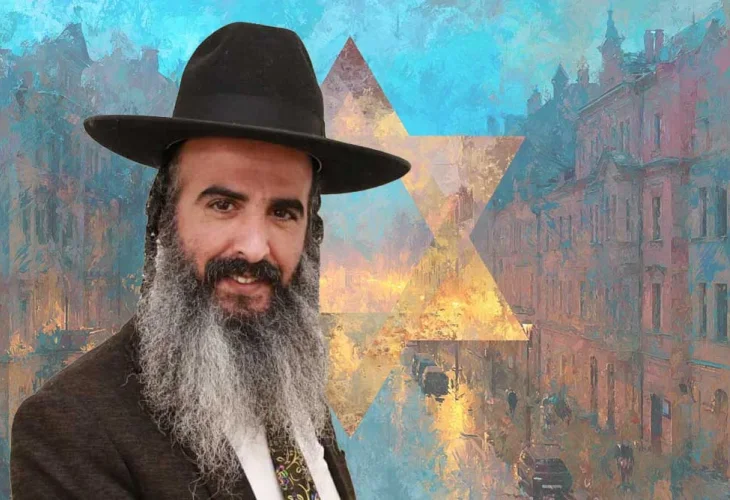
“Nothing could have prepared me to become the rabbi of Krakow’s Jewish community,” says Rabbi Boaz Gadke.
For years, Rabbi Gadke was deeply involved in preserving Yemenite Jewish tradition and music. Then, almost unexpectedly, his life took a dramatic turn. Today, he serves as the community rabbi in Krakow, Poland, leading a small but growing Jewish population in a place once devastated by the Holocaust.
A Mission That Began by Chance
“The beginning was on Lag BaOmer, eight years ago,” he recalls. “I had come as a cantor for Passover. I saw an opportunity to bring Yemenite Jewish culture to Poland, so I came with my family.”
During their stay, they led prayers and taught Torah classes. When it was time to return to Israel, community leaders approached him with an unexpected request.
“The rabbi had just left,” he says. “They asked if I could take his place.”
At first, he hesitated.
“I already served as a community rabbi in Israel, and I didn’t know how I could divide my time. But more than that, I didn’t understand what it meant to be a rabbi in a place like Krakow.”
What he saw there moved him deeply.
“A small community, many of whom had assimilated, with very little Jewish life. It was a huge question. How do you even begin such a mission?”
Rediscovering a Jewish Spark
Today, the community numbers around 250 people.
“There are older members, families who were here before the war, and a younger generation that knows almost nothing about Judaism,” Rabbi Gadke explains. “Communism erased nearly everything.”
And yet, something remains.
“When they hear about Shabbat or the holidays, you can see a spark in their eyes. The Jewish heart is still beating. That is the most moving thing.”
Rabbi Gadke sees his role as a clear mission from Hashem.
“There is no natural explanation for why I ended up here. I simply try to do the best I can.”
Bridging Worlds
To connect with the community, Rabbi Gadke learned Polish and now uses it daily, both with local Jews and with city officials.
“I even prepare weekly Torah insights in Polish,” he says with a smile. “A Yemenite rabbi speaking Polish may sound unusual, but to me, it is something beautiful.”
At first, even he found the situation surprising.
“People joke that it sounds like the beginning of a story,” he says. “But the longer I am here, the more I see how meaningful it is. We are one people, and we are meant to come together.”
A Return to Jewish Life
Rabbi Gadke often reflects on the deep historical roots of Krakow.
“We pray in the synagogue of the Rema, Rabbi Moshe Isserles,” he says. “He was known for his humility and unity. It is no coincidence that today we are witnessing a kind of revival in that very place.”
One particularly emotional moment stands out.
“There was a family that had wanted to convert for over 30 years, but it kept being delayed. This past Tu BiShvat, I had the privilege of accompanying them to the beit din. The entire family joined the Jewish people. It was incredibly moving.”
Small Moments, Deep Impact
There are many other moments that stay with him.
“We have people putting on tefillin for the first time, even at age 60 or 70,” he shares. “We celebrated late bar mitzvahs.”
One memory is especially powerful.
“I once helped an elderly man put on tefillin. He asked me to leave them on longer and longer, and he held onto me tightly for ten minutes. These are moments that simply did not exist here until recent years.”
Leading With Love
When asked about his approach, Rabbi Gadke is clear.
“There are no secrets. I feel tremendous siyata d'shmaya. I try to meet people at eye level, with a smile, with love, with encouragement.”
He does not come with demands.
“I never preach. I simply share a message: let us be good people and try to do Hashem’s will.”
Walking Through History
Despite the renewal, Krakow still carries the weight of its past.
“You walk through streets where Jewish life once flourished,” he says. “Before the war, this was a major center of Jewish life. The loss is still deeply felt.”
Even after the Holocaust, the community continued to face hardship.
“There were difficult years, pogroms, and ongoing struggles,” he adds.
Looking Toward the Future
Many community members have lived in Krakow for generations, making it difficult to leave.
“Still, I believe that the best place for every Jew is Israel,” Rabbi Gadke says. “Whenever someone makes aliyah, I feel only joy.”
Despite challenges, he continues his work with confidence and calm.
“I walk openly as a Jew, with a kippah and tzitzit,” he says. “There is still antisemitism, especially in recent years, but it does not shake me. I see how much people want to connect, and that is what matters.”
A Living Connection
Beyond the local community, Rabbi Gadke also works with visitors from around the world who come to Krakow to explore their roots or visit the graves of great Torah leaders.
“The city is filled with history,” he says. “From the Rema to the Bach, so many great figures lived here. People come searching, and often they find something deeply meaningful.”
Many historic synagogues still stand, including the Rema Synagogue, which has been standing for over 500 years.
“I have even been able to help return some Jewish properties to the community,” he adds.
Moments That Spark a Return
As Passover has just passed, Rabbi Gadke reflects on the powerful moments the community experienced together.
“The entire community gathered for the Seder,” he says. “And from experience, I can tell you that some of the most meaningful journeys begin at moments like these.”
Time and again, he has seen how a shared holiday, a prayer, or even a simple conversation can awaken something deep within a person.
As the verse teaches, there will come a time when people will seek not food or drink, but a deeper connection, a desire to hear the word of Hashem.
And in Krakow, that search is already underway.

