

Parashat Vayechi
Rachel’s Tears, Joseph’s Forgiveness, and the Path to Rebuilding Jerusalem
How Rachel’s sacrifice, Joseph’s willingness to forgive, and the spiritual strength to yield for peace reveal the timeless path toward redemption and the rebuilding of Jerusalem
- Rabbi Menachem Jacobson
- | Updated
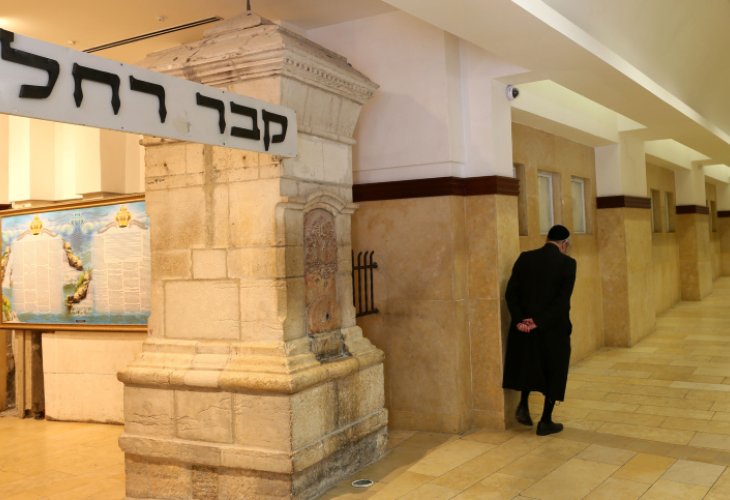
During Yosef’s final visit with his father, Yaakov says to him: “And as for me, when I came from Paddan, Rachel died beside me in the land of Canaan, while there was still some distance to come to Efrat; and I buried her there on the way to Efrat, which is Beit Lechem.”
Rashi explains that Yaakov was telling Yosef that Rachel was buried there so that she would stand in prayer for her children when they would later go into the Babylonian exile.
The great thinker and commentator Samson Raphael Hirsch notes that this explanation would seem especially relevant when Yaakov asks Yosef to ensure that he himself be buried in the Cave of Machpelah. The obvious question is: if Yaakov could be brought from Egypt all the way to Chevron, why was Rachel not taken there as well?
Rabbi Hirsch explains that Yaakov is hinting to a much deeper truth.
At first glance, Rachel appeared to lose by giving up burial in the longed-for family cave, just as she had seemingly lost when she allowed Leah to enter Yaakov’s home first. Outwardly, it was Leah who was buried with the great patriarch.
In truth however, Rachel lost nothing.
Yaakov now tells Yosef, Rachel’s son, that he is granting him the highest distinction: both of Yosef’s sons will become tribes in Israel. As Yaakov says, “Ephraim and Menashe shall be mine like Reuven and Simeon.”
Through Yosef, and through Rachel’s willingness to give up honor for the sake of future generations, the blessing of God, “I will make you into a multitude of nations,” is fulfilled.
Rachel’s Tears and Her Eternal Prayer
The Midrash beautifully connects Rachel’s two great acts of self-sacrifice into one unified theme of self-nullification for the sake of another.
What is Rachel’s prayer when her children go into exile?
“A voice is heard in Ramah, lamentation and bitter weeping; Rachel weeps for her children.”
The sages describe Rachel’s plea before God: “Master of the universe, it is revealed and known before You that Yaakov Your servant loved me greatly and worked for my father seven years for me. When the time came for my marriage, my father planned to exchange me for my sister. The matter was unbearably painful to me. I informed my husband and gave him signs so that he would know it was truly I. Yet afterward I reconsidered. I restrained my own desire and had mercy on my sister so that she would not be humiliated. That very night they exchanged my sister for me, and I gave her all the signs I had given my husband.”
From her isolated burial place, Rachel pleads for the exiled nation: “Please, God, remember for me and for my children the painful sacrifice I made for the honor of my sister.”
And God answers her: “Restrain your voice from weeping and your eyes from tears, for there is reward for your deed… and your children shall return to their borders.”
Rachel’s life teaches a timeless truth, that sacrifice for the sake of another is never truly lost.
Yosef Continues Rachel’s Path
Yosef continues this same path of forgiveness and self-restraint for the sake of the unity of the nation.
The pain still burns and the wound has not disappeared. However, Yosef does not take revenge. Instead, he reconciles. Both he and his mother are rewarded eternally.
Yosef receives the extraordinary merit of two tribes emerging from him, and to this day every father blesses his son with their names: “May God make you like Ephraim and Menashe.”
As Yaakov said: “By you shall Israel bless.”
When we pass this blessing on to our children, we should also pass on the message behind it, that nothing is lost through yielding for the sake of peace. In the span of eternal life, the reward is returned many times over.
The Tenth of Tevet and the Beginning of Destruction
The fast of the Tenth of Tevet, is due to the beginning of the siege of Jerusalem — the start of the process that led to its destruction.
The Chatam Sofer explains that the special severity of this fast is so great that some authorities held that if it had fallen on Shabbat, one would even fast on Shabbat.
This is because “every generation in which the Temple is not rebuilt is considered as if it were destroyed in that generation.”
Each year brings a renewed judgment: will the destruction continue, or will rebuilding begin? If we once again arrive at the Tenth of Tevet and repeat the order of destruction, it means that we still stand in the spiritual category of a generation in which it has not yet been rebuilt.
This is deeply connected to the theme above. The sages say that Jerusalem was destroyed because people insisted rigidly on the strict letter of the law.
The Strength to Yield
Here lies a profound difference in outlook.
One approach sees yielding as a weakness. If you give in, you are seen as vulnerable. You are considered a “sucker.”
Sadly, this mindset has also entered parts of Jewish culture, but the Torah view is the opposite.
The strong person is the one who can yield. Yielding reflects strength, inner security, and emotional resilience. Among Jews, we expect the greater person to yield to the smaller one. From a Torah scholar, we especially expect conduct beyond the strict letter of the law.
If you are truly great, truly wise, and truly strong, you demonstrate a deeper understanding of life and a greater desire to resemble the attributes of the Creator, whose essence is giving and kindness.
This capacity to yield is not weakness, but spiritual strength.
Rebuilding Jerusalem Begins Within
When we reclaim this quality, we begin rebuilding Jerusalem.
The rebuilding of the city begins with the rebuilding of the heart. When we restore to ourselves the ability to forgive, to yield, and to place peace above ego, we begin to reverse the destruction.
This is how Jerusalem is rebuilt — first within us, and then in the world.

