

Parashat Vayechi
Embracing Both Sides: Lessons from the Blessing of Ephraim and Menashe
The deeper meaning behind Yaakov's crossed hands and the timeless Jewish blessing that teaches us to focus on growth, hope, and the good within every child
- Rabbi Moshe Sheinfeld
- | Updated
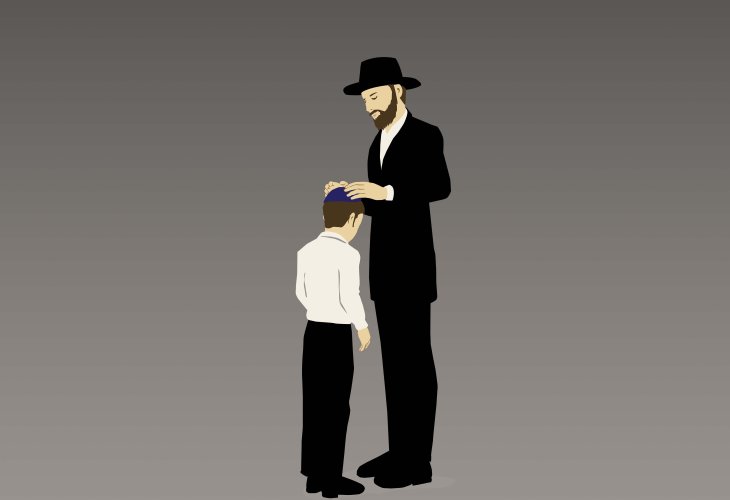
Before the Kiddush on Friday night, it is a cherished custom in Jewish homes for a father to place his hands upon the heads of his children and bless them with the well-known Priestly Blessing. Before that, however, he often adds another ancient blessing: “May God make you like Ephraim and like Menashe.”
These are the two sons of Yosef, born to him in Egypt. The source of this blessing is the moment when Yaakov blessed them before his passing, saying to Yosef: “By you shall Israel bless” (Bereishit 48:20). Throughout all generations, whenever a Jew wishes to bless his children, he blesses them with these words: “May God make you like Ephraim and like Menashe.”
The way Yaakov blessed Yosef’s sons is famous for its unusual nature. To uncover the depth of its meaning, we must first return to the dramatic moment itself.
The Crossed Hands of Yaakov
Yosef presents his two sons before his father Yaakov so that they may receive his blessing. He carefully places Menashe, the firstborn, at Yaakov’s right side, and Ephraim, the younger son, at his left. Yosef naturally expects Yaakov to place his right hand — the hand of greater honor, upon the head of the firstborn, Menashe, and his left hand upon Ephraim.
Yet Yaakov does something unexpected.
Without moving the boys from their places, he deliberately crosses his hands. His right hand rests upon Ephraim, and his left upon Menashe. With his hands crossed, he gives them the blessing.
Yosef is troubled by what he sees. Immediately after the blessing, he attempts to correct his father’s hands, saying, “Not so, my father, for this one is the firstborn; place your right hand on his head.” But Yaakov refuses to change his position. He answers with calm certainty: “I know, my son, I know… yet his younger brother shall become greater than he.” The Torah then emphasizes once again that Yaakov intentionally placed Ephraim before Menashe.
This moment is far more than a historical scene. It carries a timeless message for every generation.
Menashe and Ephraim Within Every Person
The names Menashe and Ephraim represent two emotional and spiritual dimensions that exist within every human being.
When Yosef named his firstborn Menashe, he explained: “For God has made me forget all my toil and all my father’s house.” The word suggests forgetting, disconnection, and distance. It reflects Yosef’s pain — the years of separation from his family, the sense of being cut off and forgotten.
When his second son was born, Yosef chose the name Ephraim, saying: “For God has made me fruitful in the land of my suffering.” The name Ephraim comes from fruitfulness, growth, and abundance. It expresses gratitude for the ability to grow even within pain, to find meaning even in suffering.
These two names mirror the inner life of every person.
There are times of Menashe — moments of disconnection, forgetfulness, sadness, and spiritual exhaustion. A person may lose sight of their purpose, feel cut off from their inner self, or even feel as though God has forgotten them.
Sometimes these feelings last only moments. Sometimes they linger for days, months, or even years.
And then there are moments of Ephraim — times of growth, reconnection, meaning, creativity, and spiritual fruitfulness. These are the moments when a person feels aligned with truth, with life, and with their deeper purpose.
Both exist within us.
Choosing What We Give Strength To
Most people naturally focus more on the Menashe within them than on the Ephraim.
It is like looking at a blank white page with a tiny black dot in the center. When asked what they see, most people answer, “a black dot,” even though the overwhelming majority of the page is white. The darkness captures the eye more quickly than the light.
So too in life, pain, loss, and disconnection often feel more visible than growth, goodness, and blessing. A person tends to focus on what is missing rather than on what is present.
This, perhaps, is the deeper meaning of Yosef’s arrangement. He places Menashe on Yaakov’s right side because this reflects our natural tendency: we instinctively give priority to what feels painful, broken, or lacking.
Yaakov’s response is an act of profound education.
He crosses his hands. He teaches Yosef, and all of us, not to live automatically according to what first leaps into our awareness. Even if Menashe appears more prominent, even if pain feels more immediate, we must consciously choose to place our stronger hand upon Ephraim.
We must strengthen the part of ourselves that is still alive, still growing, still capable of meaning and renewal.
A Blessing for Ourselves and Our Children
This is why the blessing remains so deeply relevant.
When we bless our children, our students, or even ourselves, we are being reminded to look beyond the visible wounds and the moments of disconnection. We are called to search for the point of Ephraim — the place of life, growth, resilience, and inner truth.
Yaakov’s blessing teaches us to nurture what is healthy and hopeful, even when the pain seems to stand in the foreground.
May we learn to walk in Yaakov’s path, to strengthen the light over the darkness, and to bless our children — and ourselves, with the words: “May God make you like Ephraim and like Menashe.”

