

Israel News
Israel’s High Court Hears Push to Oust Ben Gvir, Mulls Compromise Plan
After a marathon ten-hour hearing, justices took under advisement a petition to remove National Security Minister Itamar Ben Gvir. The attorney general’s office floated a compromise: immediate judicial oversight of limits on the minister’s role, plus a two-week window to nail down formal ground rules.
- Shlomi Diaz
- | Updated
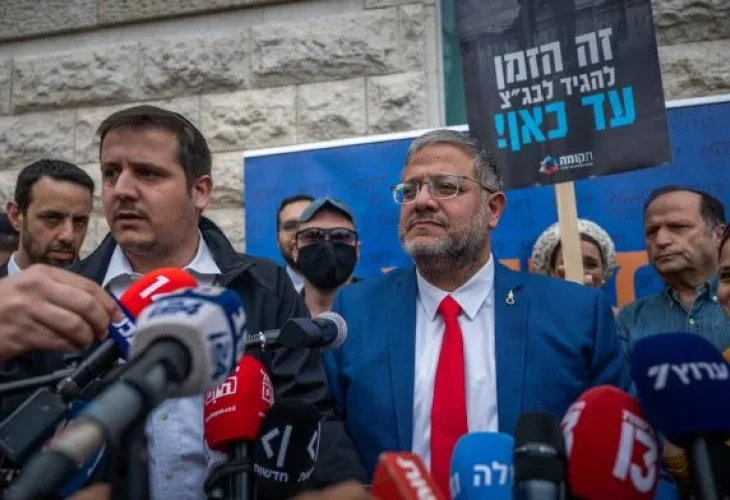 Ben Gvir, at today’s hearing (Photo: Yonatan Sindel, Flash90)
A panel of High Court justices, led by Supreme Court President Justice Yitzhak Amit, finished this evening (Wednesday) hearing a petition calling for the removal of National Security Minister Itamar Ben Gvir from office. The hearing ran for more than ten hours.
After the parties for and against the petition presented their arguments, attorney Shosh Shmueli, representing Attorney General Gali Baharav-Miara, submitted a compromise proposal. She asked that Justice Noam Sohlberg immediately begin overseeing the framework of principles agreed upon by Minister Ben Gvir and the attorney general regarding the minister’s intervention in police work. She also requested two weeks to try to reach agreement on orderly working procedures between the minister and the adviser.
According to the proposal, police appointments in sensitive areas, from the rank of Deputy Commissioner and above, would be frozen until full agreements are reached between the minister and the adviser. Baharav-Miara’s representatives asked the High Court to issue an interim order until a document of principles is drafted with the minister. The order would bar the minister from joining operational activity that involves friction with civilians and entering their homes; would bar police officers from maintaining direct contact with police officers without the presence of the commissioner; and would bar the minister from making statements about the use of police force toward civilians.
The panel did not issue a decision. Toward the end of the hearing, Justice Yael Willner asked attorney David Peter, who represents the minister, "Is the minister willing to commit to honoring the memorandum of understandings and accept an enforcement mechanism?" The minister’s representative replied: "I will not give Your Ladyship a button to dismiss a minister through a procedural arrangement." The justices suggested signing an agreed framework of principles, alongside a mechanism to determine whether the minister violates it. The attorney responded: "Willing for Justice Sohlberg to be the one who determines whether there is a violation."
During the hearing, Justice Alex Stein argued that "the dismissal of a minister by a court is an extremely extreme step, unknown elsewhere in the world, and it should be avoided whenever possible." Justice Ofer Grosskopf added: "A minister can express policy even in opposition to a prime minister." Overall, Justices Sohlberg, David Mintz, Willner, and Yechiel Kasher pressed the attorney general’s representative. Attorney Shosh Shmueli was in the hearing, and Justice Kasher said: "You submitted a list of the minister’s actions—a list that is entirely disputed. No judicial instance has examined these events, and we, the High Court, cannot do so. Based on that list, the attorney general is asking for a far-reaching step that has never happened—to bring about the dismissal of a minister."

