

Parashat Shemot
The Burning Bush Within: How Personal Growth and Redemption Begin
A powerful Torah insight on inner awakening, spiritual struggle, and why true change begins the moment we turn toward what is burning inside us
- Rabbi Moshe Sheinfeld
- | Updated
 (Photo: shutterstock)
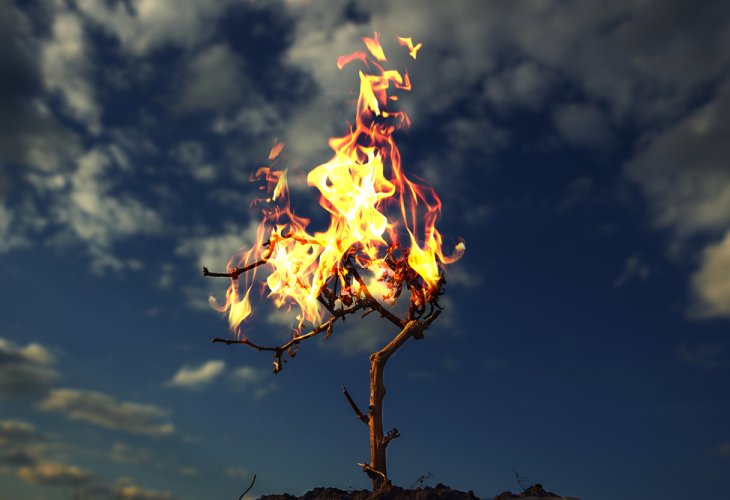
Egypt continues its crimes against the Jewish people, while Moshe is far away in Midian. By now, he is about eighty years old. Then, one day, as he is tending the flock of his father-in-law, something dramatic suddenly happens. The Torah describes the moment in unforgettable words: “An angel of the Lord appeared to him in a flame of fire from within the bush. He looked, and behold, the bush was burning with fire, yet the bush was not consumed.” At this moment, God sends Moshe to redeem the people of Israel.
The Torah makes an extraordinary point: “And the Lord saw that he turned aside to see — and God called to him.” God called to Moshe only after Moshe turned aside. The Midrash offers two opinions. Rabbi Yochanan says that Moshe physically walked five steps toward the burning bush, while Reish Lakish says that he did not move at all but simply turned his head to look. Either way, the message is profound: redemption began the moment Moshe gave attention to what was burning before him.
This scene is not only the beginning of Israel’s redemption. It is also timeless and deeply relevant for every person seeking a private redemption from their own personal “Egypt.”
When Something Begins to Burn Inside
Just as Moshe was occupied with his daily routine of shepherding sheep in the wilderness, and suddenly noticed something burning that likely ignited something in his own soul, so too we each spend our lives “shepherding our flocks.” We move through the routines of life, year after year, occupied with responsibilities, pressures, and ordinary demands.
And then suddenly, something happens. A moment of awakening. A thought that refuses to disappear. A desire that burns within. A sense that we were meant for something greater than what we have been doing until now.
There comes a moment of unusual clarity in which we begin to understand what we are capable of, what responsibility rests upon us, and perhaps even why we were created.
How can we know whether what we are feeling is real and not merely a passing fantasy?
The answer lies in the sign of the burning bush itself: the fire burns, but the bush is not consumed. The flame does not go out. The inner voice does not fall silent. The desire remains alive and cannot be replaced by something superficial. That is often how we know the call is real.
Don’t Look Away
Many people never turn to look at their burning bush. We do not want to interrupt the routine of our lives. The demands of daily life fill every corner of our schedule. It is often tempting to look away, to escape, and to pretend we never saw what we saw.
But Moshe turned to look. He did not ignore the fire. He said to himself: I must pay attention to this.
Whether he took five physical steps or merely turned his head, that small movement changed history. The moment he turned toward the flame, God spoke.
Even if all we do is turn our attention toward the fire burning within us, we too may begin to hear the voice of God calling to us. And like Moshe, we may find ourselves able to answer: “Here I am.”
The Fire Is Real Even If the Thorns Remain
The Degel Machaneh Ephraim offers a beautiful insight into the meaning of the bush that burns yet is not consumed. The fire represents the spiritual flame within the soul, while the bush, with its thorns, represents the inner struggles, distracting thoughts, urges, and emotional challenges that remain within a person.
A person may experience a moment of spiritual elevation during prayer, Torah study, acts of kindness, or deep reflection, and yet, at the same time, intrusive thoughts and inner struggles still arise. One may feel spiritually uplifted in the morning and deeply challenged again by evening.
This can lead to a painful question: If the fire is real, why doesn’t it consume the thorns?
The answer given is deeply comforting. The existence of struggle does not invalidate the reality of the fire. The fire is real even if the thorns remain.
Holiness Is Where You Are Standing Now
God’s answer to Moshe is also His answer to us: “Remove your shoes from your feet, for the place on which you stand is holy ground.”
These words encourage us not to wait for perfection. Holiness is already present in the place where we stand right now. We do not need to reach some imagined spiritual ideal before our lives become sacred.
The place we are in now — with all its struggles, doubts, and unfinished growth, is already holy ground. Connection with God does not require the absence of inner conflict. The task is to continue feeding the fire, to meet holiness in our current condition, and to keep turning toward what burns within.
And slowly, over time, the thorns begin to lose their hold and will burn away.

