

Issues in the Bible
Egypt as a False Eden: The Hidden Creation Story Within the Exodus
A profound Torah perspective on Egypt as a counterfeit Garden of Eden, the spiritual meaning of exile, and how the Exodus marks a new beginning in humanity’s journey back to redemption
- Yehosef Yaavetz
- | Updated
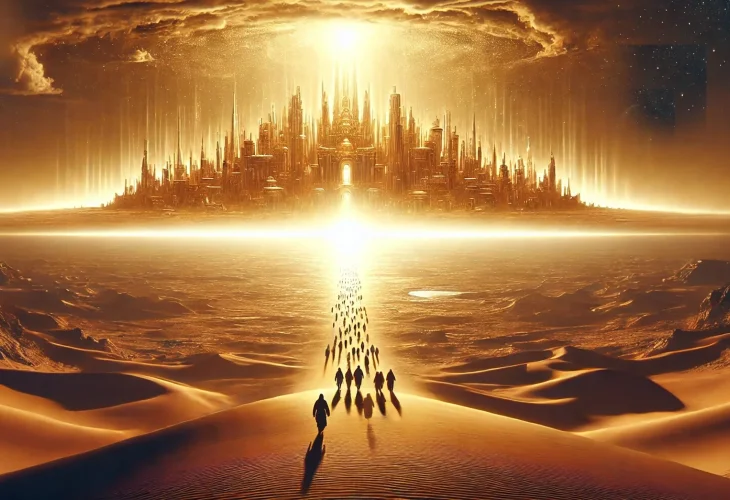
Imagine a place of constant flourishing, where the land never waits anxiously for rain and the water supply seems fixed and eternal. A river flows forth to water the land, branching into countless channels that nourish the fields on their own. The crops grow in extraordinary abundance, far beyond the needs of those who dwell there. Wealth and prosperity overflow, and towering structures gleam with gold. In theory, human beings could live there in peace, comfort, and happiness. This place is Egypt. The Torah, in the Book of Bereishit, describes it in language reminiscent of the Garden of Eden itself, like the garden of God. Yet this article presents a profound and unsettling insight: Egypt was indeed a kind of Eden, but it was an Eden of the wicked.
Humanity was expelled from Gan Eden so that it could repair itself and one day become worthy of return. Yet the opening chapters of Bereishit describe a chain of failures instead. Kayin murders his brother and is condemned to wander. The generation of the flood corrupts its ways. The generation of the Tower of Bavel fails to learn the lesson and instead places its trust in monumental buildings and human power. Only then does Avraham arise and call in the name of God. Avraham discovered the beginning of the tikkun — the path by which humanity could one day return to Eden. That repair would begin through the struggle of his descendants in the false paradise of Egypt.
A Paradise That Chose the Serpent
Egypt had abundance, power, water, prosperity, and security, but it had chosen the side of the serpent. The snake, which in Eden symbolized temptation and the path to sin, became in Egypt a revered and sacred symbol. The inhabitants of this earthly paradise standing beside the great river had aligned themselves with the force of seduction and rebellion.
In the children of Israel, however, the original blessing of Adam begins to be fulfilled. God had said to Adam and Chava, “Be fruitful and multiply and fill the earth,” and so too the Torah says of Israel: “The children of Israel were fruitful and multiplied, and the land was filled with them.” At this point, Pharaoh — who viewed himself as divine, reverses the divine order. Humanity was expelled from Eden by the Creator because it sought to become godlike on its own terms. Pharaoh reverses this. Seeing that the people of Israel have become numerous and mighty, he seeks to lock humanity inside his own false Eden. The Eden of the righteous cannot be entered without worthiness, but the Eden of the wicked cannot be escaped.
The curse upon Adam was that he would work the earth by the sweat of his brow. Pharaoh twists this curse and transfers it onto others. He forces the children of Israel to labor in the fields with crushing oppression, as if by enslaving others he can remove from himself the burden of human limitation. Just as the generation of Bavel sought to become godlike through towers of brick and mortar, Pharaoh too attempts to establish himself as a god through monumental structures built by forced labor. The buildings themselves become statements of power, meant to prove that he rules the world.
The Birth of Redemption in Darkness
This inversion becomes so extreme that when Moshe rises to defend his oppressed brother, he is seen in the eyes of Pharaoh almost as Kayin — one whose life is now forfeit, condemned to flee and wander. Yet this is precisely what marks the beginning of redemption. Moshe saves his brother from the Egyptian just as Avraham rescued his nephew from wicked kings. This, is the sign that the spiritual crown of Avraham is being restored.
The Torah hints to all of this from the very birth of Moshe. Regarding him it says, “And she saw that he was good.” These words deliberately echo the creation story: “And God saw the light, that it was good.” Within the darkness of exile, the light of redemption begins. God is already preparing the light of Mashiach. Even the opening words, “And these are the names of the children of Israel,” echo the act of naming in the creation narrative.
The article then draws a remarkable parallel between Moshe and Noach. Moshe is placed in a basket coated with pitch, just as Noach was preserved in the ark. This is how redemption begins, slowly, almost imperceptibly, little by little. Throughout the narratives of bondage, the Torah uses primarily the name Elokim, rather than the ineffable Divine Name. This suggests that God is still acting in concealment. The redemption has begun, but it unfolds in hidden ways.
Moshe carries within him the symbols of all the patriarchs. When he sees the burning bush, he “sees the place from afar,” echoing Avraham at the binding of Yitzchak. He hears the angel of God as Avraham did. He places his son upon the donkey and circumcises him, again evoking the Akeidah. He arrives at the well and displays strength like Yaakov. Later he becomes a shepherd like the fathers before him. He arrives as a complete outsider and marries the daughter of a priest, much like Yosef. Moshe is thus presented as the culmination of the ancestral story, the point at which the threads of Bereishit converge.
A New Creation Begins
The cry of the children of Israel rises before God, much like the cry of Sodom once rose before Him. Now God intervenes openly. He sends Moshe, and Moshe subdues the serpent that Egypt worshipped. He transforms the symbol of temptation and power into a simple staff. Pharaoh is struck as Egypt’s spiritual structure begins to collapse. The exodus itself mirrors earlier moments in Torah history. The hurried departure from Egypt recalls the hurried escape from Sodom. The Egyptians drown in the sea like the generation of the flood. The people eat manna in the wilderness like the perfectly prepared food of Eden.
All of this is described as a new beginning. This is why the Torah declares, “This month shall be for you the beginning of months.” It is a new beginning, a new creation, a new Bereishit. And once the chaos settles, the people are commanded in Shabbat, just as creation itself culminated in Shabbat.
The message is powerful: the Exodus is not only liberation from slavery. It is the beginning of a renewed creation story — the journey of humanity back toward Eden.

