

Parashat Shemot
The Burning Bush: How One Small Step Led to Redemption
How spiritual growth, divine revelation, and personal redemption begin the moment we choose to pause, reflect, and turn toward the fire
- Rabbi Ovadia Chen
- | Updated
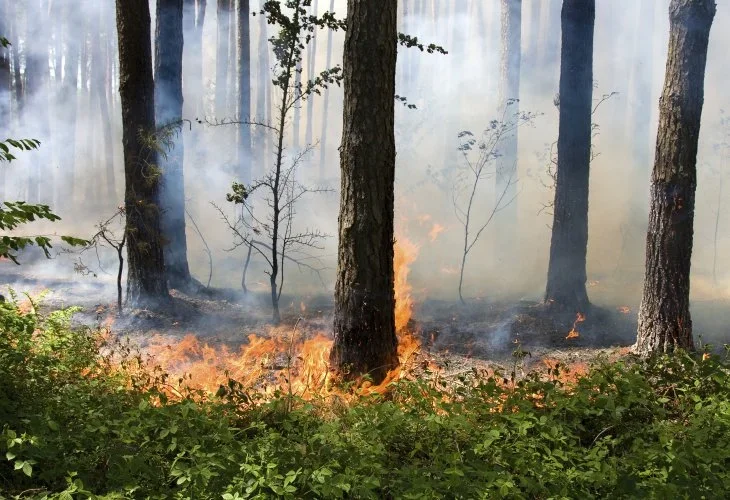
Moshe, the master of all prophets, was leading the flock of Yitro through the wilderness, carefully guiding them so they would not graze in the fields of others. As he arrived at the foot of Mount Sinai, an extraordinary and mysterious sight suddenly appeared before him. In the heart of the desert stood a thorn bush, known in Hebrew as a sneh, and it was engulfed in flames. Moshe might have continued on his way, had it not been for one strange detail: “And behold, the bush was burning with fire, yet the bush was not consumed” (Book of Shemot 3:2). Despite the fire gripping the bush, it refused to be destroyed.
The Moment Moshe Chose to Turn Aside
This was no ordinary sight. Moshe felt compelled to draw closer and investigate the astonishing vision. He said to himself, “Let me turn aside and see this great sight.” Then the Torah tells us: “And the Lord saw that he turned aside to see, and God called to him from within the bush and said, ‘Moshe, Moshe,’ and he said, ‘Here I am’” (Shemot 3:3–4). From within the bush, a voice emerged, and a dialogue began between God and Moshe — a conversation that would ultimately lead to the redemption of Israel.
A powerful question immediately arises: why did God not call to Moshe from the beginning? Why only after the Torah says, “the Lord saw that he turned aside to see”? The answer, in truth, lies within the question itself. The Ovadia Sforno explains that Moshe was not merely curious in a superficial sense. This was not idle interest. Rather, he desired to reflect, understand, and learn. Moshe recognized that something spiritual and supernatural was taking place, and immediately felt a deep longing to investigate it.
He could have continued walking. Instead, he stopped. He chose to turn aside. And only then did the revelation come. This is the meaning of the verse: “And the Lord saw that he turned aside to see — and God called to him.” When God saw that Moshe took a step of his own, seeking truth and purity, he was granted the first Divine revelation of his life. As the sages teach: “One who comes to purify himself is assisted.”
Revelation Begins With One Small Step
This idea carries an enduring spiritual lesson. God is always near. He stands beside us at every moment, waiting for us to make the first small movement toward Him. Sometimes all that is required is the spiritual equivalent of Moshe’s words: “Let me turn aside and see.” A small step. A moment of reflection. A decision to pause and look deeper. Only then do we begin to hear the call. As the prophet says in the Book of Malachi: “Return to Me, and I will return to you.” No matter how many signs and wonders surround a person, they are of little value if the person is not inwardly prepared to receive them. Revelation begins with readiness. The Divine voice is often waiting for the human response.
The sages famously say that at the splitting of the sea, even the maidservant saw visions greater than those seen by Yechezkel. And yet, the maidservant remained a maidservant, while Yechezkel became one of the greatest prophets and revealed the profound vision of the Divine Chariot. Why? The answer offered by the masters of Mussar is deeply striking. Yechezkel did not merely witness. He reflected, he turned aside to understand, and he studied what he saw. This is the reason that he merited to reveal such sublime visions. The difference is not always in what one sees. Sometimes it is in what one does with what one sees. A fleeting spiritual moment can either pass like a shadow or become the beginning of a lifetime of transformation.
The Fire That Remains Forever
A moving story is told about Israel Meir Kagan in his youth. As a young man, he was deeply attached to his teacher, Rabbi Nachum of Horodna, from whom he learned ways of life that shaped his character forever. Each day, the young Chafetz Chaim noticed that his teacher would mysteriously disappear at midnight. Since Torah must be learned in every possible way, he felt compelled to discover what his teacher was doing.
One evening, after the evening prayers, he secretly remained in the synagogue and hid in the women’s section. The caretaker locked the doors, and he waited in silence. At midnight, Rabbi Nachum entered, unaware that his student was hiding above. He ascended the bimah, took out a book of Kabbalah, and began studying in deep holiness.
Suddenly, the young Chafetz Chaim saw a holy fire burning and flickering around his teacher. The sight was overwhelming and terrifying in its majesty. His entire body trembled. He stood frozen in awe and fear. Even by morning, when the caretaker returned to open the synagogue, the young Chafetz Chaim was still rooted to his place in astonishment.
The vision of the fire of Torah remained engraved upon his heart for the rest of his life.
This, too, is the lesson of the burning bush. The fire that does not consume is the fire of holiness. It burns within the soul. And when a person turns aside to truly see it, that fire can change a life forever.

