

Israel News
Trump Announces 10-Day Israel-Lebanon Ceasefire as IDF Stays Deployed
Netanyahu confirms temporary truce but says Israeli forces will remain in Lebanon, while Hezbollah signals only conditional acceptance of the deal
- Brian Racer
- | Updated
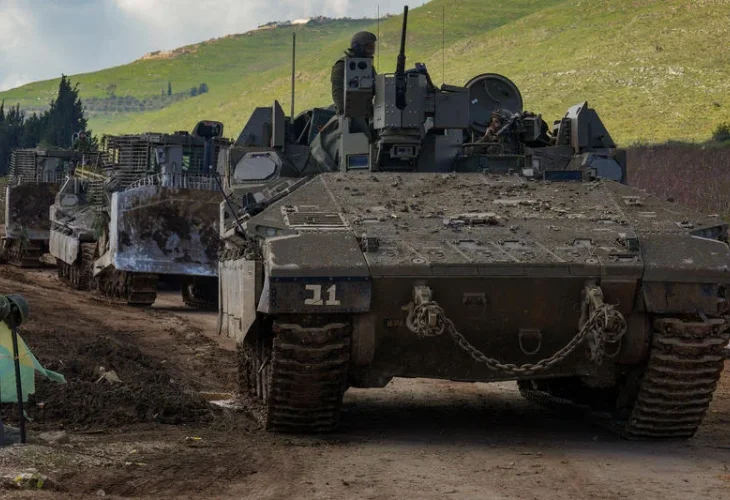 Israeli military vehicles are seen along the Israeli border with Lebanon amid the ongoing war, April 8, 2026. Photo by Ayal Margolin/Flash90
U.S. President Donald Trump announced Thursday that Israel and Lebanon have agreed to a 10-day ceasefire set to take effect at midnight Israel time, following talks with Prime Minister Benjamin Netanyahu and Lebanese President Joseph Aoun.
The temporary truce, which Trump said would begin at 5 p.m. Eastern Time, comes after rare direct talks between Israeli and Lebanese representatives in Washington earlier this week. While presented as a diplomatic breakthrough, the agreement remains limited in scope and leaves key disputes unresolved, particularly regarding Hezbollah and Israel’s continued military presence inside Lebanon.
“These two leaders agreed that in order to achieve peace between their countries, they will formally begin a 10 Day CEASEFIRE,” Trump wrote, adding, “Both sides want to see peace, and I believe that will happen, quickly.” Speaking later, Trump said the agreement also includes Hezbollah, saying, “The ceasefire also includes Hezbollah.”
Netanyahu later confirmed that Israel had agreed to the 10-day pause in fighting, describing it as an opportunity to advance negotiations already underway. “There is an opportunity to make a historic peace agreement with Lebanon,” he said. At the same time, he made clear that Israel would not withdraw its forces from southern Lebanon during the ceasefire.
“We are staying in Lebanon in a deepened security zone,” Netanyahu said, outlining a continued Israeli military presence extending roughly 10 kilometers into Lebanese territory.
Israeli officials emphasized that the ceasefire does not mark an end to operations. “Even during the ten days of the ceasefire, our forces will remain deep inside southern Lebanon,” an Israeli official said to Channel 14. The official added that if the Lebanese government does not act to dismantle Hezbollah during that period, “we will do it with great force immediately afterward.”
The deal quickly exposed a core gap between the sides. Trump said the ceasefire includes Hezbollah, but Hezbollah signaled that any ceasefire must stop Israel from operating inside Lebanon, warning that the continued presence of Israeli forces would give Lebanon and its people “the right to resist.” Hezbollah lawmaker Ibrahim al-Moussawi said the group would only respect the ceasefire if it brings a full halt to hostilities and prevents Israel from carrying out further attacks.
On the Lebanese government side, Prime Minister Nawaf Salam welcomed the ceasefire, describing it as the country’s primary objective in the Washington talks, saying it “was our primary goal.” However, senior Lebanese figure Nabih Berri urged displaced residents not to return to southern areas immediately, calling for caution until the situation becomes clearer and signaling uncertainty over how stable the truce will be on the ground.
Inside Israel, the rollout of the ceasefire drew immediate criticism after Trump announced it before a formal cabinet discussion had taken place. According to Israeli media reports, several ministers were caught off guard by the timing and first learned of the agreement through Trump’s public statement rather than through official government channels.
The 10-day ceasefire is now expected to serve as a test period for diplomacy, with the United States pushing to expand the talks into a broader agreement. Trump said he plans to invite Netanyahu and Aoun to the White House for further discussions.

