

World News
Rachel Goldberg-Polin Says ‘100% Was Not Enough’ to Save Hersh
In an emotional 60 Minutes interview, Hersh Goldberg-Polin’s mother reflects on 330 days of advocacy, his execution in Gaza, and the grief that followed
- Brian Racer
- | Updated
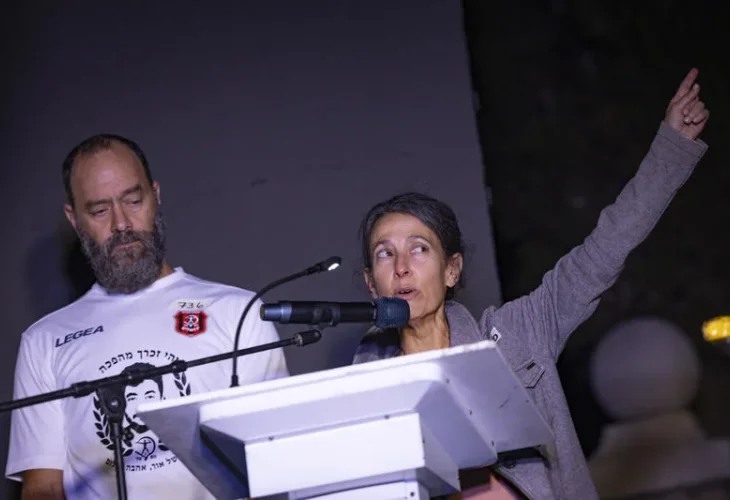 Jon Polin and Rachel Goldberg, parents of Hersh Goldberg-Polin attend a protest in Jerusalem, calling for the release of Israeli hostages held by Hamas, on October 11, 2025. Photo by Yonatan Sindel/Flash90
Rachel Goldberg-Polin, the mother of executed hostage Hersh Goldberg-Polin, said Sunday that despite months of global advocacy, “Sometimes, 100% is not enough,” reflecting on her son’s death in Gaza during an interview on CBS’s 60 Minutes.
Goldberg-Polin, an American-Israeli from Jerusalem who became one of the most prominent voices among hostage families, described the outcome of a 330-day campaign to bring captives home after Hamas terrorists abducted around 250 people on October 7. “It’s like these symbols of failure,” she said. “What we were fighting for did happen. We got all these people home — not the way we wanted. We wanted them home alive, but they had come home.”
She recalled her final moments with Hersh the night before the attack. As he left, he told her, “I love you. I’ll see you tomorrow.” The next morning, as sirens sounded, she saw two messages from him at 8:11 a.m.: “I love you” and “I’m sorry.”
Hersh had been at the Nova music festival near the Gaza border when Hamas terrorists attacked, killing hundreds. He and others fled to a roadside bomb shelter, where attackers threw grenades inside. Survivors later said Hersh was severely wounded when one exploded, blowing off part of his arm, before he was taken alive into Gaza. During a later interview with Goldberg-Polin and her husband, Anderson Cooper realized he had previously seen video of their son being abducted.
For 330 days, Goldberg-Polin and her husband worked to secure Hersh’s release, meeting world leaders and speaking to international media. She described the effort as a constant, driven by a personal mantra: “Hope is mandatory.” At the same time, she said, they struggled to convey urgency to decision-makers. “We could not convince the right people that it was urgent,” she said, adding that she felt “we let ourselves down.”
A key turning point came after the release of former hostage Or Levy, who spent several days with Hersh in captivity. Levy described Hersh as someone who “laughed about everything” and “smiled the entire time,” even in the tunnels. He said Hersh repeated a line that became his mantra: “He who has a why can bear any how.”
When Goldberg-Polin asked what her son’s “why” was, Levy answered simply: “You.”
Levy also told her that Hersh had heard her speaking publicly, including in meetings with senior officials. “He heard you on the news,” he said, offering confirmation that their efforts had reached him. “We are nobodies,” Goldberg-Polin said. “But we tried so hard. And he knew.”
Hersh was later executed in a tunnel in Rafah alongside other hostages, with Israeli forces recovering their bodies. The killing came around the same time Goldberg-Polin had traveled to the Gaza border to call out her son’s name over loudspeakers, hoping he might hear her.
Reflecting on the period of captivity, she said her perspective had shifted after his death. “Those 330 days had been the good part, because he was alive,” she said. “And now I’m in this place… How do I walk through this place without a piece of me here?”
She said her understanding of grief has also changed. “Maybe grief is actually just this precious badge of love that you wear because someone has died and your love is continuing to grow.”
Despite Hersh’s death, Goldberg-Polin and her husband continued advocating for the remaining hostages, saying they could not allow other families to endure the same outcome. Looking ahead, she said she is still searching for a way to live with the loss. “Part of what I’m trying so hard to do now is to figure out what my why is.”

