

Yom HaZikaron (Memorial Day)
"Don’t Tell My Mother": The Final Words of Shmuel Jacobson
He heard his name in the dark and thought a fellow soldier needed help. What followed was a tragic and powerful story of courage and sacrifice.
- Yosef Yavetz
- | Updated
Shmuel Jacobson was born on May 29, 1936, in Tel Aviv, into a family that placed deep importance on values and education. His parents, Avraham and Chaya, chose to move to Jerusalem so their children could grow in a more traditional environment. They settled in the Shaarei Chesed neighborhood, where they formed a close relationship with Rabbi Shlomo Zalman Auerbach, who lived nearby.
From a young age, Shmuel stood out for his strength, determination, and sense of responsibility. At 18, he enlisted in the IDF, where he quickly advanced and became an officer in the elite paratroopers. During a visit home over Sukkot, he arrived in uniform and took his sisters for a drive through the neighborhood. They looked at him with admiration and pride, a brother who embodied courage and dedication.
A Country Under Threat
Just days later, tragedy struck.
On the 29th of Tishrei, two vehicles traveling from the Dead Sea toward Be’er Sheva were ambushed by terrorists who had infiltrated from Jordan. Machine gun fire tore through the jeeps, and five of the six passengers were killed.
That same day, additional attacks shook the country. Two infiltrators entered Even Yehuda and murdered Jewish workers in a brutal assault. The sense of insecurity was overwhelming. At the time, large parts of the region were under Jordanian control, and the borders were exposed and vulnerable.
Despite identifying the attackers, Jordanian authorities released them. The message was clear, and the tension in Israel escalated.
The Mission to Qalqilya
In response, the IDF launched a reprisal operation targeting the Jordanian police station in Qalqilya. The mission was led by paratroopers under the command of Ariel Sharon, whose unit was known for its daring and complex operations behind enemy lines.
On the night of October 10, the operation began. One force successfully reached the police station and destroyed it, but another unit, including Shmuel, was tasked with blocking reinforcements from nearby villages.
What followed was a prolonged and intense battle.
A Battle in the Dark
Positioned in the dark terrain near the road, the soldiers initially succeeded in halting incoming forces. But wave after wave of reinforcements continued to arrive. The fighting grew increasingly difficult, with casualties mounting and ammunition running low.
As the unit retreated under pressure, they entered an area where enemy snipers were positioned. The conditions were chaotic. Some soldiers, including Shmuel, were not fully camouflaged, and in the moonlight, even small details became visible.
Then, in the silence of the night, a voice called out: “Shmuel!”
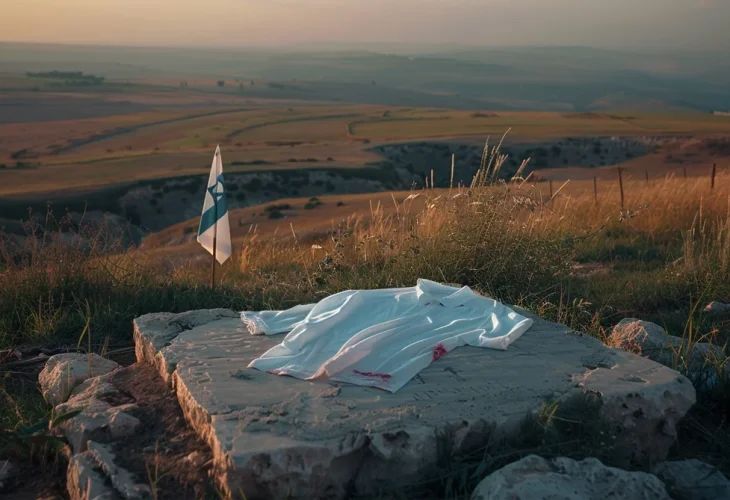
Believing it was a fellow soldier, possibly someone wounded or in need, Shmuel responded. In that brief moment, his white shirt stood out.
A sniper fired.
His Final Words
The bullet struck him, and within moments, Shmuel was fatally wounded.
His last words were simple and heartbreaking: “Don’t tell my mother.”
In those words, one hears not only pain, but deep love and concern, even in his final moments.
The Cost of War
The battle ended with heavy losses. Eighteen Israeli soldiers were killed, and although the opposing forces also suffered significant casualties, the price was deeply felt. The operation was later criticized for its planning and the risks it placed on the soldiers.
For the Jacobson family, the loss was unbearable. Shmuel’s mother, Chaya Miriam, could not recover from the grief. Her health declined, and she later passed away. She was laid to rest alongside her son in Jerusalem.
A Story That Remains
Shmuel Jacobson’s story is one of many, yet each story carries its own weight, its own world. A young man, full of strength and promise, who stepped forward to defend his people and gave everything.
His life was not defined only by the moment of his death, but by the values he lived with: responsibility, courage, and quiet devotion.
In remembering him, we remember not only the cost of what was lost, but the strength of those who gave their lives so others could live.

