

Israel News
At OneFamily’s Yom Hazikaron Ceremony, Bereaved Israelis Confront the ‘Second Wish’
Families describe what comes after unimaginable loss, as OneFamily gives voice to the struggle to choose life and move forward together
- Brian Racer
- | Updated
 Facebook/OneFamily
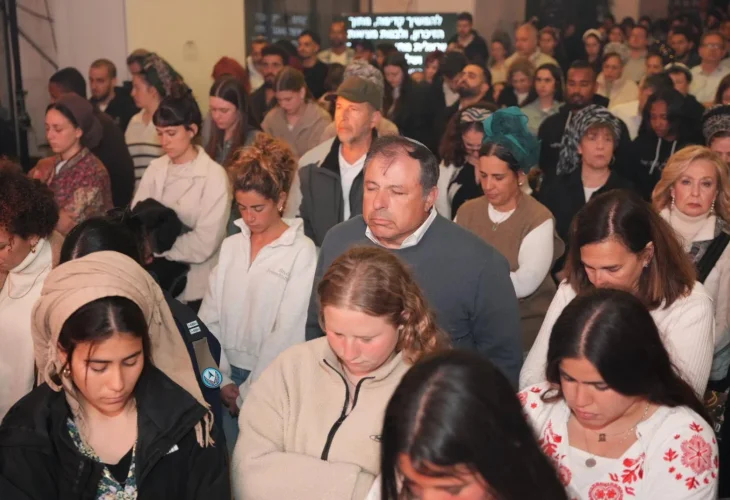
On Monday night, the eve of Yom Hazikaron, more than 1,000 bereaved Israelis gathered at the Haas Promenade in Jerusalem for OneFamily’s annual memorial ceremony, organized by OneFamily, Israel’s leading organization supporting victims of terror and war and their families, confronting a question that defined the evening: what comes after the wish that can never be fulfilled?
The first wish, shared across the crowd, was understood without being fully spoken, that their loved ones would return. When that proved impossible, the ceremony turned to what organizers called the “second wish,” reframing remembrance as a choice about how to live forward after loss in a year marked by thousands of newly bereaved families following the October 7 attacks and ongoing war.
OneFamily founding director Chantal Belzberg framed the theme as “Option B,” describing it as the path of continuing life after it has been shattered. “Option B is not surrender,” she said. “It is courage. It is the decision to find the strength to get up in the morning, even when the heart is heavy with grief.”
The ceremony was co-hosted by Lali Derai and Liat Smadga, whose sons, Sgt. (res.) Saadia Yaakov Derai and Staff Sgt. (res.) Omer Smadga, were killed in the same incident in Gaza on June 20, 2024. “Fate bound us together forever,” they said. “Saadia and Omer fell together, at the same time, in the same incident. Since then, we have become one family, connected by something deep and unbreakable through the memory of our sons.”
Throughout the evening, families took the stage, each offering a different expression of what the “second wish” looks like in practice. Moriel Zagdon, whose daughter Rinat Hodaya was murdered at the Nova Music Festival on October 7 said, “Memory brings comfort, and comfort grows out of memory. Comfort is not denial. It is the decision to live, to rebuild, to grow.”
Nadav Elkabetz, whose sister Sivan was murdered alongside her partner Naor Hasidim in Kfar Aza, spoke about the responsibility of memory. “Our responsibility as families, as a society, is to tell the story, to bear witness, to hold onto the truth even when it’s unbearable,” he said. “Because if we don’t tell it, someone else will. Sivan used to say, ‘A day without a smile is a day wasted.’”
Millie Zim, mother of Staff Sgt. Ariel Zim, who fell in combat in northern Gaza, recalled their final conversation. “On your last Shabbat, you said to me, ‘Mom, imagine: in a few years I’ll be married, I’ll have children,’” she said. “You taught me not to give up. And I won’t give up. I am proud to tell your story. And I miss you endlessly.”
Niv Teka, whose brother Binyamin Teshager Teka fell defending the Kissufim outpost on October 7, described his belief in what comes next. “He loved the army, he loved his country, and he loved his family with all his heart,” he said. “I believe there will be joy again. I believe our home will find its music again. And I will carry him with me always.”
Shira Steinberg, whose father Col. Yonatan Steinberg was among the first officers killed responding to the October 7 attacks, shared his words from a previous Memorial Day. “Memorial Day is also a day that lifts us to see the bigger picture,” he had said. “You meet those who fell in Israel’s wars and understand that they are part of the generations who fought for this land.” She added, “Dad, thank you. Your words serve as a compass for us now.”
In one of the evening’s final moments, the families turned their attention back to Belzberg, who is set to receive the 2026 Israel Prize. “This prize is the embrace of the people of Israel for you,” she said, “and a national recognition that even with broken hearts, you are the backbone of this nation.”
According to figures shared at the ceremony, 25,650 individuals have fallen in defense of the Jewish homeland since 1860. Since last Yom Hazikaron, 174 names have been added, along with 54 disabled veterans who died of service-related injuries and were officially recognized as fallen.
After the formal program ended, many families remained at the promenade, continuing to sing, speak and share memories together. The ceremony was livestreamed to thousands worldwide, extending the gathering beyond Jerusalem. One attendee, Rachel Moore, described the experience: “I left filled with sadness at the pain our people have endured and are enduring. It is a very difficult privilege to understand the individual stories of so many families torn apart. At the same time, people outside Israel may not fully comprehend how deeply Israelis feel that we have something worth defending—the love for the country, the land and the commitment to one another was profoundly present in the room.”

