

Parashat Vayechi
Where This World Meets the Next: Discovering True Joy in Torah and Life
Yaakov's seamless transition teaches that real fulfillment isn’t in wealth — but in living a life already connected to the World to Come
- Rabbi Ovadia Chen
- | Updated
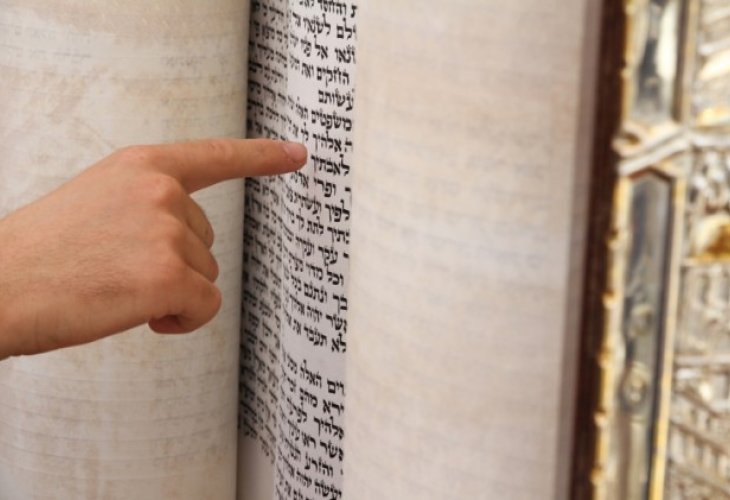 (Photo: shutterstock)
Anyone who looks at a Torah scroll during the lifting (hagbah) of Parashat Vayechi will notice something unusual. Unlike other portions of the Torah, which are separated by a visible space, this portion begins almost immediately after the previous one, with virtually no break, other than the space of a single letter.
Rabbi Raphael Berdugo, in his work Mayim Menuchot, offers a profound explanation. The lack of separation between Parashat Vayigash (which describes Yaakov’s life) and Parashat Vayechi (which describes his passing) teaches that for Yaakov there was no real divide between this world and the World to Come.
He moved seamlessly from one state of delight to an even greater one. For the righteous — especially Yaakov, life transitions from “peace to peace,” from one form of joy to another. This idea reflects the teaching of the Sages that “Yaakov did not die” — just as his descendants live, so too does he live.
Still, since the pleasures of this world and the next are not identical — one being physical and the other spiritual, the Torah marks a minimal distinction between them. Yet in essence, they remain connected.
Living the World to Come — Now
Rabbi Shalom Messas expanded on this idea by pointing to a familiar phrase from the daily prayers: “Whoever studies halachot every day is assured that he is a person of the World to Come.”
Why is it phrased in the present tense — “he is” rather than “he will be”?
The answer is that such a person already experiences the World to Come while still living in this world. The spiritual joy of Torah study is not postponed to the future, but is accessible here and now.
Rabbi Messas shared from personal experience that the few minutes spent deeply engaged in Torah study surpassed all the pleasures he had witnessed in the homes of wealthy and powerful individuals. True fulfillment, he explained, is found in spiritual depth, not material luxury.
What Is True Enjoyment?
A striking story is told about Rabbi Aharon Kotler, who once approached a wealthy man to support his struggling yeshiva in Lakewood. When asked how much was needed, Rabbi Kotler replied, “Five thousand dollars.”
The man immediately wrote a check for the full amount. Rabbi Kotler thanked him sincerely and began to leave, but then he sighed deeply.
Concerned, the donor asked, “Rabbi, why are you sighing?”
“I am sighing for you,” Rabbi Kotler replied. “I see that you will have a share in the World to Come, because you are generous. But where is your share in this world?”
The man was astonished. “What do you mean? Look at my mansion, my carpets, my silverware, my staff, my cars — what could I possibly be lacking?”
Rabbi Kotler shook his head. “All of that is not ‘this world.’ It’s just paper, fabric, and metal. Do you know what true ‘this world’ is? It is to be immersed in a deep question of Torah, struggling to understand a difficult passage, and after great effort, arriving at clarity. The satisfaction and joy in that moment, is real happiness.”
A Unified Vision of Life
For the righteous, there is no sharp divide between this world and the next. When a person connects to something eternal — through learning, growth, and spiritual depth, they begin to experience a higher reality even within ordinary life.
What appears to be two separate worlds is, in truth, one continuous journey, where true joy is not postponed, but already within reach.

