

Magazine
He Faced the Gallows at 20: The Courage of Eliyahu Hakim
After watching the Patria sink, Eliyahu Hakim vowed revenge. At 20, he went to the gallows unbowed. Decades later, his legacy endures.
- Michal Arieli
- | Updated
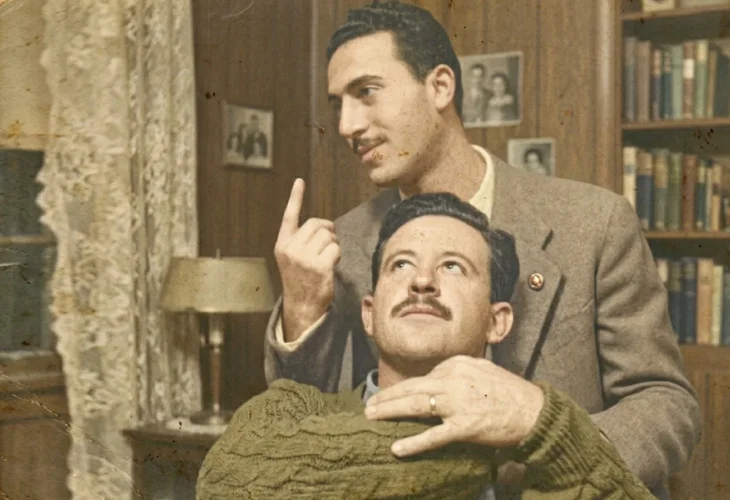 Eliyahu Hakim (standing) and Eliyahu Bet-Zuri (image processed with AI)
In 1940, the British ship Patria stood anchored near Haifa Bay, carrying hundreds of Jewish refugees gathered from intercepted vessels. Their destination was not freedom, but deportation to far-off Mauritius. Jewish underground groups attempted to intervene, but the effort failed. The ship sank, and around 230 people drowned.
From a balcony on Yefe Nof Street, an 18-year-old named Eliyahu Hakim watched the tragedy unfold. He understood immediately the magnitude of what he was seeing. Turning to his mother, he made a quiet but powerful promise: “They will pay for this.”
At that moment, he was not yet part of the underground. But something had shifted.
A Life of Mission
Soon after, Eliyahu joined the Etzel and later moved to Lehi. He saw it as his mission to fight for the establishment of a Jewish state. By the age of 20, he would become one of the Olei HaGardom, the twelve martyrs executed by the British.
His story, nearly 80 years later, continues to live on through his family. In a conversation, his nephew Eli Hakim of Haifa, who is named after him, and Dani Hakim of Hod HaSharon, his great-nephew, share how his legacy remains deeply woven into their lives.
 Dani Hakim, Eliyahu Hakim's great-nephew
The Two Eliyahus
“My grandfather was Eliyahu’s brother,” Dani explains. “So Eliyahu is my father’s uncle. I never met him, of course, but I grew up hearing stories from my grandfather about his younger brother’s actions.”
Eliyahu’s courage was well known even among his leaders. Yitzhak Shamir, then head of Lehi, later told the family how devoted, determined, and daring he was. Despite his young age, he was entrusted with some of the movement’s most dangerous missions.
The most well-known was the assassination of Lord Moyne, the British Minister of State for the Middle East, who had blocked Jewish immigration to the Land of Israel during the Holocaust.
“Members of the underground couldn’t accept that Jews were being slaughtered around the world while survivors were denied entry,” Dani explains.
He adds a lesser-known detail: “At the time, Adolf Eichmann offered to release a million Jews from Hungary in exchange for trucks. But Lord Moyne reportedly responded, ‘What would I do with a million Jews?’ That sealed their fate.”
The Mission in Cairo
Eliyahu Hakim and Eliyahu Bet-Zuri traveled to Cairo and spent weeks tracking Lord Moyne’s movements.
On the day of the assassination, Moyne stepped out of his car. Hakim fired three shots, killing him, and also shot his guard. The two fled on bicycles, but were eventually captured and imprisoned in Egypt.
During the trial, both were sentenced to death.
A Choice That Defined Him
One detail, his nephew Eli shares, reveals something essential about Eliyahu’s character.
After the assassination, their plan had been to escape into a crowded marketplace. Eliyahu Hakim, who spoke fluent Arabic and could easily blend in, had a real chance to get away.
But when he saw that Bet-Zuri had been captured, he turned back to help him, and was caught as well.
Years later, Bet-Zuri’s daughter came to meet the Hakim family in Haifa. “She told us how much her family appreciates my uncle,” Eli recalls. “To them, he is a hero.” Since then, the families meet every year at Mount Herzl, at the graves of the Olei HaGardom.
“In the End, the Truth Prevails”
In the months between the assassination and the execution, Eliyahu’s parents clung to hope.
“They went every week to the Western Wall to pray for his release,” Eli says. “They truly believed they would succeed.”
The family even sold property to fund a legal defense. A lawyer offered Eliyahu a possible way out: forged documents showing he was under 18, which could have spared him from execution.
He refused.
From prison, he wrote to his parents:
“As a soldier I was sent to the front and fell into captivity, and one must know not only how to fight but also how to fall. I am happy to stand this test, because now, more than at any other moment in my life, I am certain of the justice of my ideas; because my ideal is the idea of truth, and in the end the truth will prevail… The day will come… when the Hebrew flag will fly above the hills of Jerusalem and freedom will reign in all the cities of the land.”
He also rejected the suggestion to plead insanity to reduce his sentence. He insisted on full responsibility for his actions and openly accused the British authorities of preventing Jews from finding refuge.
During the trial, he declared: “They accuse me of harming Lord Moyne, and I accuse Lord Moyne, because of whom hundreds and thousands of our people were murdered.”
At one point, he even referred to his death-row clothing as “the most beautiful suit” he would ever wear, words that reflect a level of conviction that is difficult to comprehend.
Pride and Pain
Within the family, his loss was experienced in very different ways.
“My grandmother never saw herself as a bereaved mother,” Eli explains. “She was deeply proud. She even refused benefits offered to bereaved families.”
His grandfather, however, carried the grief quietly for the rest of his life.
 Eli Hakim, named after his uncle
A Living Legacy
For Dani, the story shaped his identity.
“I grew up with a sense of responsibility to remember, not only him, but the values he stood for,” he says. “I passed that on to my children.”
In recent years, Dani has also deepened his connection to Jewish texts and tradition. “I’m not fully observant,” he says, “but Tanakh is part of my life. Some passages are so powerful that I’ve set them to music.”
His project, Songs I Wanted to Remember, brings these texts to life. His latest release, based on King David’s lament, carries personal meaning as well: “The words ‘How the mighty have fallen’ feel very real to me, as a descendant of Eliyahu, and as someone who lost a relative in battle.”
Eli, too, feels that connection daily. Named after his uncle, he says, “Not a day goes by without someone asking me about him. His story lives on.”
Above his store in Haifa stands a synagogue his grandfather established, filled with Torah scrolls. “It moves me,” he says, “to know that prayers are said there in his merit, someone who gave so much for all of us.”
A Story That Endures
Nearly a century has passed, yet Eliyahu Hakim’s story remains present, not only in history books, but in the lives of those who carry his name and his legacy.
It is a story of courage, conviction, and sacrifice. But it is also a story of memory, of how one life, lived with purpose, continues to shape generations long after it ends.

