

Beginners Guide
Havdalah Made Simple: A Beginner’s Guide
Learn how to make Havdalah with this simple guide covering the key blessings, order, and customs to close Shabbat the right way.
- Yosef Yaavetz
- | Updated
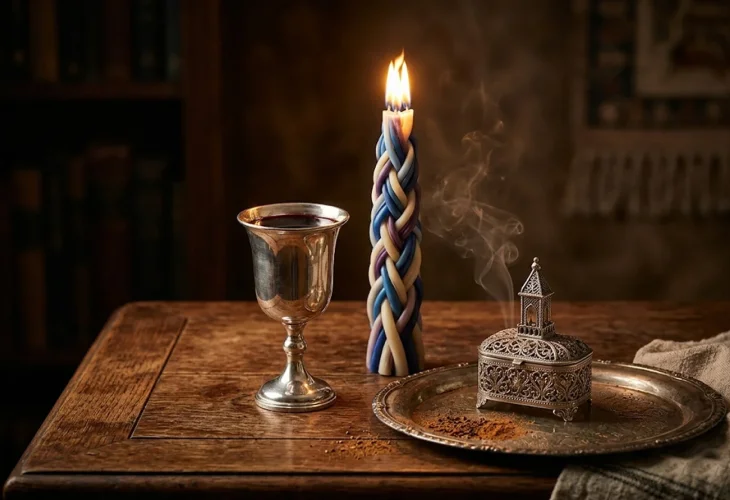
The Sages established the mitzvah of Havdalah to mark the end of Shabbat. Just as we welcome Shabbat with Kiddush, we honor its departure with Havdalah.
Before doing any activity that is forbidden on Shabbat (melachah), a person must first mark the end of Shabbat verbally. This can be done by saying “Baruch hamavdil bein kodesh lechol,” or any similar phrase that expresses the separation between holy and ordinary time. In addition, during the evening prayer, we include the paragraph of Ata Chonantanu in the blessing of Chonen HaDa’at.
Once this verbal separation is made, it becomes permitted to do melachah.
Havdalah Over a Cup
In addition to the verbal declaration, the Sages instituted Havdalah over a cup of wine or another beverage. Because of its importance, a person should not eat or drink anything before making Havdalah, except for water.
If someone forgot to make Havdalah on Saturday night and went to sleep, they should make it on Sunday before eating. Havdalah can be recited until Tuesday. After that point, it can no longer be made.
The Special Blessings of Havdalah
Havdalah includes several blessings that highlight the uniqueness of Shabbat.
Along with the blessing over the wine and the blessing of separation, two additional blessings are recited on Motza’ei Shabbat:
The blessing over spices (besamim), which helps comfort the soul after the departure of the extra Shabbat soul.
The blessing over fire (Borei Me’orei Ha’esh), recalling the discovery of fire after the first Shabbat.
These two blessings are specific to the end of Shabbat and are not recited when Yom Tov ends.
The Order of Havdalah
The order of the blessings is:
First, the blessing over the wine, Borei Pri HaGafen
Then, the blessing over the spices, Borei Minei Besamim
Next, the blessing over the fire, Borei Me’orei Ha’esh
Finally, the Havdalah blessing, Hamavdil bein kodesh lechol
A common way to remember this order is with the acronym “Yavneh”: wine, spices, candle, Havdalah.
Another helpful way to remember is by thinking of the senses: first tasting the wine, then smelling the spices, then seeing the fire, and finally reflecting with the mind through the Havdalah blessing.
The Havdalah Cup and Drink
The cup used for Havdalah should be clean, whole, and filled to the top, similar to Kiddush.
Havdalah is ideally made over wine or grape juice. However, it can also be made over another important beverage in that location, known as chamar medina. In some places, this may include beer or even coffee. In such cases, the appropriate blessing (Shehakol) is recited instead of Borei Pri HaGafen.
The person making Havdalah should drink m’lo lugmav, an amount that fills one cheek.
Who Is Obligated
Women are also obligated in Havdalah. The common custom is that they do not drink from the Havdalah wine when someone else is making it. However, if a woman is alone, she should make Havdalah herself and drink the required amount.
Spices and Candle
The blessing over spices should be made on natural fragrant items, not on synthetic scents like perfumes or diffusers.
The blessing over the fire should be made on a flame with at least two wicks close together, such as a braided Havdalah candle.
Before reciting the blessing over the fire, it is customary to benefit from its light. Many people look at their fingernails by the flame before making the blessing.
After Havdalah
After Havdalah, many have the custom to pour a small amount of wine onto a plate and use it to extinguish the candle, as a symbol of blessing.
It is also customary to wish each other “Shavua tov,” a good week, and to sing songs associated with the close of Shabbat, such as those about Eliyahu HaNavi.

