

Magazine
From Fame to Faith: When a Son Is Wounded in War
From the music scene to a life of Torah, Erez Lonberg’s journey took a dramatic turn when his son was critically wounded in Gaza. A powerful story of faith.
- Michal Arieli
- | Updated
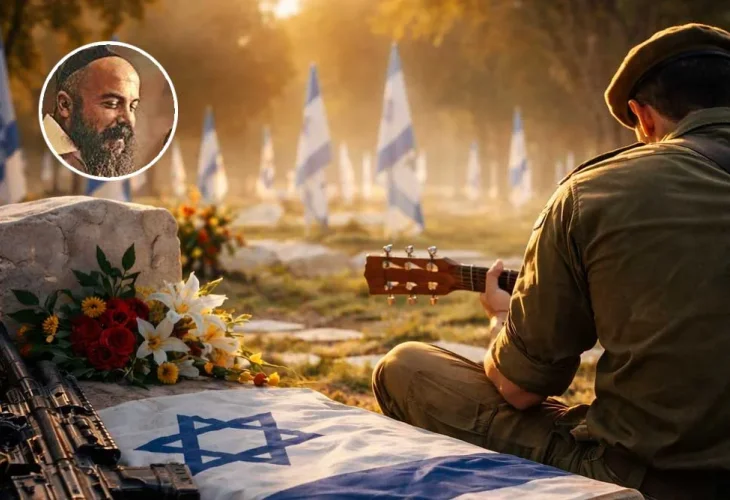 Illustration. Inset: Erez Lonberg (Photo: Raz Blizovsky)
Anyone who knew Erez Lonberg in the 1990s would hardly recognize him today. Once the lead singer of the band Roch, known for its place in Israel’s music scene, Lonberg now devotes most of his time to studying Torah.
“It’s hard for me to pinpoint the exact moment I became observant,” he says. “I grew up on a kibbutz, in a home far from Judaism. But I always felt like I was searching for something deeper. Even back then, I was drawn to emotional and spiritual worlds. I wanted something more authentic, and that feeling only grew stronger.”
What ultimately changed his life was an encounter at a Chabad House in India. “From that point on, everything shifted,” he says. “Looking back, I see that drawing close to Hashem gave me the strength I would later need to face one of the hardest challenges of my life.”
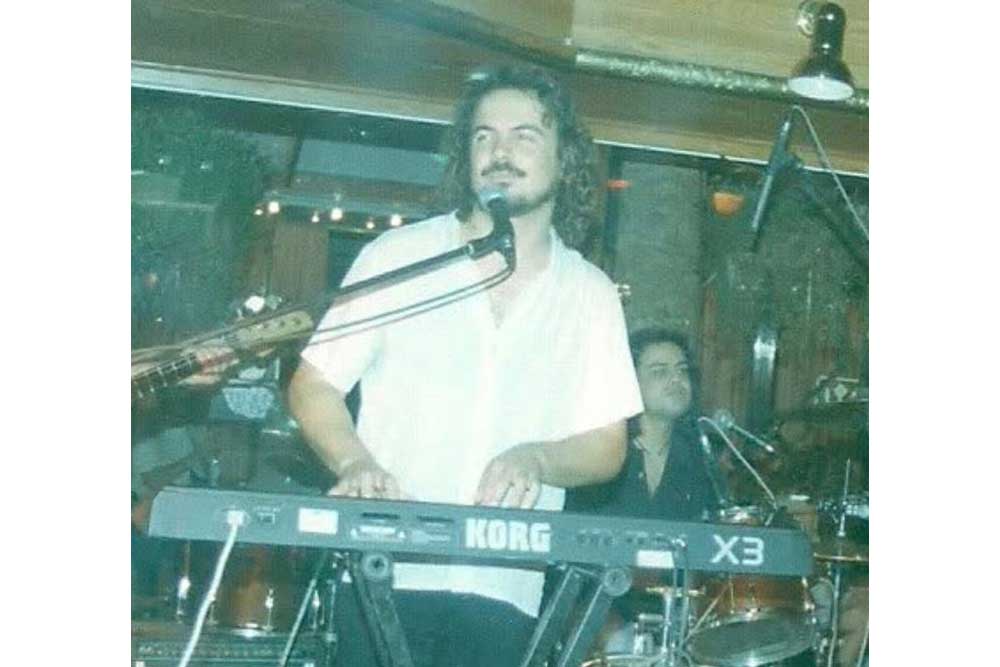 Erez Lonberg before he became observant
Starting Over
After becoming observant in his 30s, Lonberg made a bold decision.
“At the time, we were about to release our second album and were on the verge of major success,” he recalls. “But I knew I couldn’t continue on that path. I chose to start over completely, like a beginner learning from scratch.”
He began studying in a Lithuanian-style yeshiva and later continued within the Chabad community.
Music, however, never fully left his life.
“It’s still part of who I am,” he explains. “But it’s no longer everything. In the past, music defined me. Today, Torah gives me a deeper and more lasting sense of life. Music has become another way to connect to Hashem.”
Alongside his studies, Lonberg now works as a coach and emotional therapist, even developing a unique method that combines coaching with vocal expression.
A Life-Changing Test
Over the past year and a half, Lonberg faced a profound personal test.
His son, a young man with great potential, enlisted during the war and served in a combat unit in Gaza. After months of intense fighting, everything changed in a single moment.
During one operation in Beit Hanoun, terrorists emerged and opened fire. Lonberg’s son rushed forward to respond. As he reached a window to engage, an RPG was fired directly at him.
He was critically wounded.
“He lost one of his legs,” Lonberg says quietly. “The soldier next to him was killed instantly. Another was severely injured and has not regained consciousness. For many days, we didn’t know if our son would survive.”
Between Fear and Faith
Lonberg received the call from the hospital and rushed there, filled with fear.
“When I arrived, they told me he was in surgery, but they didn’t say more. Later, a doctor came out and said, ‘He lost a leg, but he’ll be okay.’ But it was far more complicated than that.”
Infection set in, and the situation remained critical. Over the course of a month, his son underwent 15 surgeries before his condition finally stabilized.
Finding Strength
Despite everything, his son showed remarkable resilience.
“He stayed optimistic,” Lonberg says. “From the beginning, he felt he had done something meaningful in protecting the Jewish people. Baruch Hashem, he has completed rehabilitation and is now moving forward with his life, even returning to music.”
For Lonberg himself, the emotional journey was more complex.
“Being so close to losing him shook me deeply,” he admits.
During this time, he also worked with bereaved families, witnessing unimaginable loss. He began to reflect on the perspective faith offers in such moments.
“As believing Jews, we understand that the soul continues and is in a good place,” he explains. “That doesn’t take away the pain, but it can offer a different kind of strength.”
A Message Through Music
These thoughts found expression in a song Lonberg created.
He tried to imagine what a fallen soldier might say to his mother. With the help of a family friend who had lost a brother in the war, the message took shape:
“I’m okay. I’m not alone. I’m in good company.”
Lonberg is careful to approach this subject with humility.
“I don’t pretend to understand the pain of bereavement,” he says. “But being so close to it, I feel a responsibility to try to offer comfort and strength.”
Recently, a relative of a fallen soldier reached out to him, saying the song gave their family a sense of hope.
“That is exactly what I hoped for,” he says. “To offer a different perspective, one that brings a bit of light into a very dark place.”
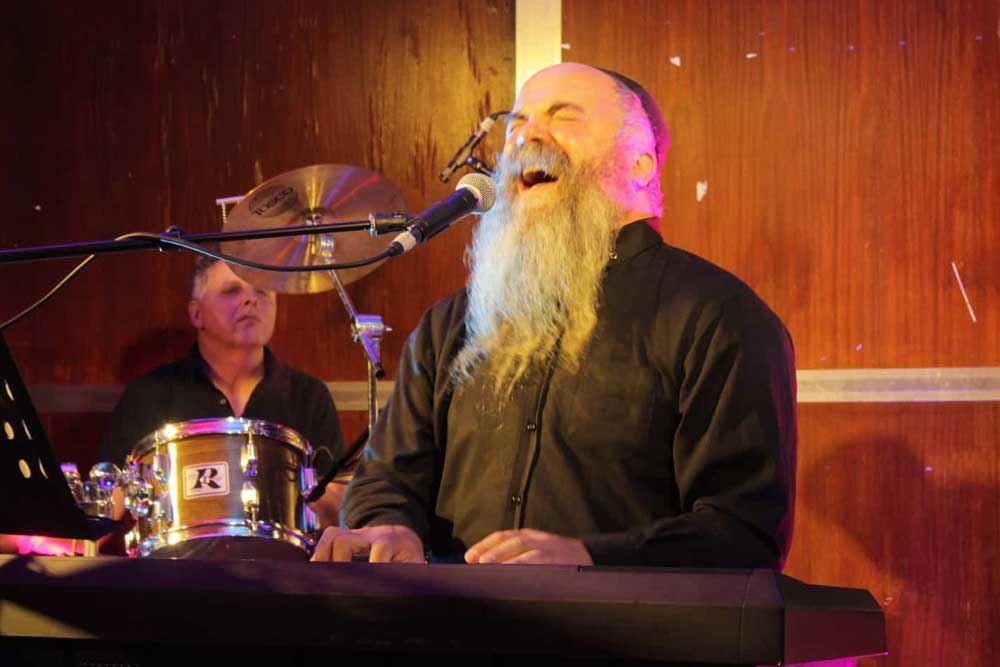 Erez Lonberg today
A Shared Faith
One of the most moving parts of this experience, Lonberg says, is seeing how these messages resonate across different parts of the Jewish people.
“Even those who don’t define themselves as religious connect to this,” he reflects. “After everything we’ve been through, it’s clear that we are one people. Faith belongs to every Jew, no matter where they come from.”
He pauses, then adds softly, “May we merit to learn from these heroes, and to see better days very soon.”

