

Israel News
Lag BaOmer in Meron Approved — Inside Israel’s Safety Plan
40,000 people are expected over 32 hours under a rotating-entry system as Israel works to protect the gathering from Hezbollah
- Brian Racer
- | Updated
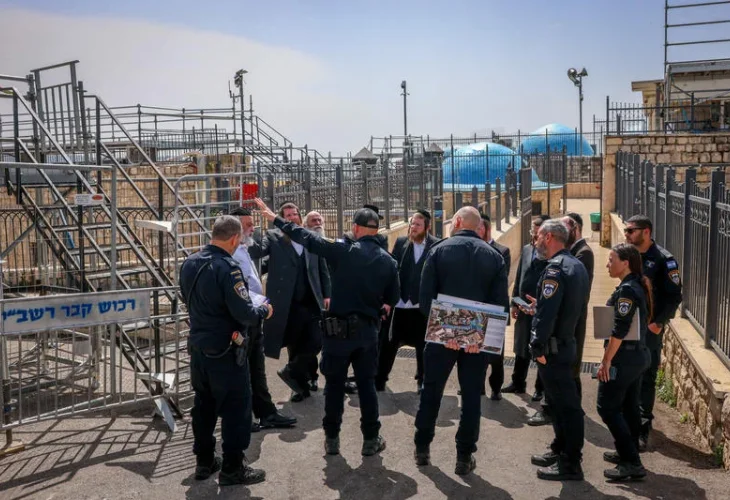 Meron Preparations (David Cohen/Flash90)
Israel is moving ahead with this year’s Lag BaOmer celebrations in Meron under a tightly controlled safety framework designed to allow tens of thousands of worshippers to attend while guarding against possible Hezbollah attacks near the Lebanese border.
Under the plan, visitors will rotate through separate compounds with strict attendance caps, while police, emergency forces and transportation officials prepare for scenarios ranging from rocket fire to mass evacuation.
The annual Meron hillula is one of Israel’s largest religious gatherings, drawing Jews to the tomb of Rabbi Shimon Bar Yochai for prayers, bonfires, singing and celebrations marking Lag BaOmer. In normal years, attendance can exceed 200,000 people.
“The hillula is one of the most important religious events in the country,” Jerusalem and Heritage Ministry Director General Shimon Elbaum told lawmakers during a tour and meeting held Tuesday by the Knesset National Security Committee at the Meron site.
The debate over whether to hold the event intensified this week as fighting and tensions continued in northern Israel despite a fragile ceasefire with Lebanon.
Earlier this week, Prime Minister Benjamin Netanyahu directed that the event be held only in a “symbolic format” following security assessments warning of the risk of a mass-casualty incident because of Meron’s proximity to Lebanon and the difficulty of evacuating large crowds during an attack.
But after Netanyahu’s office announced earlier this week that the Meron hillula would be held only in a “symbolic format,” pressure from Charedi political figures, including Jerusalem Affairs Minister Meir Porush, pushed authorities to reconsider a full cancellation. At the same time, Home Front Command experts and planners warned that completely shutting the mountain could create a more dangerous situation if large numbers of worshippers attempted to arrive without organized transportation, barriers, crowd control, or emergency management, leading officials toward a limited but tightly controlled framework instead.
According to the current framework, Meron will be divided into multiple separate compounds, each with different crowd limits based on terrain and distance. Officials said no more than 1,500 people will be permitted in a specific area at one time.
Officials stressed that the overall number of people simultaneously present in the Meron area could still reach roughly 10,000 because the crowds will be dispersed across more than a million square meters and several kilometers of separated compounds.
Authorities say the structure is intended to avoid the kind of deadly congestion that led to the 2021 Meron disaster, when 45 men and boys were killed and about 150 people injured in a crowd crush during Lag BaOmer celebrations.
Still, criticism of this year’s plan has continued. National Security Minister Itamar Ben Gvir warned Wednesday that “we are racing with open eyes toward the next disaster. Charedi blood is not ownerless. I am raising a red flag.”
Transportation Ministry representatives also warned during discussions that buses waiting for emergency evacuation could themselves become targets.
“The enemies know there is a Meron hillula and that it is a symbol,” one representative said. “This would be a death trap sitting within spitting distance of Hezbollah.”
Despite the warnings, emergency agencies say they are preparing extensively for the event. Plans include one-way traffic systems, ticketed transportation, police roadblocks, firefighting teams, ATV patrols, emergency access roads, and reserve buses for evacuation if needed.
Police officials said the event can proceed safely if the approved framework is maintained. “If the framework is maintained as approved, we are prepared and ready for the event,” police representative Supt. Noach Sagas told the committee.

