

Israel News
Mass Meron Hillula Canceled; Symbolic Bonfires Planned Under Heavy Police Closure
Police seal roads to Meron over Hezbollah threats, while three symbolic bonfires approved in its place
- Brian Racer
- | Updated
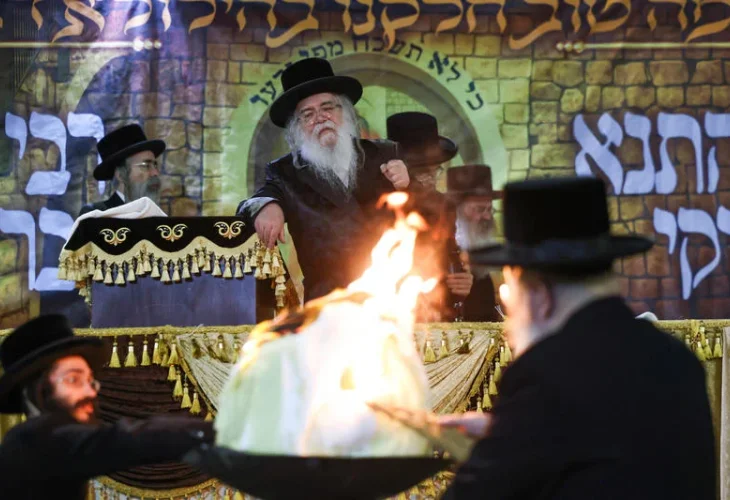 Darag Grand Rabbi and his followers pray and light a bonfire at the Rashbi gravesite in Meron, Northern Israel, May 19, 2025. Photo by David Cohen/Flash90
Israel Police officially announced Sunday morning that this year’s Lag BaOmer hillula at Meron will not take place in its traditional mass format, as authorities sealed roads leading to the mountain and barred public access to the tomb of Rabbi Shimon Bar Yochai due to escalating security concerns in northern Israel. Under the restrictions, no private vehicles or buses will be permitted to enter Meron, including those carrying rabbis or public officials, as entry to the village will be limited to residents and authorized guests presenting identification.
Despite the cancellation, Israeli authorities are still moving forward with a symbolic reduced framework designed to preserve the tradition of lighting bonfires in Meron on Lag Baomer under strict limitations. Officials approved plans for three traditional bonfires Monday night: the central bonfire of the Boyan Rebbe, a Sephardi bonfire led by Rabbi Shlomo Amar, and a third ceremony associated with Religious Zionist rabbis.
Each ceremony will reportedly be capped at 200 participants whose attendance will be coordinated in advance by the organizing communities. Livestream broadcasts from the bonfires and the Rashbi compound are also expected, while the traditional Lag BaOmer orchestra is slated to perform in the courtyard area near the tomb.
The limited framework emerged after several days of rapidly shifting government decisions. Earlier this week, Israeli authorities had prepared a broader controlled plan that envisioned approximately 37,500 worshippers entering Meron in rotating shifts over roughly 32 hours, with about 10,000 people allowed on the mountain at any given time.
But Home Front Command restrictions tightened sharply Friday, limiting outdoor gatherings in the area to 200 people and effectively collapsing the larger framework. Israeli officials cited Hezbollah rocket fire, explosive drone threats, Meron’s proximity to the Lebanese border, and fears that tens of thousands of worshippers could not be evacuated quickly in the event of an attack.
At the same time, authorities reportedly concluded that fully sealing the site could create an even more dangerous situation because several thousand people were already legally present in Meron and additional groups might attempt to arrive regardless of restrictions. The symbolic framework was therefore designed in part to manage crowds already on site under organized supervision.
Police and Border Police forces have now deployed extensively throughout the region, including in forests and open areas surrounding the mountain, to prevent unauthorized arrivals by vehicle or on foot.
In an unusually sharp warning, police said they had been exposed to “serious and extremist publications calling on the public to equip themselves with assault equipment, pepper spray, and other means intended to harm police officers.”
“The forces will operate on the ground with one goal — protecting public safety and enforcing the law,” police said, adding that “any attempt to act violently against security forces or disturb public order will be met with a firm response and zero tolerance.”
Meron remains one of Israel’s largest annual religious gatherings and has carried heightened national sensitivity since the 2021 disaster in which 45 worshippers were killed in a crowd crush during Lag BaOmer celebrations.
Police urged the public not to attempt to reach Meron this year and instead celebrate in homes, synagogues, and local communities. “In the shadow of the security threats in the north, avoiding blocked routes is the right way to preserve the tradition of Israel with joy and safety,” police said.

