

Parashat Shemot
Egypt’s Strategy: How the Israelites Were Drawn Into Slavery
How did Egypt turn the Jewish people from welcomed guests into forced laborers? A powerful look at the strategy, the mindset, and the moment everything began to shift.
- Rabbi Menachem Yaakovzon
- | Updated
How do you bring an entire nation into slavery, beginning with their own willingness?
How did Pharaoh manage to draw wise and thoughtful people into a system of servitude?
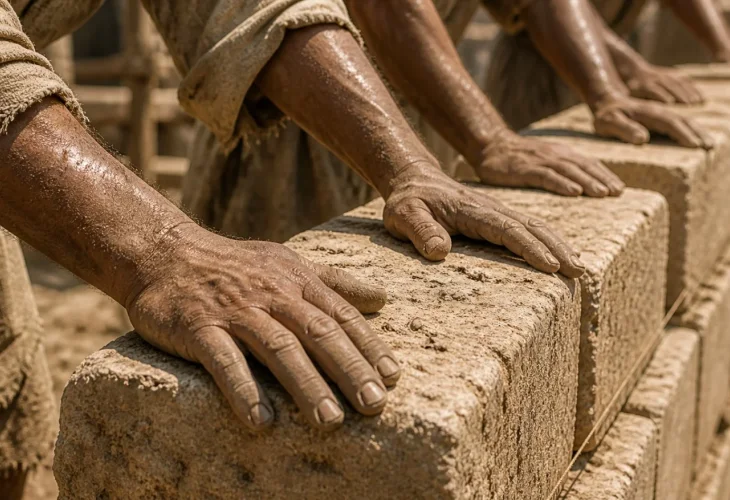
Our sages explain that at first, Pharaoh himself joined the national building effort. He presented it as a shared mission, inspiring a sense of unity and patriotic responsibility. It seems that the Jewish people were among the first to volunteer, perhaps even the primary target of the campaign.
The Subtle Beginning
At the root of this process was something deeply human.
The people of Israel felt a sense of obligation toward the Egyptians. They had arrived during years of famine and were welcomed. That memory created discomfort. They felt a need to justify their place in Egyptian society.
The Egyptians understood this well.
Pharaoh and the surrounding culture played on these emotions. The public atmosphere began to portray the Jews as dependents, as people living off the generosity of others.
In response, the Jews felt compelled to prove themselves. They volunteered, worked hard, and showed loyalty.
But once they were drawn in, the shift began.
Gradually and strategically, voluntary work turned into forced labor. What began as goodwill became obligation, and eventually, servitude.
From Volunteers to Laborers
The transition did not happen overnight.
Even as conditions worsened, there were elements that softened the reality. The food, for example, may have improved. As the Torah records: “We remember the fish we ate in Egypt freely, the cucumbers, the melons, the leeks, the onions, and the garlic.”
This made it harder to recognize what was really happening.
A nation that had once been welcomed slowly became a workforce that could no longer walk away.
Forgetting the Truth
Where did the mistake lie?
The Egyptians succeeded in erasing a crucial truth. They made the people forget that it was Joseph who had saved Egypt from famine. They forgot the merit of Jacob, whose presence brought blessing to the land.
Rashi, at the beginning of Parshat Vayechi, cites the teaching of our sages: when Jacob passed away, “the eyes and hearts of Israel were closed” from recognizing the beginnings of their suffering.
The commentators ask: did the physical servitude really begin at that moment?
The answer offered is that something deeper had already started.
The First Stage of Enslavement
From the time of Jacob’s passing, a different kind of servitude began to take hold.
It was not yet physical. It was internal.
The people began to feel unsure of their right to exist. They felt the need to justify themselves, to explain their presence, to earn their place.
This was the first stage of enslavement.
Later, the Torah tells us that “a new king arose over Egypt who did not know Joseph.” On the surface, this sounds like simple neglect. But neglect can shape public perception in powerful ways.
Through it, a nation that once owed its survival to Joseph could now see his descendants as a burden.
A Pattern in History
This pattern did not remain in Egypt.
It appeared again in Spain, where Jews helped build the economy, only to be expelled. It appeared in Germany, where Jews saw themselves as loyal citizens, contributing to society, only to face devastating betrayal.
Time and again, the same shift occurs. From valued contributors to unwanted outsiders.
A Familiar Challenge
There are moments when similar dynamics can be seen closer to home.
Communities that contribute, that serve, that give of themselves, can suddenly find themselves questioned or criticized. Their efforts are overlooked. Their identity is challenged.
Whether it is those who serve, those who build, or those who dedicate their lives to Torah, the experience can feel strikingly similar.
The Real Danger
The problem is not only what is said publicly.
The deeper danger begins when those voices start to affect how we see ourselves.
When people begin to feel they must apologize for who they are. When they start to justify their very existence. When they lose clarity about their identity.
That is the turning point.
History shows that once this internal shift happens, it becomes much easier for others to take advantage.
Holding On to Identity
The story of Egypt is not only about the past.
It is a reminder.
A reminder to hold on to truth. To remember where we come from. To recognize the value and purpose that do not depend on outside approval.
Because the moment that clarity is lost, the process that began in Egypt can begin again.
Adapted from the teachings of Rabbi Menachem Yakovzon, head of the Mahar Yitzchak Yeshiva in Moshav Chemdat.

