

World News
Poll Shows Most Jewish New Yorkers Oppose Mamdani on Israel and Antisemitism
Most Jewish NYC voters oppose the mayor’s performance and link rising antisemitism to normalized anti-Zionism
- Brian Racer
- | Updated
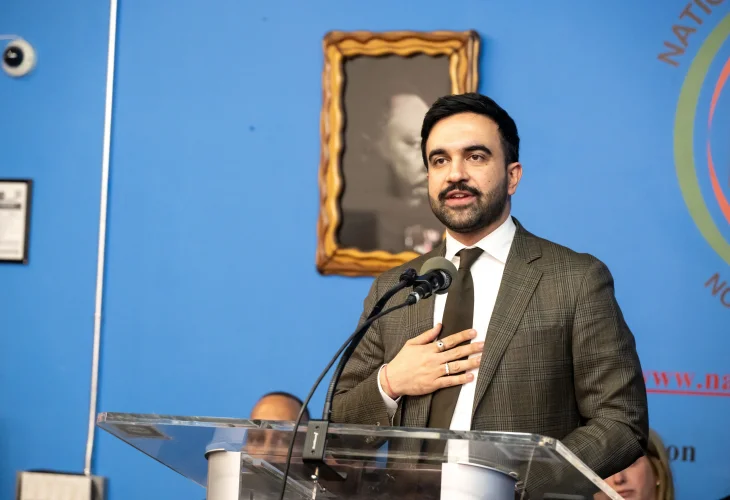 Zohran Mamdani (Shutterstock)
A new poll of Jewish New York City voters found that most disapprove of Mayor Zohran Mamdani’s performance and believe rising antisemitism is connected to the normalization of anti-Zionist rhetoric.
The survey, conducted by Jewish Majority and co-sponsored by the Jewish Community Relations Council of New York, found that 58% of Jewish voters believe Mamdani is doing a poor job as mayor, while 32% approve and 10% remain undecided. The poll surveyed 665 Jewish voters in New York City between Feb. 17 and 28, 2026, in English and Yiddish.
The findings challenge the idea that Mamdani’s support among some Jewish voters reflects broader Jewish backing for anti-Zionist politics. According to the survey, many Jewish voters who supported Mamdani still oppose some of his positions related to Israel and antisemitism.
According to the survey, 26% of Jewish voters backed Mamdani in the mayoral election, compared to 55% who supported former New York Gov. Andrew Cuomo and 8% who voted for Republican candidate Curtis Sliwa.
“Those who voted for Mamdani did so in spite of his anti-Zionism, not because of it,” Jonathan Schulman, executive director of Jewish Majority, told JNS.
The survey found that 58% of respondents believe the recent rise in antisemitism is linked to the normalization of anti-Zionism, while 25% said they do not see such a connection.
Sixty percent of respondents said the phrase “globalize the intifada” calls for the violent destruction of Israel, and the same percentage said Mamdani’s refusal to condemn the slogan has emboldened pro-Hamas protesters. Fifteen percent said the term refers to civil disobedience.
The survey also found broad support for Israel’s existence even among respondents critical of Israeli policy. Sixty percent supported a two-state solution if it would end the Israeli-Palestinian conflict, including 84% of Mamdani’s own Jewish voters.
“We’re not seeing any indication that a large part of the Jewish community supports anti-Zionism,” Schulman told JNS.
The poll showed that security and public safety remain major concerns for Jewish voters in the city. Eighty-four percent supported New York City’s new law creating protest buffer zones around houses of worship, while 73% backed banning face masks used during harassment or intimidation protests.
Another 85% supported government funding for security enhancements at Jewish communal institutions.
Mamdani, the city’s first Muslim mayor, has faced repeated criticism from mainstream Jewish organizations over Israel-related controversies since taking office earlier this year.
During the campaign, Mamdani said he would seek the arrest of Israeli Prime Minister Benjamin Netanyahu if he visited New York City. His administration also drew backlash after a spokeswoman said synagogues hosting pro-Israel events violate international law.
Last month, Mamdani vetoed a New York City Council bill that would have created buffer zones around schools to prevent harassment and intimidation, despite signing a similar measure protecting houses of worship. Eleven Jewish organizations later issued a joint statement saying they were “deeply disappointed” by the veto.
Additional criticism followed after the city released a public service announcement video featuring an official wearing a keffiyeh.
The political tensions come ahead of New York City’s Celebrate Israel Parade on May 31. According to multiple reports, Mamdani is not expected to participate in the event, whose theme this year is “Proud Americans, Proud Zionists.”
“At a moment of heightened division and rising antisemitism, our political leaders should foster thoughtful dialogue that recognizes the broad diversity of Jewish perspectives,” said Mark Treyger, CEO of the Jewish Community Relations Council of New York.

