

Beginners Guide
Is Your Mezuzah Kosher? A Simple Guide to Getting It Right
From buying to placement, everything you need to know to ensure your mezuzah is truly kosher.
- Yosef Yaabetz
- | Updated
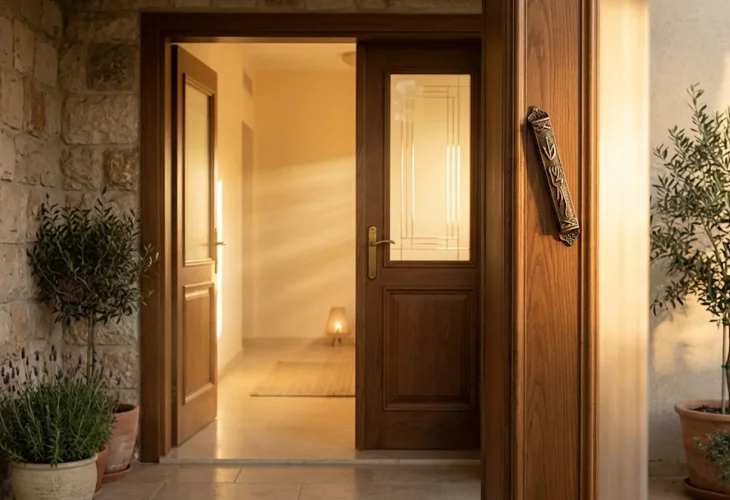
The mezuzah is one of the most recognizable signs of a Jewish home. Today, especially in Israel, many homes and even public places have one on their doorposts.
But like any mitzvah, it is not enough to have it. We need to know how to fulfill it properly.
There are basic requirements that must be met. Without them, the mitzvah is not fulfilled at all. Beyond that, there are additional details that enhance the mitzvah and allow us to fulfill it in a more complete and meaningful way.
It Starts With a Kosher Mezuzah
The most basic requirement is simple but often overlooked. There must be an actual, valid mezuzah inside the case.
It has been discovered many times that in hotels or public buildings, there is a decorative mezuzah case on the door, but inside there is only a printed paper or nothing at all. A mezuzah case may look authentic, but without a proper parchment inside, it has no halachic value.
A kosher mezuzah must be handwritten on parchment by a qualified scribe, known as a sofer, following all the laws that apply to sacred texts.
Why You Cannot Rely on Appearances
Even when a mezuzah looks correct, there is no way to verify its validity just by looking at it.
Was it written with proper intent? Was the parchment prepared correctly? Was the text written in the correct order? Even a small mistake can invalidate the entire mezuzah.
Because of this, the only reliable option is to buy a mezuzah from a trustworthy sofer or from a store with proper rabbinic supervision.
Who Is Responsible
The obligation of mezuzah falls on the person living in the home.
Even if you are renting, you are responsible to make sure your home has kosher mezuzot. This obligation applies once the residence is considered permanent, generally after thirty days.
Which Doorways Need a Mezuzah
Every doorway in the home requires a mezuzah, with a few exceptions.
Very small spaces that are not at least four by four amot are exempt, as are bathrooms.
In addition, only a doorway with a proper frame or structure is obligated. If there is any uncertainty, it is best to ask a knowledgeable rabbi.
Where and How to Place It
The mezuzah is placed on the right side of the doorway, based on the direction you normally enter the room.
It should be fixed in the upper third of the doorpost.
There are different customs regarding how it is positioned. Sephardim place it upright, while Ashkenazim place it on a slight angle.
When putting up a mezuzah, a blessing is recited.
It is important that the mezuzah be affixed by a Jew who is obligated in the mitzvah. This may seem obvious, but in practice, mistakes happen. For example, during renovations, a worker may remove and replace a mezuzah. In such cases, it must be properly reattached by someone who is obligated in the mitzvah.
Checking Your Mezuzot
Mezuzot should not be treated as a one-time installation.
Over time, heat, humidity, and wear can damage the parchment or ink. For this reason, mezuzot should be checked periodically, traditionally twice every seven years.
Some people also choose to have their mezuzot checked during difficult times, to ensure everything is in proper condition.
What the Mezuzah Really Means
It is important to remember that the mezuzah itself is not a protective charm.
Protection comes from Hashem. The mezuzah is a mitzvah, and through fulfilling it properly, a person brings blessing into their home.
There is a well-known teaching from Onkelos, who explained to the Roman emperor that while earthly kings are protected by guards, Hashem protects His people. The mezuzah at the door is a sign of that relationship.
Beyond that, the mezuzah serves as a daily reminder. As the Rambam writes, whenever a person enters or leaves their home, they are reminded of Hashem’s unity and are awakened from routine and distraction.
A Simple but Powerful Mitzvah
A mezuzah may seem like a small detail on the doorframe, but it carries deep meaning.
By taking a little extra care to ensure it is valid and properly placed, we turn a symbol into a living mitzvah that brings awareness, connection, and blessing into everyday life.

