

Beginners Guide
Minyan Explained: Why Praying Together Matters
Why does Jewish prayer require ten men? A clear guide to the meaning, laws, and power of a minyan.
- Yonatan HaLevi
- | Updated
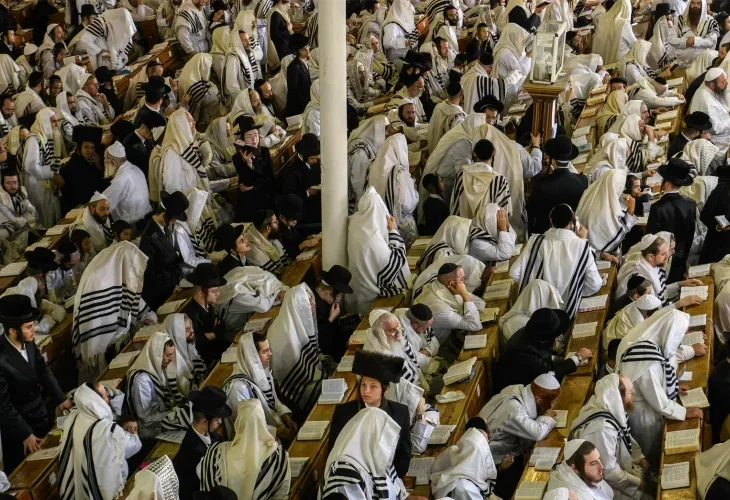 (Photo: Shutterstock)
If you want your prayers to reach as high as possible, it helps to understand what happens when ten Jews gather to pray together.
This gathering is called a minyan, and it is one of the most powerful tools in Jewish life.
What Is a Minyan?
A minyan is a group of at least ten adult Jewish men who come together to perform certain mitzvot that require a communal setting.
According to halacha, these must be men who are thirteen or older, meaning they are obligated in mitzvot.
Why Ten Matters
The number ten is not arbitrary.
The Mishnah in Avot teaches that when ten people engage in Torah together, the Shechinah rests among them, as it says, “Hashem stands in the assembly of God.”
The Gemara explains that a “congregation” is defined as ten. Another source comes from the verse, “And I shall be sanctified among the children of Israel,” which the Sages interpret as requiring a group of ten.
This same principle applies to prayer.
There is a unique strength in communal prayer, as the verse says, “The Almighty is great and does not despise the prayer of the many.”
What Requires a Minyan
Some prayers and mitzvot can only be performed with a minyan.
These include:
- Kaddish
- Kedushah
- Barechu
- Birkat Kohanim
- The chazzan’s repetition of the Amidah
- Reading from the Torah
- Sheva Berachot
- Zimun with Hashem’s Name when ten are present
There are also mitzvot where a minyan is strongly preferred, even though the obligation can still be fulfilled without one.
These include:
- Brit milah
- Kiddushin
- Reading the Megillah on Purim
- A funeral
Praying Alone vs. With a Minyan
It is possible to pray the Amidah individually. However, the ideal form of prayer is with a community.
Some halachic authorities go even further and view praying with a minyan as an obligation whenever it is reasonably possible. This is discussed in Responsa Igrot Moshe, Orach Chaim, volume 4, siman 68.
A Time of Favor
Rabbi Shimon bar Yochai teaches that communal prayer has a special quality.
He explains the verse, “And as for me, my prayer is to You, Hashem, at a time of favor,” and asks, when is a time of favor?
When the community is praying together.
The Strength of the Many
The Rambam writes that the prayer of a community is always heard.
Even if some members of the group are not perfect, Hashem does not reject the prayer of the many. For this reason, a person should make every effort to pray with a community rather than alone.
He adds that a person should go regularly to the synagogue, morning and evening, because prayer is most readily accepted there (Mishneh Torah, Hilchot Tefillah u’Birkat Kohanim 8:1).
Who Counts Toward a Minyan
According to halacha, only adult Jewish men who are obligated in mitzvot count toward a minyan.
A minor does not count. A person who is not of sound mind is also not included. Classical halachic sources also exclude someone who is unable to hear or speak and is therefore not considered fully obligated.
In addition, according to halacha, a woman does not join a men’s minyan.
A Simple but Powerful Idea
A minyan is more than just a number.
It is the moment when individual voices come together and become something greater. A shared prayer, a shared presence, and a connection that carries more weight than any one person alone.
When ten come together, something changes. And that is what gives communal prayer its unique strength.

