

Behind the News
Trump’s ‘Project Freedom’ Backs Iran Into a Corner
Plan to guide trapped ships out of the Gulf tests whether Iran will back down or risk breaking the ceasefire
- Brian Racer
- | Updated
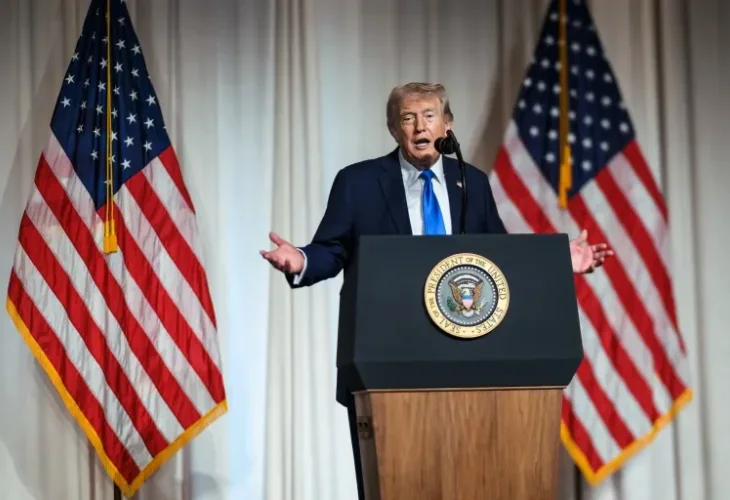 Donald Trump (White House)
US President Donald Trump said yesterday the United States will begin guiding commercial ships out of the Strait of Hormuz starting Monday morning, launching what he called “Project Freedom” as tensions rise over Iran’s control of the strategic waterway.
“This process, Project Freedom, will begin Monday morning, Middle East time,” Trump said in a statement published on Truth Social. “Countries from all over the World have asked the United States if we could help free up their Ships which are locked up in the Strait of Hormuz. They are merely neutral and innocent bystanders. We will guide their Ships safely out of these restricted Waterways, so that they can freely and ably get on with their business. This is a Humanitarian gesture. If, in any way, this Humanitarian process is interfered with, that interference will, unfortunately, have to be dealt with forcefully.”
On the surface, this is about freeing ships to keep the global economy moving, but in reality it is about leverage. By announcing the operation publicly, Trump is trying to back Iran into a corner: allow the ships to leave and weaken its claim of control over Hormuz, or interfere and risk being blamed for breaking the ceasefire.
The operation does not necessarily mean every commercial vessel will be physically escorted by a US Navy ship. According to Axios, US Navy vessels may remain near shipping lanes rather than travel beside each tanker, while providing guidance on safe routes and warning ships about threats such as Iranian deep-sea mines.
That is because many of the ships are effectively stuck. The ships are caught in a new military and diplomatic environment in the Strait of Hormuz after the war and ceasefire, with Iranian officials insisting the waterway will not return to its pre-war state and that safe passage must be coordinated with Iran’s armed forces, the core challenge Trump is now trying to break.
In response to Trump’s announcement, senior Iranian lawmaker Ibrahim Azizi said, “Any American interference in the new maritime regime of the Strait of Hormuz will be considered a violation of the ceasefire.” A statement from the unified command of Iran’s armed forces also warned the US Navy against entering the strait, saying that “any safe passage must be coordinated with the armed forces,” while Iranian officials added that ships tied to the US and its allies may face restrictions and Israeli vessels “will under no circumstances” be allowed passage.
Project Freedom is meant to challenge that position, and that is where Trump’s strategy comes into focus. If Tehran allows the ships to leave, it weakens its claim that it controls the strait. If it blocks them, it risks appearing to hold neutral crews and global commerce hostage. If it attacks, Trump can argue that Iran broke the ceasefire and endangered civilian shipping. If it only threatens and does nothing, American deterrence appears stronger, and Iran’s threats become weaker.
But Trump is not only trying to reopen a waterway. He is trying to show that Iran cannot use mines, maritime disruption, shipping pressure, proxies, nuclear threats, or regional geography to threaten Israel, Gulf states, US forces, and the global economy after the ceasefire.
It also strengthens Washington’s position in negotiations. Trump said Sunday that Iran’s latest reported peace proposal was “not acceptable.” The plan, reported by Al Jazeera, reportedly called for sanctions relief, an end to the US blockade, a withdrawal of American forces from the region, and a broader end to hostilities, while US and Iranian officials remain in contact through Pakistani mediation.
Project Freedom shifts the balance going into those talks. By moving to free the ships, Trump is trying to strip away one of Iran’s main sources of leverage, especially its ability to disrupt shipping and trap neutral vessels, before any agreement is reached. His message is that Iran cannot use trapped ships as bargaining chips while demanding concessions from Washington.
Still, the strait remains dangerous. UKMTO kept the maritime security threat level in the Strait of Hormuz at “critical,” warning mariners to expect increased naval presence, heightened force protection, possible radio hailing, and congestion near anchorage areas.
That means Project Freedom could become the next major test of the ceasefire. If Iran backs down, Trump may have weakened one of Tehran’s strongest post-war pressure points without launching a new offensive. If Iran interferes, the ship crisis could become the trigger for renewed conflict, and the moment the ceasefire begins to unravel.

