

Raising Children
Promising Study Shows Brain Stimulation May Help Children with Autism
New research highlights a potential breakthrough in using noninvasive brain stimulation to improve communication abilities in children with autism.
- Shira Dabush
- | Updated
 Illustration
A new research development is drawing attention from both medical professionals and parents. Researchers in China have tested an innovative, noninvasive form of brain stimulation that may help improve communication and language abilities in children on the autism spectrum.
While still in early stages, the findings offer cautious optimism and open the door to new approaches in autism treatment.
Inside the Study
The study followed 200 children between the ages of 4 and 10, all diagnosed with autism at varying levels. Some of the participants also had intellectual disabilities.
The children were divided into two groups. One group received the actual brain stimulation treatment, while the other received a sham treatment for comparison. This allowed researchers to better evaluate whether the effects were truly linked to the therapy itself.
How the Treatment Works
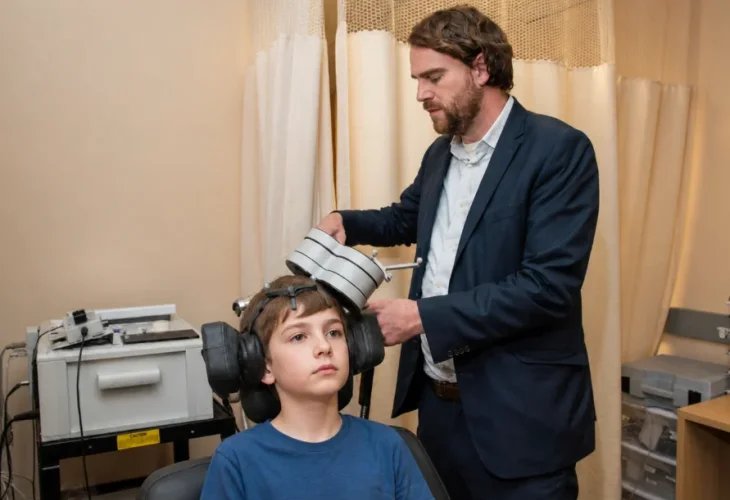
The method uses a noninvasive technique known as magnetic brain stimulation. A small coil is placed on the scalp, sending gentle pulses to a targeted area of the brain.
In this study, researchers focused on the left motor cortex, a region associated with movement, language, and aspects of social interaction.
The goal of the treatment is to help regulate brain activity. By calming overactive areas and strengthening less active ones, researchers hope to improve communication between different parts of the brain.
What the Results Showed
After a five day course of treatment, the children were evaluated using tools that measure social communication.
The group that received the real treatment showed significantly greater improvement compared to the control group. These improvements were seen immediately after the treatment and were still noticeable one month later.
In addition to social communication, the children also showed progress in language abilities, suggesting that the method may support multiple aspects of development.
Safety and Ongoing Questions
The researchers reported some side effects, but they were generally mild. Children experienced temporary restlessness and slight discomfort on the scalp, which passed quickly.
At the same time, experts urge caution. Some note that longer term studies are needed to determine whether the improvements last over time. Others point out that the long term effects of brain stimulation on young, developing brains are not yet fully understood.
Why This Matters
In recent decades, autism diagnoses have risen significantly. Today, about one in 31 children faces challenges with language and communication, and some children do not speak at all.
Existing therapies, such as speech therapy, can help, but progress varies widely from child to child. Because of this, any new tool that may support communication development is seen as potentially important.
A Promising Direction, With Careful Next Steps
This new approach to brain stimulation may offer a promising direction for supporting children on the autism spectrum.
At the same time, researchers and clinicians emphasize the need for further study. As with any developing treatment, careful evaluation and long term research will be essential before it becomes widely used.
For now, the findings represent an encouraging step forward in the search for new ways to support children and families navigating autism.

