

Magazine
I Prayed in Rashbi’s Cave. The Next Day I Met My Husband
A dream, a hidden cave in Peki’in, and a heartfelt prayer became part of Sarah Spielman’s remarkable path to Torah and family.
- Moriah Luz
- | Updated
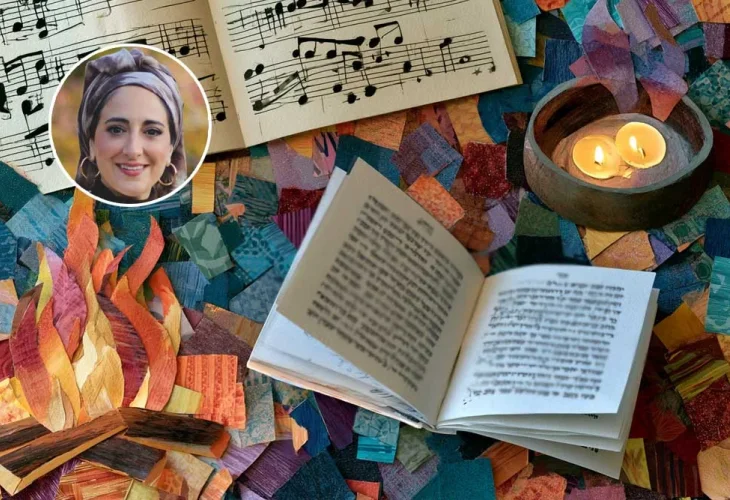 In the circle: Sarah Spielman (Photo: Tal Luria)
Sometimes a single moment can quietly change the course of a life. For Sarah Spielman, that moment came in a hidden cave in the Galilee, a place connected by tradition to Rabbi Shimon bar Yochai and the writing of the holy Zohar.
What began as a journey to explore her roots became a path toward Torah, family, and a completely different future.
“To Me, Being Jewish Meant Friday Night Chicken”
Sarah Spielman grew up in London in a musical family. Her mother, an Israeli singer, had come to England through the Jewish Agency, while her father balanced work as an accountant with singing at weddings and serving as a cantor in the local Orthodox synagogue.
Although the family was traditional, they did not fully observe Shabbat or keep kosher.
“We made Kiddush on Friday night, and I thought being Jewish meant eating chicken,” she recalls with a smile.
Music became the center of her life from a very young age. At just five years old, she began intensive musical training that continued for years. On Shabbat mornings, instead of spending time in synagogue, the family often drove to the conservatory.
Still, something inside her was drawn toward Judaism. At age ten, after attending a local Hebrew school, she asked her parents to take her to synagogue on Shabbat mornings. At first, the motivation was simple: her teacher kept track of who attended.
But over time, the experience began to affect her more deeply.
A Dream That Changed Everything
As a teenager, Sarah joined a religious youth movement that strengthened her Jewish identity and introduced her to Shabbat observance.
Later, after being accepted to the prestigious University of Cambridge, she continued pursuing music at the highest level, specializing in Russian and Italian music.
During one school break, she received what seemed like a dream opportunity: an invitation to record an album with an important choir.
But when she arrived, she discovered the recordings were Christian Christmas songs.
That night, she had a powerful dream.
“I dreamed I was on a plane that was about to crash,” she recalls. “Just before the crash, I woke up.”
She immediately felt the dream carried a message. It pushed her into deep reflection about purpose, truth, and the direction of her life.
“My conclusion was that I could not make decisions because of social pressure. I needed to choose according to eternal truth, according to Torah.”
The Struggle Over Music
As Sarah grew closer to Torah observance, one struggle became central in her life: the halachic issue of kol isha, women singing publicly before men.
Music had always been her deepest passion and source of joy. The idea of giving up public performance was painful.
“I asked myself, why can’t I share with the world the closeness to Hashem that I feel when I sing?”
Then came a serious illness.
While battling pneumonia and struggling to breathe, she found herself speaking honestly to Hashem. At first, she felt she was being punished. But over the course of several emotional days, something shifted.
“For the first time, I allowed myself to imagine singing only for women,” she says. “Suddenly, I felt peace.”
Rather than seeing it as a loss, she began to understand it as a new direction filled with purpose and meaning.
A Discovery About Her Family Roots
During her graduate studies in Boston, another experience deeply impacted her.
While spending Shabbat with relatives of a friend in New York, she saw an elderly Jewish man unroll a long white cloth embroidered with generations of family names. The cloth had been used for family milestones for hundreds of years.
The moment stirred something inside her.
“What I saw there, my family didn’t have,” she wrote in her journal afterward.
She began exploring her own family history and eventually discovered that she descended from the Zinati family of Peki’in, a family rooted in the Land of Israel for generations. One relative, Margalit Zinati, became known as the last Jew of Peki’in.
The Cave That Changed Her Life
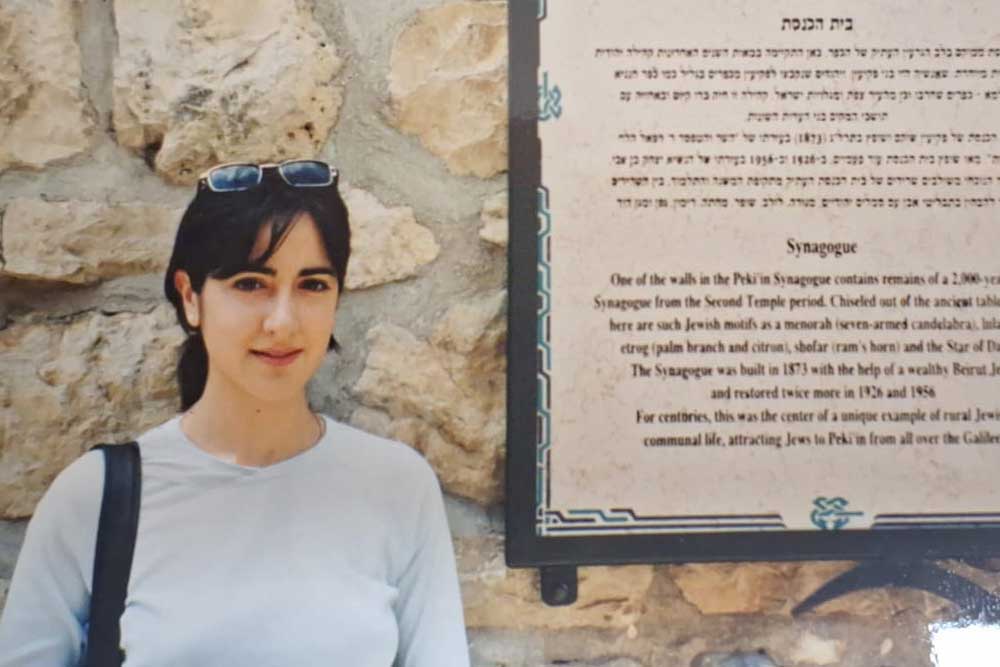
Soon afterward, Sarah traveled to Israel and visited Peki’in with family members.
Toward the end of the tour, they entered a cave traditionally identified as the place where Rabbi Shimon bar Yochai wrote the Zohar.
The atmosphere deeply moved her.
Aware of tensions within the extended family, she asked her uncles to recite Shema Yisrael together and add the prayer of forgiveness traditionally said before sleep.
They agreed.
Before leaving the cave, Sarah also prayed for several single women to find their matches.
The very next day, while traveling to a wedding, she met Doron, the man who would later become her husband. Nearly thirty years later, they have six children together.
A Life Built Around Torah and Music
Today, Sarah Spielman lives in Ma’ale Adumim, where she continues teaching and performing music in a way that aligns with halachah.
She performs for women, teaches voice professionally, and mentors young women studying music at high levels.
Looking back, she does not feel she lost her dream. Instead, she feels she found a deeper purpose within it.
“The main thing,” she says, “is the emotion within the singing.”
Learning to Be Present
As a mother of six, Spielman says she has learned that true fulfillment is not always found in public success.
“Since COVID, I’ve understood that I need to be more present in the moment,” she explains. “The children need our presence and our conversations.”
Even now, music remains part of her spiritual journey.
“The light of Torah cleansed me from the shells of life,” she says.

