

Torah Personalities
The Story Behind Rashi’s Famous Explanation of the Ephod
After struggling to explain the ephod, Rashi suddenly found the answer in an unexpected encounter.
- Yosef Yaavetz
- | Updated
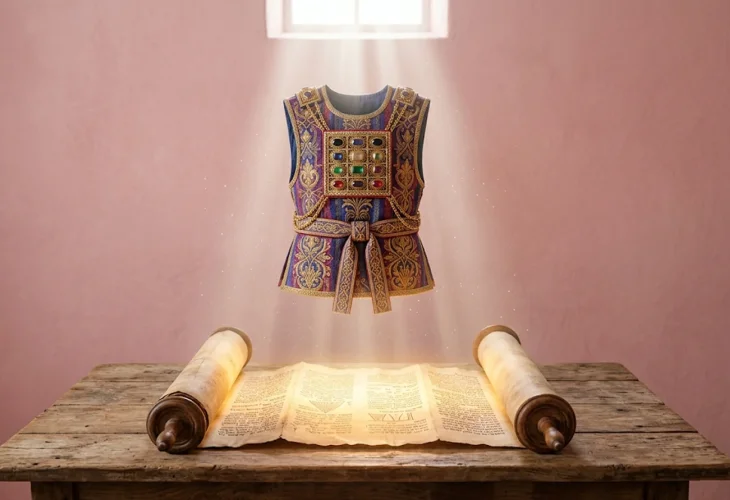
For generations, Jews have studied Rashi’s commentary on the Torah with awe. His explanations are so clear and precise that it is easy to forget how much effort, brilliance, and Heavenly assistance stood behind every word he wrote.
One remarkable story describes how Rashi finally solved a difficult mystery surrounding the ephod, one of the special garments worn by the Kohen Gadol in the Mishkan.
A Question That Troubled Rashi
Nearly a thousand years ago, Rashi left his study hall in the city of Worms and began walking home along the Jewish street.
As was his custom, he walked with great modesty and holiness, avoiding unnecessary sights and distractions. For years he had traveled the same route daily without lifting his eyes to the surrounding streets.
But on this particular day, something unusual happened.
Rashi suddenly looked up and noticed a duchess riding past on horseback.
The sight disturbed him. Why had he looked up at all?
Within moments, however, he understood.
The Garment That Solved the Mystery
The day before, Rashi had spent hours struggling to understand the exact structure of the ephod described in the Torah.
He had carefully examined passages in the Gemara, books of grammar, teachings from his rabbis, and earlier commentaries. Yet despite all his efforts, he could not clearly picture how the garment was shaped.
Rashi was known for his extraordinary precision. He refused to write unclear explanations or guesses. In his commentary, he had honestly written: “I do not know what it is.”
But now, as the duchess rode past him, the puzzle suddenly became clear.
She was wearing a unique riding garment with a panel in front and another in back, connected by straps over the shoulders.
“This,” Rashi realized, “is the structure of the ephod.”
He immediately understood that the unusual sight had appeared before him for a reason: to help him understand a word in the holy Torah.
Returning to the Study Hall
Rashi quickly turned around and returned to the study hall.
He reopened the notes where he had written that he could not understand the ephod, and began recording a detailed description of the garment.
His explanation was so vivid and exact that it sounded as though he had personally seen the ephod in the Beit Hamikdash itself.
Rashi described the garment as resembling an apron worn by women riding horses, attached by shoulder straps and wrapped around the body in a very specific way.
That explanation remains part of his Torah commentary to this day.
Siyata diShmaya
The story highlights not only Rashi’s brilliance, but also his humility and honesty.
He was not ashamed to admit when he did not fully understand something. And when clarity finally came, he recognized it as siyata diShmaya, special help from Heaven.
The comparison is striking.
Moshe Rabbeinu struggled to understand the vision of the Menorah until Hashem showed him a menorah of fire.
Rashi did not receive prophecy, but according to this tradition, he merited Heavenly assistance that enabled him to illuminate the words of Torah for generations to come.
A Lesson in Torah Study
This story offers a powerful lesson about Torah learning.
Great Torah scholars do not rely on assumptions or pride. They search deeply, ask questions honestly, and continue seeking truth with patience and humility.
And sometimes, the answer arrives from the most unexpected place.

