

Magazine
The Rabbi Who Refused to Leave Sderot During the Rocket Attacks
How Rabbi Zev Pizem transformed a small Chabad House in Sderot into a source of strength, hope, and spiritual resilience during years of terror, rockets, and uncertainty
- Avner Shaki
- | Updated
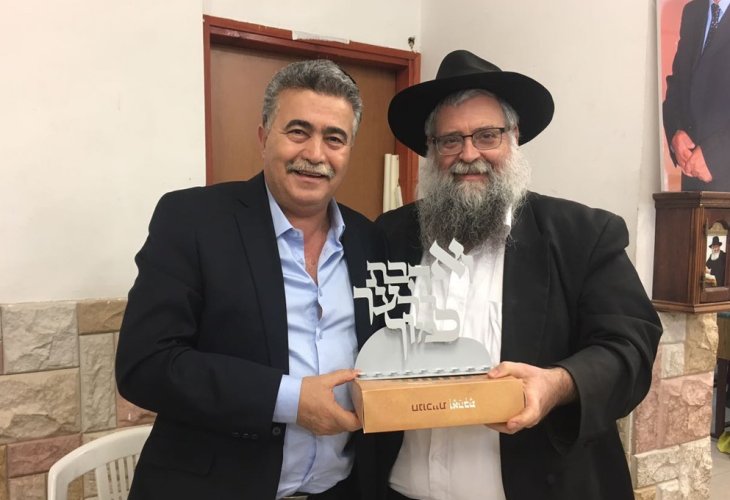 On the right: Rabbi Ze'ev Pizem
“After we were blessed to receive a positive response from the Lubavitcher Rebbe regarding our request to serve as his emissaries in Sderot,” recalls Rabbi Zev Pizem, Chabad emissary in the cultural capital of the Negev, with the passion so characteristic of Chabad chassidim when speaking about their Rebbe, “the first thing we did was look for an apartment in the center of the city. In those days, that was no simple task. There was no Facebook, and not even real estate agents. My wife and I literally walked from door to door, asking neighbors if they knew of any available apartment where we could begin our work.”
“Today it’s hard to believe, but that’s exactly how it was. We knocked on doors and asked around. Most people directed us to a small religious neighborhood on the outskirts of town. I can’t blame them — we looked like ultra-Orthodox Jews in every way. But we kept telling everyone the exact opposite: we specifically wanted to live in the center of the city. Thank God, we eventually found an apartment in a large building among ordinary Israelis. Today there are many baalei teshuvah living in Sderot and beyond — married with children, who returned to Judaism because we lived in that crumbling apartment building.”

It is not easy these days, just before Passover, to find time to speak with Rabbi Zev Pizem, married to Sima and father of nine children. In addition to organizing the central public Passover Seder at the Chabad House in Sderot for the past thirty years — drawing countless people who otherwise would have nowhere to celebrate the holiday, the rabbi and his family are busy collecting donations for needy families, running matzah-baking workshops in schools and kindergartens, delivering Torah classes, and much more. Despite the hectic preparations, Rabbi Pizem agreed to speak about the early years of their mission and the extraordinary journey that followed.
Sent by the Rebbe
“Generally speaking,” Rabbi Pizem explains, “the entire Chabad emissary movement established by the Rebbe developed in stages. In the beginning, the Rebbe personally told people where to go — one to Australia, another to France, and so on. Later, people who felt suited to become emissaries would suggest themselves and propose places where they thought they could serve best. Then they would wait for the Rebbe’s answer. Some received approval, others did not.”
How did it happen for you? And why specifically Sderot?
“I grew up in the Krayot,” he says. “As strange as it sounds, I had never even heard of a place called Sderot. But my father-in-law, Rabbi Avraham Donin, who had served as an emissary in the south for several years, knew the area and suggested that my wife and I move there as Chabad emissaries. We asked the Rebbe for his blessing and approval, and we received it — together with detailed instructions connected to the city and the people living there. It included names of individuals and places. It was incredibly powerful. And that’s how we arrived — without knowing a single person.”
Building a Jewish Community
Shortly after arriving, they began organizing activities for children, Torah classes, and public verse recitations in typical Chabad style.
“Baruch Hashem,” Rabbi Pizem says, “there are many people today who keep Torah and mitzvot because of those simple verse gatherings. It’s unbelievable how much impact such a simple activity can have on a soul.”
The people of Sderot, he says, welcomed them warmly.

Living Through the Rocket Attacks
Most Israelis today no longer remember the years when Sderot endured relentless Kassam rocket attacks. But Rabbi Pizem remembers very well.
“Before all of this began,” he says, “Sderot was quiet and pleasant. Then one day, rockets started falling here, and life completely changed.”
At first, he recalls, many residents were almost excited by the sudden media attention.
“People across Israel barely knew Sderot existed before the rockets. Suddenly newspapers and television were talking about us constantly. But very quickly, the excitement turned into fear and trauma. Many people here still carry deep emotional scars to this day — elderly people, women, children.”
When asked how they felt realizing the Rebbe had specifically sent them to such a dangerous city, Rabbi Pizem answers without hesitation:
“We quickly understood why the Rebbe sent us here. Our work was no longer only about Judaism in the regular sense. We realized our presence gave people strength and emotional support. It strengthened their spirit and resilience. It was clear to us that we were not leaving. The city’s difficult situation obligated us to stay.”
A Chabad House Under Fire
The Chabad House became a center of refuge and encouragement. They organized camps outside the city so children could relax, but most activities remained inside the fortified Chabad House itself.
“We built a large indoor play center for children,” he recalls. “It was surreal. Outside you heard ‘Color Red’ sirens and rockets falling, while inside the Chabad House children were playing peacefully.”
As the years passed and the attacks intensified, the emotional damage became severe.
“There were periods when 50 to 60 rockets fell every single day,” Rabbi Pizem says. “It was horrifying.”
One major initiative involved cooperation with Chabad centers around the world.
“Thank God, we managed to fly 200 children who were emotionally traumatized to Chabad summer camps abroad. People everywhere helped. The children came back strengthened and emotionally healthier.”
The elderly also suffered greatly. “There were older people terrified to leave their homes,” he says. “We helped them physically, emotionally, and financially — especially families waiting for government compensation after rockets destroyed their homes.”
“Being an emissary under fire is something unique,” he reflects. “But apparently God believed we were suited for it. Everything is Divine Providence. There are no mistakes. Every person, in every place they are sent, has a mission.”
Preparing for Passover
As Passover approaches, the work intensifies even more.
“The biggest project is Kimcha D’Pischa,” Rabbi Pizem explains — the large-scale food distribution campaign for needy families. “Hundreds of families receive food packages from us, including Torah scholars with many children and anyone else who truly needs help.”
He admits that raising the money is extremely difficult every year. “Sometimes people ask us for help, and we simply have nothing left to give,” he says painfully.
Then comes the public Seder night itself — a massive communal event inspired directly by the Rebbe’s instructions.
“There are lonely people, widows, immigrants, people who simply don’t know how to conduct a Seder,” he explains. “There is enormous joy in celebrating together.”
For Rabbi Pizem’s own children, communal Seders are the only kind they have ever known. “Since we arrived in Sderot, we have only hosted public Seders,” he says. “My children don’t even know what a private family Seder looks like.”
And then he smiles.
“They know what Passover once looked like in the days of the Temple — and what it will look like again soon, with God’s help, in the rebuilt Beit HaMikdash.”

