

Magazine
Mr. Prime Minister, We’re Long Past “Deeply Disturbing”
From Churchill’s Finest Hour to Today Britain’s Struggle With Antisemitism and Moral Resolve
- Rachel Wigman
- | Updated
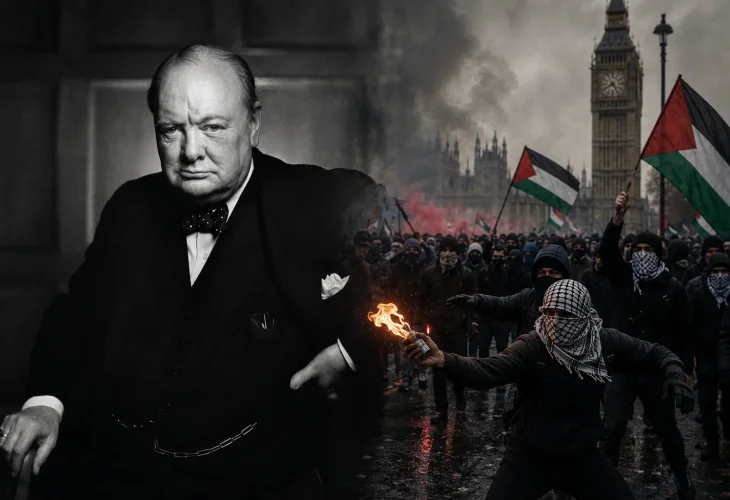
On June 18, 1940, the new prime minister, Winston Churchill, stood in front of the British Parliament. He had been prime minister for just over a month at that point, after Neville Chamberlain was ousted, and as the leader of Great Britain and the United Kingdom, his job was now to explain why, two weeks prior, Britain had evacuated nearly its entire force from the European continent, leaving France to fight Hitler on its own.
Churchill made clear from the outset that what happened in France made no difference to the British resolve to continue fighting. He framed the retreat as tactical, giving Britain the time to collect itself so that one day, with the help of the United States a few years later, it could push troops on the continent and beat Hitler back across multiple fronts.
More than explaining the retreat, though, in his speech, Churchill outlined his vision for the war and for the future. As he closed his speech, Churchill laid at the feet of Parliament—and the world—the need to continue in this fight against evil:
What General Weygand called the Battle of France is over. I expect that the Battle of Britain is about to begin. Upon this battle depends the survival of Christian civilization. Upon it depends our own British life, and the long continuity of our institutions and our Empire. The whole fury and might of the enemy must very soon be turned on us.
Hitler knows that he will have to break us in this Island or lose the war. If we can stand up to him, all Europe may be free and the life of the world may move forward into broad, sunlit uplands. But if we fail, then the whole world, including the United States, including all that we have known and cared for, will sink into the abyss of a new Dark Age made more sinister, and perhaps more protracted, by the lights of perverted science.
Let us therefore brace ourselves to our duties, and so bear ourselves that, if the British Empire and its Commonwealth last for a thousand years, men will still say, “This was their finest hour.”
It’s a phenomenal speech. I used to read it with my students, back when I taught English, as an example of excellent rhetoric. Because Churchill was a brilliant rhetorician. But more importantly—and this was the theme I tried to flesh out in class—he was a man with a backbone. He may not have been the man with the desk sign that said, “The buck stops here,” but he may as well have been.
It’s hard not to think of Churchill and his predecessor following the attack last week in Golders Green. It’s the latest in a string of antisemitic attacks in England, attacks that can no longer be framed, in any light, as anything other than antisemitic. Hunting Jews in the street is not anti-Zionist, no matter one’s political disagreements with the current Israeli government. Setting fire to ambulances because they belong to a Jewish emergency response organization—which, to be clear, will treat Jew and non-Jew alike—is antisemitism in its purest form, and it can no longer be masked as anything but.
In the immediate aftermath of the attack last week, Prime Minister Keir Starmer called the attacks “deeply disturbing.” Mr. Prime Minister, we are long past deeply disturbing. The time for deeply disturbing was on October 8, 2023, when Israel had yet to bury its 1200 dead and yet there were chants on the streets of London to globalize the intifada.
Deeply disturbing is the fact that England has now raised the antisemitism threat to its highest level. Deeply disturbing is the fact that it was England that fostered the environment in which antisemitism could fester. Deeply disturbing is the fact that all that’s happened in the last two and a half years is vague platitudes, even when Jews in Manchester were attacked on the holiest day of the year. It is England, Mr. Prime Minister, that is deeply disturbing.
Starmer, of course, is not entirely responsible for the fact that there was a spike in antisemitic incidents across the UK following the October 7 attack in Israel, and that there have been sustained high levels since. But he has been prime minister since July 2024, nearly two years now, and until last week, the most we heard him offer following attack after attack was that antisemitism has no place in Britain. It seems, Mr. Prime Minister, that your constituents didn’t get that memo. Not the first time, not the second time, not the hundredth time.
I’m not willing to pass judgment yet on Starmer as to whether he is a Churchill or a Chamberlain. In many ways, this is a mess that he inherited, yet in many ways, he is to blame. What happens now will be crucial in determining the way history will remember him. To Starmer’s credit, he has, in the last week, begun to push for stronger stances against inflammatory rhetoric and protests that, to all who are willing to see with honest eyes, have long since tipped over from anti-Zionist to antisemitic.
This is Starmer’s litmus test. What he does—not just what he says—will determine if he will forever be remembered as the man who was deeply disturbed every couple of weeks by the surprise that there apparently is a place for antisemitism in England or, indeed, if this is his finest hour.

