

Magazine
Finding Harmony Through Stuttering: An Intimate Conversation with Musical Artists
Israeli musicians share their emotional journey with stuttering, childhood struggles, music, faith, and self-confidence
- Avner Shaki
- | Updated
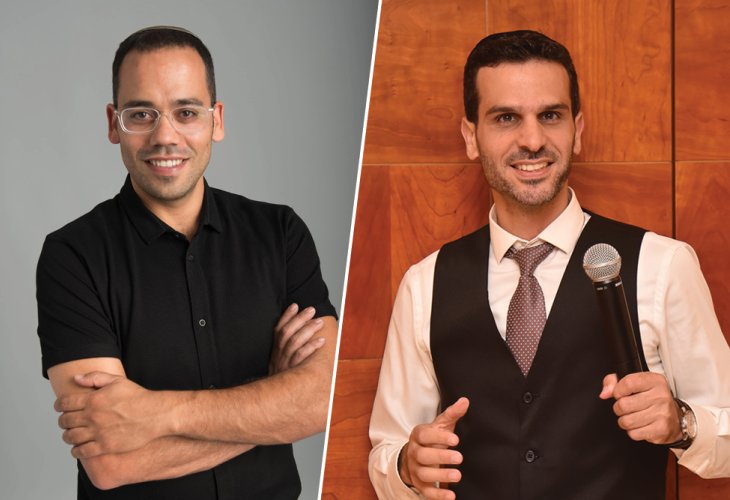 Mati Shriki and Assaf Shafir (Photo: Nati Gold)
Tens of millions of stutterers — including the writer of this article himself — carry an ongoing fear of humiliation during emotional speeches, difficult conversations, and even ordinary daily interactions.
Some people who struggle with speech fluency choose to hide from the spotlight and minimize speaking as much as possible. Others make the opposite decision entirely, and refuse to let stuttering define or silence them.
Among them are Israeli singer-songwriters Mati Shriki and Asaf Shefer, both respected performers who chose public careers despite the constant challenge of stuttering.
“I Started Stuttering at Age Four”
“Thank God, I’ve accomplished a lot in my life,” says Mati Shriki. “I’m married, a father of six, I live in Shvut Rachel, I’m a singer-songwriter, and I also work in graphic design and animation. But stuttering has been with me since childhood.”
Shriki says he began stuttering at age four, though he cannot say with certainty why it started.
“During a lecture I once gave,” he recalls, “someone suggested that it might be connected to a childhood incident where I ate another girl’s sandwich at a playground and she reacted by hitting me. Maybe it’s connected — after all, both eating and stuttering involve the mouth.”
Asaf Shefer, meanwhile, cannot pinpoint the source of his stutter.
“My difficulty with speech fluency began in kindergarten,” he says. “My parents took me to endless treatments — speech therapists, electrical therapies, speech institutes that tried to teach speaking techniques. We spent enormous amounts of money, but nothing really helped.”
Then, unexpectedly, things improved.
“At some point I realized that the soul itself doesn’t stutter,” he says. “And one of the ways the soul expresses itself is through singing. That realization shaped my entire life.”
The Teacher Who Changed Everything
One childhood memory remains especially powerful for Shefer.
“When I was in first grade,” he says, “my teacher — who obviously knew I stuttered, suggested that I sing solo at a school event.”
He was terrified.
“I was convinced I wouldn’t succeed because of the pressure and excitement. But the teacher believed in me so strongly that he planted confidence inside me.”
Eventually, Shefer stood before the crowd and sang alone.
“The audience was deeply moved,” he recalls. “And I still remember the tears of happiness running down my mother’s face.”
Looking back, he says the faith his teacher and parents had in him gave him the confidence to build a life around music.
One of the highlights of his career was releasing an album called Mizmor LeAsaf (“A Psalm for Asaf”). Over the years he has performed at countless events, often using music as a bridge connecting secular audiences to Judaism through warmth and joy.
The Mystery of Singing Without Stuttering
One of the greatest mysteries surrounding stuttering is that many people who stutter speak fluently while singing. Science still struggles to fully explain why this happens.
For many stutterers, singing becomes the one place where words flow freely and naturally.
Shriki’s connection to music began at age eight when he received a toy keyboard that was later replaced with a piano.
“I studied classical music from a young age,” he says. “I performed in concerts, and in yeshiva high school I started giving performances.”
He wrote his first song at age fifteen after a girl he knew died suddenly.
“Eventually I gathered enough courage to enter a recording studio and professionally record my songs,” he says. “When my first album was released four years ago, I felt like I was floating in the clouds.”
Since then, Shriki has performed extensively in Israel and abroad, won “Breakthrough Artist of the Year” from Radio Moreshet, and received an ACUM award for his debut album.
Turning an Obstacle Into a Gift
Remarkably, both artists say that stuttering ultimately shaped them in positive ways.
“Stuttering is a wall and an obstacle,” Shriki says. “But it exists so I can work to overcome it. And every time you overcome an obstacle, you reach a higher place. You discover light that was previously hidden.”
He explains that music, creativity, and songwriting became his tools for overcoming frustration.
“People don’t stutter while singing, and that is an incredible kindness from God,” he says.
He also believes that stuttering taught him the value of silence. “Our sages praise silence enormously,” he says. “And even though I didn’t choose it, stuttering forced me into silence many times. Sometimes silence is a tremendous gift.”
Shefer agrees that performing publicly gradually improved his speech fluency.
“I believe the many performances and successes strengthened my spirit,” he says. “And during performances, the stutter disappears entirely.”
The Pain Behind the Struggle
Despite their success, both singers speak openly about the pain stuttering caused them.
“Meeting new people, participating in discussions, even casual conversations, can still be difficult,” Shriki admits.
“If I get stuck somewhere in the street and need directions, I’ll often do everything possible to avoid asking someone.”
Shefer describes stuttering as a kind of disability.
“One time,” he recalls, “a couple wanted me to sing at their wedding ceremony. But after speaking to me on the phone, they became worried and asked if I’d be able to sing properly despite the stutter.”
Eventually, after watching videos of his performances, they relaxed and hired him.
“But yes,” he says honestly, “it wasn’t a pleasant experience.”
“I Never Hit Anyone Until That Day”
Shriki also remembers moments of cruelty during his teenage years.
“There was a boy in high school who constantly mocked my stutter,” he says. “Usually I ignored him.”
But one Shabbat during seudah shlishit, the boy publicly mocked him again in front of everyone.
“That time I snapped,” Shriki says. “I stood up and slapped him hard.”
Everyone was stunned — including Shriki himself. “I had never hit anyone before in my life.”
Yet after that incident, the bullying stopped.
“I Just Want to Bless God”
Perhaps the most emotional part of the interview comes when Shriki describes the private spiritual pain of stuttering.
“Sometimes I ask God questions,” he says quietly. “‘Why can’t I bless aloud? Make Kiddush? Receive an aliyah to the Torah? God, I just want to bless You.’”
Still, he says he has learned to accept both the strengths and the struggles God gave him.
“I’m learning to find the good even within the difficulties,” he says. “And to transform them into something that helps me grow.”
He believes that without stuttering, he might never have discovered music at all.
“What Truly Succeeds Comes From the Heart”
Toward the end of the interview, Shefer reflects on the deeper meaning of success.
“In today’s world,” he says, “there’s a huge temptation to compare yourself constantly to other artists.”
He mentions admiring performers like Yaakov Shwekey, Ishay Ribo, Ishay Lapidot, and Shuli Rand.
“But ultimately,” he says, “what truly succeeds is what comes from the heart, and what God wants to succeed.”
For Shefer, the real question is not fame or recognition.
“The most important thing,” he says, “is discovering what mission God wants from you in this world — and trying to fulfill it in the best way possible.”

