

Israel News
Internal Israeli Memo: Gaza Aid Flow Far Exceeds Need—and Boosts Hamas
Internal assessments warn that sending about 600 trucks a day overshoots basic humanitarian requirements; the surplus fuels smuggling, market control, and Hamas entrenchment.
- Yuval Aviv
- | Updated
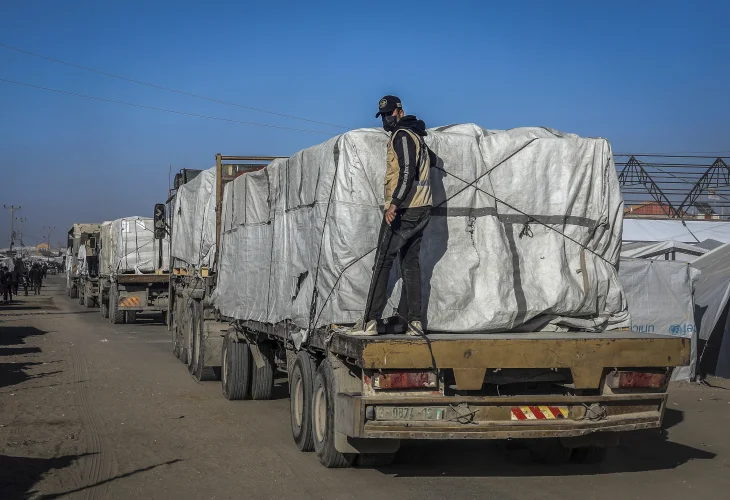 (Photo: Abed Rahim Khatib, Flash90)
Internal documents presented to Israel’s political leadership warn of serious consequences from continuing to let hundreds of aid trucks enter the Gaza Strip at today’s pace. IDF data say that bringing in roughly 600 trucks of aid and goods per day significantly exceeds actual humanitarian needs and creates security, economic, and strategic risks.
This morning (Tuesday), the "Israel Heim" website reported that a recent internal memo from the Coordinator of Government Activities in the Territories (COGAT), Maj. Gen. Yoram Halevi, told the political echelon that Israel is still allowing aid in these volumes mainly because of commitments made in a cease-fire agreement. However, according to UN assessments, as well as a professional study by COGAT in coordination with intelligence and international partners, Gaza requires about 250 aid trucks a day to meet basic humanitarian needs.
The memo says the gap between what is needed and what is actually entering is creating "significant surpluses" in the Strip, enabling Hamas to deepen its civilian and economic control.
According to the assessment, Hamas is systematically exploiting the aid to build up its power—taxing merchants, seizing goods, stockpiling food in the organization’s warehouses, attempting smuggling, and controlling distribution mechanisms and the local market. The document states explicitly that "every truck beyond the actual humanitarian need strengthens Hamas" by fostering economic dependence and tighter control over the population.
A separate Southern Command document, discussed in the Knesset, also highlights the scale of smuggling and warns this is not only about surplus aid fueling Hamas’s finances, but also the entry of materials that can be used to build explosives, along with dual-use machines and equipment, and large quantities of generators.
Security officials also see other vulnerabilities not directly tied to the truck crossings. According to the report, drones are being smuggled from Egypt and from Israel into the Strip—carrying drugs and weapons—alongside fence-crossing smuggling by criminal actors. In recent days, the IDF asked the police for help stopping drone smuggling after giant drones were spotted crossing into Gaza carrying drugs.
Last week, Minister Orit Strock toured the Kerem Shalom crossing and saw the scale of smuggling attempts up close. According to her, crossing personnel found tobacco hidden in tea sachets, machine oil concealed in regular cooking-oil bottles, and glycerin disguised in water bottles. Screening does catch a significant portion of smuggling attempts, but open questions remain about many materials beyond tobacco, as well as how drivers, trucks, and the factories shipping the smuggled goods are being handled. Strock is expected to raise the issue with the cabinet.
The matter has already been brought to the prime minister and a small ministerial team. Following the information, the prime minister instructed on Tuesday evening to reduce the number of trucks in line with the recommendations. However, before that directive was implemented, he announced the next morning that the aid should continue at the regular volume.
Senior officials believe U.S. pressure drove the decision to keep the current levels, even though the data presented showed that during a period when aid volumes dropped to 250 trucks due to operational constraints, humanitarian needs were fully met.

