

Relationships
Two Myrtle Branches and the Secret to Stronger Relationships
How choosing to see the good in others can transform marriages, families, and everyday life
- Dr. Yaakov Aranberg
- | Updated
After twelve years hidden inside a cave, Shimon bar Yochai and his son Eleazar ben Shimon finally emerged back into the world. But something inside them had changed.
The Talmud describes how their eyes burned whatever they looked at. Their intense spiritual state made ordinary life seem unbearable. Because of this, they were sent back into the cave for another year.
When they emerged a second time, Rabbi Shimon healed whatever his son damaged. Yet even then, their minds were still unsettled.
And then something small, almost insignificant, happened.
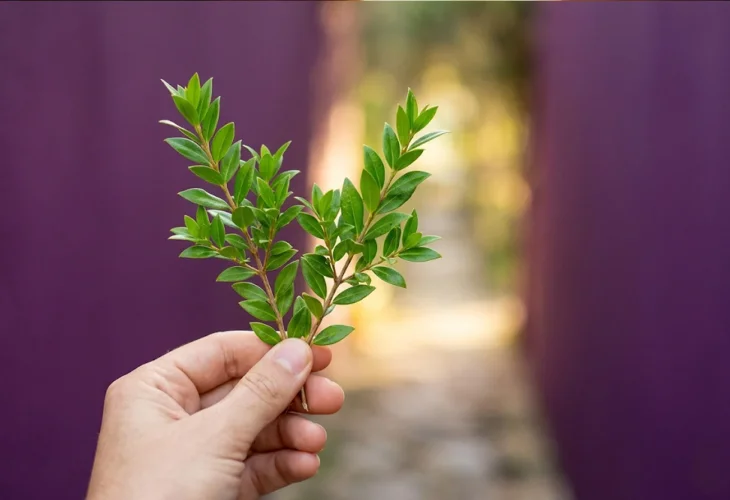
An elderly man came running on Friday evening carrying two myrtle branches in honor of Shabbat. Rabbi Shimon and his son asked him why he needed two branches.
The man answered simply: “One corresponds to ‘Remember,’ and one corresponds to ‘Observe.’”
The Talmud then says something remarkable: “Their minds were put at ease.”
What Finally Brought Rabbi Shimon Peace?
Rabbi Shimon bar Yochai was one of the greatest sages in Jewish history, associated with the revelation of the Zohar and some of the deepest spiritual teachings ever brought into the world.
What finally calmed him?
Not a miracle, a heavenly vision or a dramatic revelation.
Just a simple elderly Jew running joyfully toward Shabbat with two small branches in his hands.
A quiet act of love.
A moment of connection.
A person living his values with warmth and sincerity.
Rabbi Shimon himself once taught: “Everything depends on love.”
Perhaps that is exactly what he recognized in that elderly man: a human being who looked at the world through the lens of love.
Two Myrtle Branches, Two Eyes That See Good
There is a beautiful symbolic idea hidden inside this story.
The leaves of the myrtle branch resemble small eyes — soft, oval, green eyes.
Perhaps the two myrtle branches symbolize two eyes that choose to see goodness.
Rabbi Shimon emerged from the cave with eyes that burned the world around him. He saw flaws, emptiness, and spiritual failure. But then he encountered someone whose entire way of living reflected a different perspective — someone who saw holiness in simple acts and love in everyday life.
The elderly man did not preach. He did not argue theology or philosophy. He simply demonstrated what it looks like to live with joy, connection, and appreciation.
And perhaps that is the lesson every one of us is expected to carry into daily life. To wake up each morning holding two figurative myrtle branches: one eye searching for the good in a spouse, and the other searching for the good in children, coworkers, friends, and the world itself.
The Small Gestures We Stop Seeing
Again and again, especially in relationships, people stop truly seeing one another. Not because love necessarily disappeared, but because attention disappeared.
People wait for dramatic moments while overlooking the “two myrtle branches” hidden inside ordinary life: a gentle “good morning,” a cup of coffee brought without being asked, someone quietly preparing dinner, a thoughtful gesture at the end of a long day. These are small acts that are actually very large.
Real Change Begins With the Way We See
In relationships, the person who truly changes the atmosphere is usually not the one trying to change their spouse.
It is the one willing to change themselves: the way they see, the words they choose, and the energy they bring into the relationship. Surprisingly, that often transforms the other person as well.
When someone walks through life carrying “two myrtle branches,” people around them feel it.
The elderly man in the Talmudic story had no idea he was changing Rabbi Shimon’s life. He simply loved. He simply ran toward Shabbat. He simply lived his values quietly and joyfully.
Real influence is not lectures, criticism, or dramatic speeches, but a warm presence that illuminates others.
The Invitation of Lag BaOmer
Lag BaOmer is more than a memorial day for Rabbi Shimon bar Yochai.
It is an annual invitation to ask ourselves: What are my “two myrtle branches” in everyday life? And to whom am I bringing them?
Every person who chooses connection over anger, kindness over criticism, and the search for goodness over negativity becomes, in a sense, that elderly man carrying myrtle branches into the world.
And there is no way to know whose life may be transformed because of it.

