

Magazine
A Love Letter to Jerusalem
Through war, longing, and ordinary mornings, the eternal city reveals why Jerusalem is far more than a place to live
- Rachel Wigman
- | Updated
It was early spring in 1967 when Rabbi Alexander and Mrs. Marga Carlebach set out from their home in England to move to Israel. Their two daughters were both adults, studying in university, and it was time to fulfill a lifelong dream of Rabbi Carlebach’s. They had hardly settled into their apartment on Betzalel Street in Jerusalem when the calendar flipped to June.
On June 5, Israel kicked off what would come to be known as the Six-Day War with a preemptive strike against the Egyptian Air Force, following escalating tensions in the region. Stunningly, miraculously, the strike was an unmitigated success, and most of Egypt’s air force was destroyed before it could begin to think about mobilizing. Two days later, halfway through this war, IDF paratroopers entered the Old City of Jerusalem, recapturing the city that was the beating heart of the Jewish people for thousands of years.
Motte Gur, a commander in the paratroopers, unknowingly radioed what would become one of the most iconic sentences in modern Israeli history: “Har Habayit beyadenu! The Temple Mount is in our hands!” Fifty-nine years later, it continues to stir the soul, with the emotion bound up in that moment breaking through the bonds of time such that we can still feel the joy—and wonder—as the young Israel Defense Forces recaptured its ancient capital city.
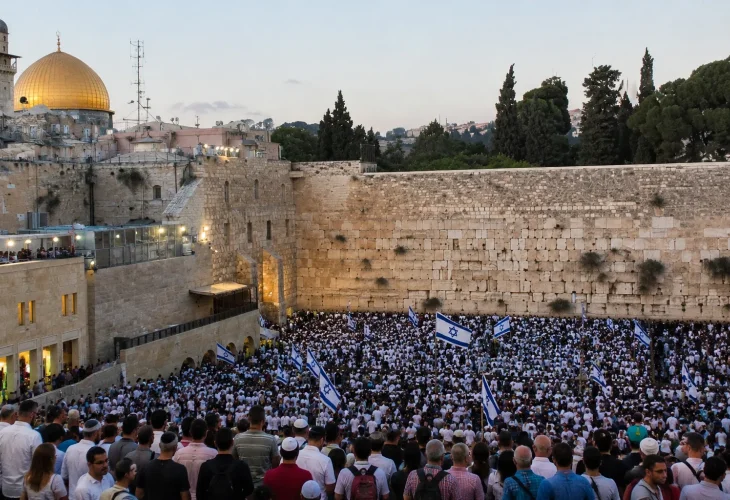
And then a week later was the holiday of Shavuot. The war, by now, was over; it was clear that Israel had brilliantly won against enemies who, by all rights, should have been able to wipe Israel off the map. And in the euphoria of the victory, in the euphoria of a newly reunited Jerusalem, that Shavuot morning, Rabbi and Mrs. Carlebach, together with what felt like the entire city, streamed down to the Western Wall. There was no advanced coordination; there was no need for crowd control. There were just endless streams of people who didn’t know what else to do with themselves and so they answered the magnetic pull of the ancient wall that had been empty for the last nineteen years.
In the years since 1967, Jerusalem has veritably exploded, with new neighborhoods constantly being built, continuous road and infrastructure work, major archeological finds, and a population that does not stop growing as more and more people choose to live in this beautiful city. And every year since 1967, on the anniversary of the reunification of Jerusalem (28 Iyar), the city has stopped to celebrate, as we will do this week, with a joy that knows no bounds, that the heart of the Jewish people is once again whole.
Personally, I’m not much of a city girl. I grew up in a suburban area, and I really, really like having trees and grass and flowers and sky. But Jerusalem? She holds a special place in my heart. Shortly before my husband and I got engaged, he took me to a fire tower where we could see for miles, including the Jerusalem skyline in the distance. I told him then that Jerusalem would forever be my first love, and he has to be okay with coming in second. (I’ve since told him I love schnitzel more than him, though, so take that with a grain of salt.) But he was more than okay with it because, frankly, he felt the same. Rabbi and Mrs. Carlebach were his great-grandparents. Fifty years later, he actually lived in the same building as they had when they made aliyah.
We are incredibly blessed to live in Jerusalem. I feel it every day when I walk the streets. I feel it when I go running in the mornings, when we go for a walk on Shabbat, when I take the bus to work, when we go grocery shopping. Mundane life is elevated by the simple virtue that we live in Jerusalem.
It’s not something I take for granted, as I think about my own great-grandmother who would have given anything to be able to call Jerusalem home. I think about the two-thousand year journey that we took as a people before we made it back, about the heartbreak of 1948, when Jerusalem found itself divided between Israel and Jordan, with the Temple Mount and the Western Wall weeping, weeping at night, with no one to comfort her from all of her loved ones, to quote Jeremiah (Lamentations 1:2). I think about the ecstasy of 1967, about the healing for the Jewish people as Jerusalem, our heart and soul, was once again made whole.
And I cannot believe that I am so lucky, so unbelievably lucky, that I have the privilege of living here.
Of course, Jerusalem is still a regular city. Traffic can be a nightmare. Israelis are notorious for honking incessantly when they get impatient, which happens all too often. Some neighborhoods could use more green. Others could use more beautiful architecture. But beauty is not to be found in scrutinizing every small detail. Beauty is found when you zoom out, when you see a city with a soul so ancient that the city has a syndrome named after it, when you see the lifeblood that pulses through her and how that spreads beyond her city limits.
Our Jerusalem of gold, she is beautiful. She is the harp to all of our songs, and she continues to pluck at our heartstrings in a way that only she can do. And whether, like me, you are lucky enough to live here or not, she is—as she always was, as she always will be—home.

