

World News
Tens Of Thousands Fill London Streets In Rival Nationalist And Pro-Palestinian Marches
Tommy Robinson supporters and Nakba Day demonstrators rallied across central London under one of Britain’s largest policing operations in years
 Shutterstock
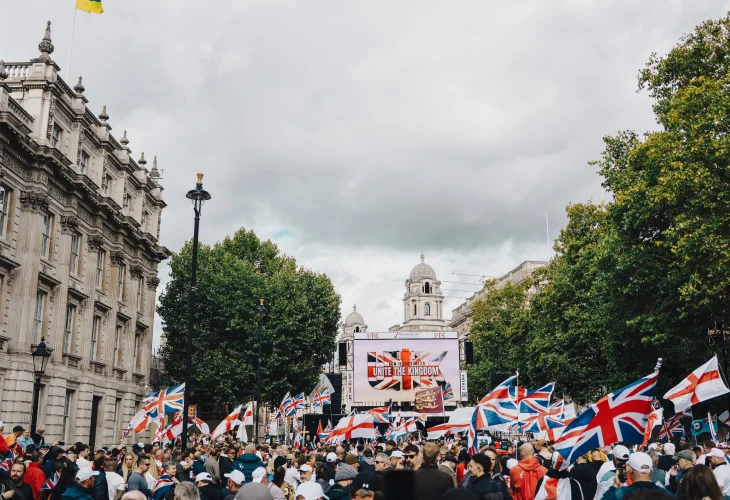
Tens of thousands of people filled the streets of central London on Saturday as rival nationalist and pro-Palestinian movements held massive demonstrations under a heavy police presence designed to prevent clashes between the groups.
One march was the “Unite the Kingdom” rally led by far-right activist Tommy Robinson, while the second was a large pro-Palestinian Nakba Day demonstration that drew left-wing activists, anti-Israel protesters and anti-fascist groups. More than 4,000 Metropolitan Police officers were deployed across the capital, alongside drones, police horses, dogs and armored vehicles.
Supporters of Robinson’s rally protested against immigration, the British government and what they described as the erosion of British identity and culture, while the pro-Palestinian march focused on the war in Gaza, support for Palestinians and opposition to Britain’s far right.
The demonstrations became one of Britain’s largest public-order operations in recent years and highlighted growing political polarization in the country around immigration, nationalism, Islam, Gaza and identity politics. British authorities also barred 11 foreign nationals described by the government as “far-right agitators” from entering the UK ahead of the rally.
Prime Minister Sir Keir Starmer condemned the Unite the Kingdom march before the demonstrations began. “We’re in a fight for the soul of this country,” Starmer said. “Its organisers are peddling hatred and division, plain and simple.”
Robinson, whose real name is Stephen Yaxley-Lennon, is the founder of the anti-Islam English Defence League and has become one of Britain’s most recognizable anti-immigration figures. His supporters gathered in Kingsway before marching toward Parliament Square carrying Union flags and St. George’s crosses, with some wearing red “Make England Great Again” hats.
Many demonstrators chanted “we want Starmer out,” while speakers accused Britain’s political establishment of failing to control immigration and protect national identity.
Addressing the crowd, Robinson urged supporters to move beyond protests and become politically active ahead of the next British election. “Are you ready for the battle of Britain?” Robinson told the crowd. “2029 we have an election.”
He also led chants thanking billionaire Elon Musk, who has publicly amplified content linked to Robinson and previously supported Unite the Kingdom events on his social media platform X.
Other speakers at the rally included former media personality Katie Hopkins, actor-turned-political activist Laurence Fox and television personality Ant Middleton. Anti-extremism organization Hope Not Hate said the turnout appeared lower than Robinson’s September rally last year, which police estimated drew around 150,000 people. Police estimated Saturday’s turnout at roughly 60,000.
The separate pro-Palestinian demonstration began in Kensington before marching toward Waterloo Place. Organizers said the rally marked what Palestinians call Nakba Day, their term for the displacement of Palestinians during the 1948 war surrounding Israel’s establishment.
The march also positioned itself as opposition to Britain’s far right. Demonstrators carried Palestinian flags and anti-fascist signs reading “smash the far right,” while many participants wore keffiyehs as symbols of solidarity with Palestinians.
Speakers included former Labour Party leader Jeremy Corbyn, veteran left-wing MP Diane Abbott, Labour MP Apsana Begum and left-wing politician Zarah Sultana.
Abbott told demonstrators that the far right represented a “common enemy.” “We have to come together… to fight the racists, to fight the fascists, to fight the antisemites,” she said.
Police established a “sterile zone” between the rival marches and imposed strict timing restrictions to prevent the groups from meeting directly. Authorities also used live facial recognition cameras at major train stations for the first time during a protest policing operation.
Police said 43 arrests had been made connected to the demonstrations. Four officers were assaulted and another six officers were subjected to hate-crime offenses, according to the Metropolitan Police.
Despite the scale of the operation and fears of violence, police said both demonstrations proceeded “largely without significant incident.”

