

History and Archaeology
From Neglect to Renewal: The Mount of Olives in Modern Times
The Mount of Olives has stood at the heart of Jewish longing for thousands of years. Discover the story of its destruction, desecration, and remarkable restoration in more recent times.
- Yehosef Yaavetz
- | Updated
The prophet Zechariah describes an awe inspiring vision of the future redemption:
“And His feet shall stand on that day upon the Mount of Olives, which is before Jerusalem on the east, and the Mount of Olives shall split in half…”
According to Pesikta Rabbati, this moment will mark the beginning of the resurrection of the dead. The earth will open, and the departed will rise once again.
For thousands of years, the Mount of Olives has held a uniquely sacred place in Jewish history and longing. It is a site connected to prophecy, the Divine Presence, the Beit HaMikdash, and generations of Jewish burial. Yet alongside its holiness, the mountain also endured decades of destruction and desecration before slowly being restored in modern times.
The Ancient Importance of the Mount of Olives
The Mount of Olives appears already in the days of King David.
When fleeing from his son Absalom, the verse says:
“He went up by the ascent of the olives, weeping, with his head covered.”
The mountain is also connected to what Chazal called “the Mount of Anointing,” likely because of the many olive trees that once covered its slopes and produced olive oil used for sacred purposes.
Chazal describe the mountain as a flourishing and holy place. The Jerusalem Talmud even mentions special cedar trees on the Mount of Olives where countless birds nested, enough to provide offerings for all of Israel.
The mountain also played a central role in Temple service. It was there that the priest would burn the red heifer in order to prepare the ashes used for purification from ritual impurity connected to the dead.
Later, before the destruction of the Second Temple, Titus established his camp on the summit of the Mount of Olives during the Roman siege of Jerusalem.
Where the Divine Presence Rested
The prophet Ezekiel describes that after the destruction of the Temple, the Divine Presence departed from the Temple Mount and rested upon the Mount of Olives.
Because of this, an ancient custom developed in the Land of Israel to gather there during the festivals and pray while facing the site of the Holy of Holies.
Special blessings were recited there for supporters of the yeshivot in the Land of Israel, and their names were publicly mentioned during the prayers.
Why So Many Jews Wanted to Be Buried There
More than anything else, the Mount of Olives became identified with Jewish burial.
Based on the teaching in Pesikta Rabbati that the resurrection of the dead will begin there, generations of Jews longed to merit burial on the mountain and be among the first to rise at the coming of the final redemption.
Over the course of two thousand years, tens of thousands of Jews were buried there.
Among the many great Torah figures buried on the mountain are:
- The Ramban
- Rabbi Ovadia of Bartenura
- Rabbi Yehuda HeChasid
- Rabbi Chaim ben Attar, the Or HaChaim
- The author of Pri Chadash
- Rabbi Shalom Sharabi
- Many other towering sages of the Jewish people
The Destruction Under Jordanian Rule
After the establishment of the State of Israel, the Mount of Olives remained under Jordanian control.
During those years, systematic destruction took place across the ancient cemetery on a shocking scale.
Residents of western Jerusalem would stand at the armistice line and look toward the mountain through binoculars, unable to reach the graves of loved ones and ancestors. From a distance, they could already see areas that appeared destroyed, flattened, and desecrated.
Despite agreements promising access to holy sites, Jews were effectively prevented from visiting the mountain.
At the same time, gravestones were uprooted and used as paving stones and building materials. Entire sections of the cemetery were leveled. Roads were paved through burial areas, and the Intercontinental Hotel was built on top of destroyed graves near the summit.
After the Six Day War, reports estimated that roughly 38,000 gravestones had been damaged, many of them completely destroyed.
Beyond the terrible desecration itself, many burial records were also lost, making it difficult for families to even identify where relatives had been buried.
The Long Restoration of the Mountain
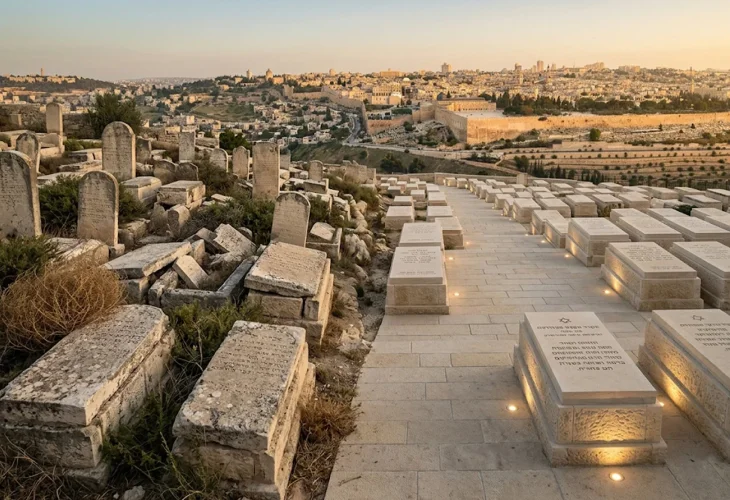
When the Mount of Olives returned to Israeli control after the Six Day War, restoration work slowly began.
The process took years and was complicated by ongoing vandalism and neglect in the area. But gradually, graves were repaired, records reconstructed, and security strengthened.
Today, visitors can once again locate family graves using digital records and databases.
On special occasions, such as the yahrzeit of the holy Or HaChaim, thousands of Jews fill the mountain’s narrow paths. The area is illuminated, secured, and filled with prayer once again.
A Place Bound to Redemption
The Mount of Olives is far more than an ancient cemetery.
It is a place woven deeply into Jewish memory, prophecy, longing, and hope.
For centuries, Jews dreamed of being connected to this mountain because they believed it would play a central role in the future redemption itself.
And just as the mountain has already experienced a small measure of restoration after years of destruction, may we soon merit the complete redemption foretold by the prophets, beginning there on the Mount of Olives.

