

Parashat Terumah
The Mishkan as a Miniature World: A Reflection of Creation
The Torah’s description of the Mishkan reveals a powerful parallel to creation, reflecting Divine order, balance, and the structure of the human soul.
- Yehosef Yaavetz
- | Updated
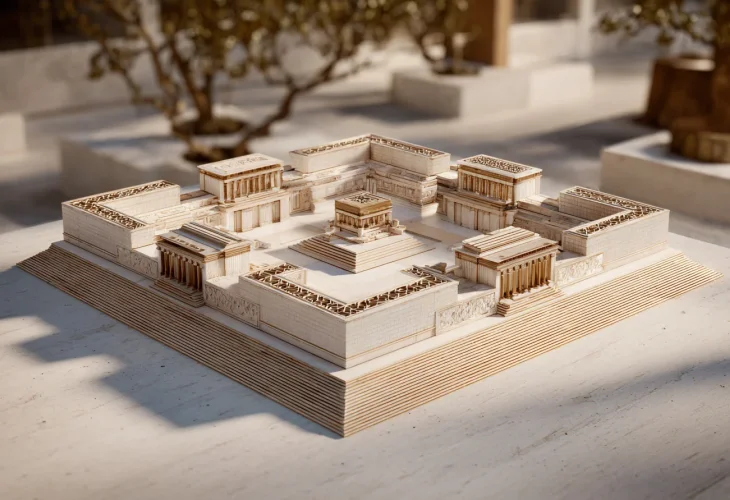
The Torah’s description of the Mishkan teaches us something remarkable: the Mishkan was not only a holy structure, but a miniature model of the world itself.
Just as Hashem created the world in a carefully ordered way in order to place humanity within it, the Jewish people built the Mishkan in a similarly precise way in order to create a place for the Divine Presence to dwell. The parallels between the creation of the world and the construction of the Mishkan appear throughout the Torah and reveal a deep spiritual idea about creation, order, and the human soul.
Creation and the Mishkan Were Both Built With Purpose
The world was created through speech. Hashem spoke, and creation came into existence according to a clear plan and structure.
Again and again in the story of creation, the Torah repeats phrases such as “And God said,” “and He made,” and “and it was so.” Each stage unfolds with intention, action, and completion.
The same pattern appears in the portions describing the Mishkan. The Torah repeatedly says: “And they shall make,” “and he made,” and “as Hashem commanded.” These repeated phrases emphasize that the Mishkan was not built randomly or artistically according to personal taste. Every detail followed a precise Divine design.
A World of Order and Balance
The Torah describes creation as a world built with boundaries, structure, and balance. The heavens, the earth, the stars, time, seasons, light, and water were all placed in their proper roles and limits.
Today we call these patterns the laws of nature.
The Mishkan reflects this same idea on a smaller scale. Every measurement was exact. Every vessel had a specific location. Every action was performed in a precise manner and at a designated time.
Nothing in the Mishkan was accidental.
The Mishkan as a Picture of the Ideal World
The world we experience today often feels chaotic. There is noise, imbalance, conflict, and disorder. According to the Torah, this confusion entered the world after the sin of Adam HaRishon.
The Mishkan presents a different picture: the world as it was originally meant to be.
It is a world where everything stands in its proper place and where physical life, action, spirituality, and thought exist together in harmony. In this sense, the Mishkan becomes a model for the kind of world humanity should strive to rebuild.
By studying the Mishkan, a person learns what a balanced and spiritually ordered life can look like.
The Completion of Creation and the Completion of the Mishkan
At the end of creation, the Torah says:
“Thus the heavens and the earth were completed, and all their array.”
At the completion of the Mishkan, the Torah similarly says:
“And all the service of the Tabernacle, the Tent of Meeting, was completed.”
In both cases, the Torah describes the completion of an entire system in which all parts come together to form one complete whole.
The similarities continue.
After creation, the Torah says:
“And God saw all that He had made, and behold, it was very good.”
After the Mishkan was completed, it says:
“And Moses saw all the work, and behold, they had done it as Hashem had commanded.”
In both stories, there is a final act of looking over the completed work and seeing that the result perfectly matched the original plan.
Blessing Comes After Completion
Both creation and the building of the Mishkan conclude with blessing.
After creation, Hashem blesses the seventh day. After the Mishkan is completed, Moshe blesses the people.
The blessing comes only after the work reaches completion. Once harmony and order are established, blessing can rest upon them and allow them to continue and endure.
Creation ends with the sanctification of time through Shabbat. The Mishkan ends with the sanctification of space through the resting of the Divine Presence.
The Human Being as a Miniature World
Why is all this important?
Because the Torah teaches that the human being is also a miniature world.
When we look around us, it is often difficult to recognize order because the world contains so much confusion and brokenness. The Mishkan helps us remember that beneath the chaos, there is still a Divine structure and purpose.
The Mishkan also teaches a person how to understand himself.
Entering the Mishkan was, in many ways, like entering the inner structure of the human soul.
The outer courtyard, filled with activity and action, reflects the practical world of daily life. The inner sanctuary, separated and holier, reflects the inner world of values, spirituality, and deeper thought.
The Meaning Behind the Vessels of the Mishkan
Each vessel in the Mishkan carried symbolic meaning connected to a different area of life.
The menorah represented light, wisdom, clarity, and steadiness of thought.
The table represented material existence, nourishment, and abundance in a balanced and elevated form.
The altar represented ongoing action and spiritual movement carried out within an orderly system.
Together, the vessels created a complete structure in which physical and spiritual life existed side by side in harmony.
Living With Divine Order
The connection between the Jewish people and the Mishkan teaches us to recognize the order and purpose hidden within creation.
It reminds us that life is not random.
Every detail has meaning, and every part of existence has a proper place and balance. The more humanity lives according to the Divine structure revealed through the Torah, the more the world itself can return to the harmony and order that existed at the time of creation.

