

Faith (Emunah)
WiFi to Hashem: The Tzitzit Stories Defining This Generation
From a tattooed waiter in Bnei Brak to a baal teshuvah actor in Mexico, these unforgettable stories reveal a generation searching for connection.
- Efrat Barzel
- | Updated
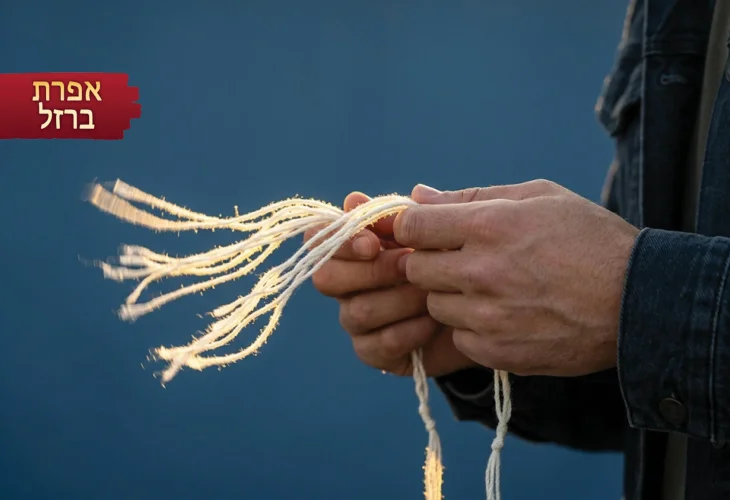
The wave of stories surrounding tzitzit among soldiers, yeshiva students, and Jewish men from every background reveals something deeply moving about the connection between a Jewish man and his Creator.
We often speak about women’s spiritual heroism, about modesty, head coverings, and the journeys women take upon themselves. But men, too, carry hidden stories of faith, process, longing, and sacred clothing.
And sometimes, all of that is wrapped inside a few simple white strings.
The Waiter With the Tzitzit
One weekday afternoon, my husband and some of my children went to eat at a hamburger place in Bnei Brak.
I was not there myself, but they came home glowing with excitement and immediately started telling me “tzitzit stories.”
“There was a completely secular waiter,” they said. “Covered in tattoos. No kippah. But he had very visible tzitzit hanging out.”
Honestly, I smiled.
That really is the look of this generation.
But the story did not end there.
My son Yehali said that when his sandwich arrived, loaded with meat, onions, lettuce, tomatoes, ketchup, and mayonnaise, he got up to wash his hands before eating bread.
As he filled the cup and began washing, he suddenly noticed the waiter staring at him intently.
Yehali poured water over his right hand.
Then his left.
And the waiter kept watching closely.
Finally he asked:
“What is that? What are you doing?”
Yehali motioned:
“One second, one second…”
He finished washing, returned to the table, and began explaining that before eating bread, Jews perform ritual hand washing.
The waiter became fascinated.
He kept asking questions:
How exactly do you do it?
What comes first?
How do you pour the water?
What are the rules?
“No kippah, but yes netilat yadayim?” I found myself thinking afterward.
And honestly, I understood it deeply.
Because this generation often stands before Judaism like people standing before an open buffet of spirituality, searching, tasting, trying to understand exactly where they belong.
“I Wear Tzitzit Because I’m a Jew”
On Shabbat we shared the story with our old friend Jacques Winitsky, the father of our daughter in law Eliana.
Winitsky himself became a baal teshuvah many years ago. Today he is a successful architect responsible for some of the most beautiful villas in Israel, but he grew up as a completely secular teenager in Mexico.
And suddenly, hearing the story, he became emotional too.
“When I first started becoming religious,” he told us, “I also walked around without a kippah.”
At the time he was a young theater actor. He once received a role in the play Yentl, based on the work of Isaac Bashevis Singer.
For the role, he had to wear tzitzit as part of the costume.
“When the play ended,” he said, “I went out to eat with my father and brother. I had no kippah on. The tzitzit were hidden underneath my shirt."
“Officially they were still just part of the costume."
“But inside, I already knew the truth."
“They were mine."
“They were my private connection with the Creator of the world.”
Then he smiled sadly.
“My father suddenly looked at me and asked:
‘What do you have under your shirt?’"
“I said:
‘Nothing. Just an undershirt.’"
“‘And under the undershirt?’" he asked.
“And at that point I couldn’t hide it anymore.”
So he pulled out the tzitzit and showed him.
“I wear tzitzit, Dad,” he said quietly.
“‘Oh,’ my father asked, ‘is that because of the play?’"
“‘No,’ I answered him.
‘It’s because of me.
And because I’m a Jew.’”
“It’s WiFi to Hashem”
Winitsky told us another story.
Not long ago, while traveling in Dubai, an Iranian man noticed his tzitzit and asked:
“What are those strings the Jews wear?”
Winitsky answered him instantly:
“It’s WiFi to Hashem.”
And honestly, I cannot think of a more accurate description.
A Generation Asking to Understand
Meanwhile, back in the hamburger place, the waiter continued asking Yehali question after question about ritual hand washing.
There is something extraordinary about this generation.
It is a generation of:
“Na’aseh v’nishma.”
Tell us what Hashem wants from us.
Explain the details.
Teach us exactly how to do it.
Not approximately.
Not emotionally.
Exactly.
And perhaps that itself is one of the most moving signs of all.

