

Faith (Emunah)
The Power of Peace: The Decision That Saved Our Family
A powerful true story about family tension, choosing peace over pride, and the moment one act of giving in may have saved an entire family.
- Inbal Idan
- | Updated
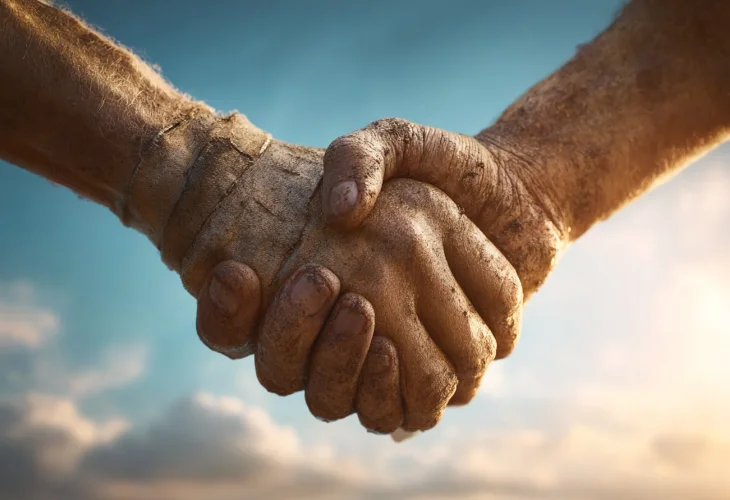
If there was one value my father lived by more than anything else, it was peace. Not peace spoken about dramatically or preached constantly, but peace lived quietly through personal example. My father was not a man of many words. He taught us mostly through the way he behaved: by giving in, staying silent when necessary, and constantly choosing unity over ego.
And anyone who has ever truly tried to live that way knows how difficult it is. Giving in is not natural for people. It requires strength, patience, humility, and endless work throughout life.
After My Father Passed Away
After a long period of suffering and illness, my father returned his soul to his Creator. Even when a family emotionally prepares for such a moment, nothing truly prepares you for the emptiness that follows. A father is a father.
And once the central figure holding the family together is gone, maintaining peace and unity suddenly becomes far more fragile.
My father passed away during the month of Nisan. According to custom, we do not visit cemeteries during Nisan itself, so every year our family would visit his grave on the eve of Rosh Chodesh Nisan instead. But this year, something unexpected happened.
The Brother Who Chose a Different Path
All of us siblings are more or less similar in outlook and lifestyle. Except for my brother Moishy.
Over recent years, Moishy slowly began following a somewhat different spiritual direction. It began quietly, listening to Torah classes from circles different from the one we grew up in. Then his style gradually changed too.
He remained fully observant, careful with mitzvot in every sense. But still, for a deeply rooted family with generations of Torah heritage behind it, watching someone move toward a different path is not always easy.
There were whispers sometimes. Comments. Difficult adjustments. But we tried very hard to preserve peace, because despite the differences, Moishy himself had not changed. The soul inside him remained exactly the same.
The Request That Created Tension
A major part of Moishy’s new spiritual world revolved around a learning group he had become deeply connected to.
This year, shortly before the family cemetery visit, he called me with a request: could we move the visit up by one day?
Why? Because on the original day, he wanted to participate in a special tikkun his group was organizing for our father.
At first I wanted to explain why the custom is specifically to visit on the eve of Rosh Chodesh. But then I stopped myself, because deep down, I already understood that this was not really about halachic explanations anymore.
This was about something much deeper: how far are we willing to go to preserve peace inside a family?
What Would My Father Have Wanted?
I found myself standing at a crossroads.
On one side stood the family custom and the wishes of most of the family. On the other side stood my brother, sincerely wanting to honor our father in the way that made sense within his own spiritual world.
I knew that if we refused, there was a good chance Moishy would not come with us at all. And even if he did, hurt feelings and tension would follow afterward.
I also knew something else: if I began opening the discussion widely, emotions would explode. People would become offended, angry, defensive. The atmosphere would become poisoned.
And suddenly I asked myself one simple question: what would my father want?
The more I thought about it, the clearer the answer became. Above everything else, my father would want peace. He would rather lose the argument than lose unity between his children.
And once I understood that, the decision became easy.
I informed the family that we were moving the visit up by one day.
The Day Everything Became Clear
That year, Israel was in the middle of the war. Missiles. Sirens. Fear everywhere.
We arrived at the cemetery as a large family group through a side entrance near the fence. As soon as we arrived, two desperate brothers approached us asking for help completing a minyan for their father’s grave. For years, they told us, they had not managed to gather enough people.
And there we suddenly were, sent to them exactly when they needed us. That alone already felt meaningful.
Afterward, while we were praying at my father’s grave, a siren suddenly went off. There was no nearby shelter where we stood. We lay flat on the ground with our hands over our heads while interceptions exploded above us.
It was frightening. But eventually everyone got home safely.
And I remember thinking: at least we passed through all of this peacefully, without arguments or resentment.
The Missile That Fell the Next Day
The following day, at the exact same time we had originally planned to be at the cemetery, a cluster missile struck right near my father’s grave.
A friend later sent me a photograph. I was shaken.
If we had arrived on the original day, as planned, most of the family would likely have been standing there at that exact moment. And from where we had entered the cemetery, we would not even have known where the protected shelter was located.
I sat there stunned, because suddenly the entire story looked different.
You Never Lose by Giving In
For me, that moment became holy.
Because somehow, through one painful act of giving in, through choosing peace over correctness, an entire family received life as a gift.
This time, Moishy was the messenger. And I truly believe my father was advocating for us in Heaven. The merit of peace stood by us.
People often think that giving in means losing. But sometimes giving in saves things we cannot even measure: relationships, families, souls, and sometimes perhaps even lives themselves.
You never truly lose by choosing peace. The gain is far beyond anything we can calculate.

