

History and Archaeology
The “Cursed” Jerusalem Building That Hid a Terrifying Secret
A fascinating look at the isolated compound that terrified residents for decades and the doctors who changed its story forever.
- Yehosef Yavetz
- | Updated
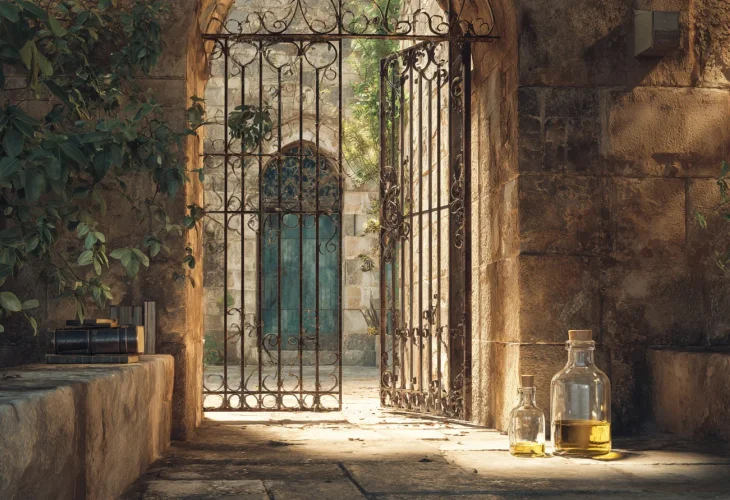
In the heart of Jerusalem’s beautiful Talbiya neighborhood, on what is now Gedaliah Alon Street, stands a large stone building hidden behind thick walls and an old iron gate.
For decades, almost no movement could be seen inside the compound. The shutters remained half closed, the courtyard stayed hidden behind high walls, and only occasionally could faint sounds be heard from within. Residents of the growing neighborhood began whispering stories about the mysterious structure. Many referred to it simply as “the cursed house” and avoided going near it.
The reason behind the fear was chilling: beginning in 1887, the building served as Jerusalem’s hospital for leprosy patients.
The Disease That Terrified the World
Before the hospital was established, people suffering from leprosy lived in isolated huts near Zion Gate and in parts of the Kidron Valley around Jerusalem. German donors later funded the construction of the hospital in Talbiya, and it quickly filled with patients from across the region.
At the end of the 19th century, leprosy was one of the most feared diseases in the Middle East and around the world. Known medically today as Hansen’s disease, after Norwegian physician Gerhard Armauer Hansen who identified the bacteria causing it in 1873, the illness was long considered incurable.
Patients often developed light or reddish skin patches and gradually lost sensation in different parts of the body. As the disease progressed, nerve damage could lead to paralysis and severe deformities in the hands, feet, and face. But beyond the physical suffering came something equally painful: isolation.
The Patients the World Avoided
In many societies, people with leprosy were treated as complete outcasts. Families often distanced themselves from infected relatives, and some patients were forced to leave their homes entirely. Many lived in near total isolation from the outside world.
The Jerusalem hospital became known as Hansen House, named after Hansen himself. The compound’s high walls were designed not only to prevent feared contagion, but also to hide the patients from public view.
Inside lived Muslim Arabs, Christians, and Jews together, all separated from the rapidly developing city surrounding them.
Meanwhile, Talbiya itself became one of Jerusalem’s most elegant neighborhoods, filled with impressive stone homes, trees, and quiet streets. But in the center of it stood the mysterious walled compound from which patients with bandaged faces or visible deformities would occasionally emerge. For local children, the place became the source of endless frightening stories.
The Truth Behind the Walls
Despite the terrifying rumors, life inside the compound was mostly quiet and deeply sad. Many patients remained there for years, some for the rest of their lives, while doctors struggled to understand the disease and search for effective treatment.
Then, in the second half of the 20th century, everything began changing.
The Doctor Who Challenged the Fear
One of the central figures in transforming attitudes toward Hansen’s disease was Dr. Moshe Goldgraber, who worked and even lived inside the Jerusalem compound with his family.
Goldgraber became convinced that the disease was far less contagious than people had feared for generations. His willingness to live among the patients became a powerful statement against the stigma surrounding them. He worked tirelessly not only to treat patients medically, but also to change society’s attitude toward them.
The Cure That Changed Everything
Another major breakthrough came through physician Yaakov Sheskin, who worked inside Hansen House.
In 1964, Sheskin helped develop an effective treatment for Hansen’s disease using thalidomide, dramatically changing the future of patients suffering from the illness. Patients who once expected lifelong isolation were finally able to recover and return home.
The hospital continued operating for several more decades while treating remaining cases, but eventually Hansen’s disease was effectively eradicated in Israel.
From “Cursed House” to Cultural Center
Today, the former hospital has undergone a remarkable transformation.
Hansen House now serves as a center for art, design, exhibitions, tourism, and cultural events. The same place once surrounded by fear, rumors, and isolation has become a lively and creative public space filled with visitors, galleries, and life.
It is one of Jerusalem’s most striking examples of how a place associated with suffering and fear can ultimately be transformed into something hopeful and beautiful.

