

Hanukkah
Hanukkah 2026: The Complete Guide to the Festival of Lights
Everything You Need to Know — Dates, Blessings in Hebrew & English, How to Light the Menorah, the Maccabee Story, Foods, Dreidel & the Meaning of Chanukah
- Hidabroot
- | Updated
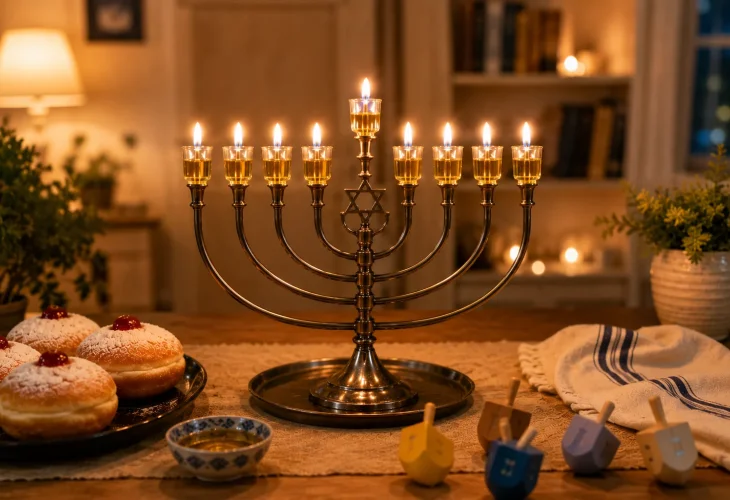 Hanukkah menorah with all eight candles lit on the eighth night
What is Hanukkah?
Hanukkah (also spelled Chanukah, חֲנֻכָּה) is an eight-day Jewish festival, widely known as the Festival of Lights, commemorating the rededication of the Second Temple in Jerusalem after the Maccabean victory over the Seleucid Greek empire in the 2nd century BCE, and the miracle of a single cruse of oil that burned for eight days. The name "Hanukkah" means "dedication" in Hebrew.
The holiday is celebrated each year beginning on the 25th of Kislev on the Hebrew calendar — typically falling in November or December. Its central observance is the nightly kindling of the hanukkiah (the nine-branched Hanukkah menorah), accompanied by special blessings, songs, and prayers. Around this core, the holiday is also marked by eating foods fried in oil (most famously latkes and sufganiyot), playing the spinning-top game of dreidel, and giving Hanukkah gelt to children.
Unlike Rosh Hashanah, Yom Kippur, or the three pilgrimage festivals, Hanukkah is a rabbinic festival — ordained by the Sages to commemorate events that occurred after the close of the biblical period. As a result, the prohibitions on work that apply on Yom Tov do not apply on Hanukkah; schools and workplaces operate normally, and the holiday is observed each evening at home.
A note on spelling: Both "Hanukkah" and "Chanukah" are correct English spellings — both are transliterations of the Hebrew חֲנֻכָּה. "Hanukkah" is currently the most common spelling in American English; "Chanukah" is also widely used, particularly in communities following Ashkenazi pronunciation. Other variants (Hanukah, Chanuka) also appear. All refer to the same holiday.
When is Hanukkah 2026?
Hanukkah 2026 begins at sundown on Friday, December 4, 2026, and ends at nightfall on Saturday, December 12, 2026 — eight nights beginning on the 25th of Kislev, Hebrew year 5787. Because the first night falls on Erev Shabbat (Friday), Hanukkah candles must be lit before the Shabbat candles on that first evening.
Hanukkah 2026 Candle Lighting Times by City
Because the first night of Hanukkah 2026 falls on Erev Shabbat (Friday evening), candles must be lit before sunset on December 4. Approximate candle lighting times for major cities:
| City | Candle Lighting — Friday, Dec 4, 2026 |
|---|---|
New York City, NY | 4:09 PM EST |
Los Angeles, CA | 4:26 PM PST |
Miami, FL | 5:12 PM EST |
Chicago, IL | 4:02 PM CST |
Toronto, ON | 4:06 PM EST |
Jerusalem, Israel | 4:16 PM IST |
Tel Aviv, Israel | 4:18 PM IST |
Hanukkah Dates for the Coming Years
| Hebrew Year | First Candle (sundown) | Last Night Ends (nightfall) |
|---|---|---|
5787 (2026) | Friday, Dec 4, 2026 | Saturday, Dec 12, 2026 |
| 5788 (2027) | Friday, Decr 24, 2027 | Saturday, Jan 1, 2028 |
| 5789 (2028) | Tuesday, Dec 12, 2028 | Wednesday, Dec 20, 2028 |
| 5790 (2029) | Saturday, Dec 1, 2029 | Sunday, Dec 9, 2029 |
| 5791 (2030) | Saturday, Dec 21, 2030 | Sunday, Dec 29, 2030 |
Why Does Hanukkah Fall on Different Dates Each Year?
Hanukkah always begins on the same Hebrew date — the 25th of Kislev — but its position on the Gregorian calendar shifts each year. The Hebrew calendar is lunisolar: months follow the cycles of the moon, while the year is periodically adjusted to stay aligned with the solar seasons. A regular Hebrew year runs about 354 days — roughly 11 days shorter than the solar year. To keep the festivals from drifting through the seasons, a thirteenth month is added in seven out of every nineteen years. As a result, Hanukkah can fall anywhere from late November to late December, occasionally overlapping with Christmas and sometimes falling weeks before it.
How to Celebrate Hanukkah
The central mitzvah of Hanukkah is kindling the menorah each night, accompanied by blessings and song. Around this core, beloved customs have developed across generations.
Lighting the Menorah (Hanukkiah)
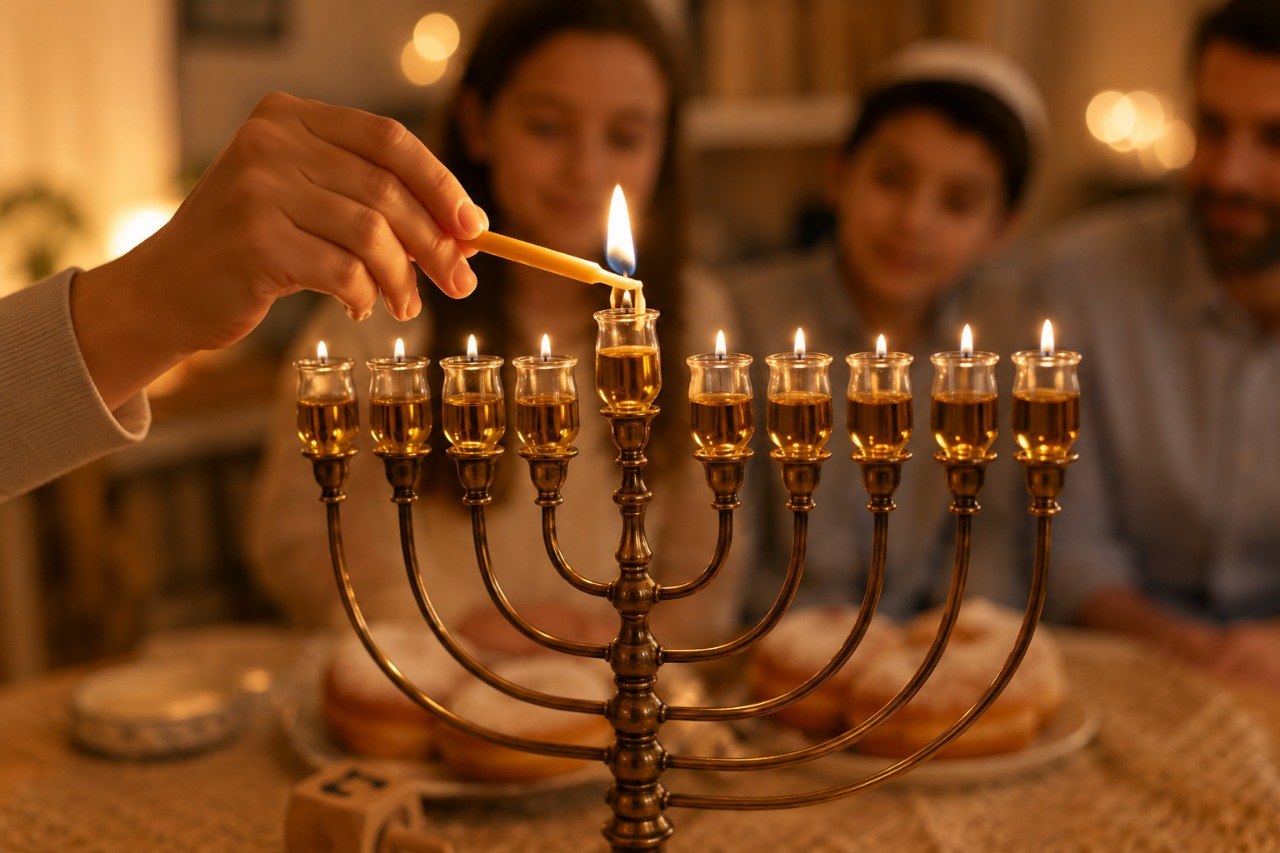 Lighting Hanukkah candles
The defining act of Hanukkah is lighting the hanukkiah — the nine-branched Hanukkah menorah. On the first night, one light is kindled; each subsequent night, an additional light is added until on the eighth night all eight burn brightly, plus the shamash. The lights may be candles or, in the most traditional form, olive oil with wicks — directly recalling the Temple menorah.
The lights are meant to publicize the miracle (pirsumei nisa), so the hanukkiah is placed in a window facing the street, or in a doorway visible to passersby. Once lit, they must burn for a minimum of thirty minutes after nightfall. The Hanukkah lights are designated solely for viewing — one may not use their light for any practical purpose — which is why the shamash is included: any incidental use of light is attributed to it, not to the sacred Hanukkah flames.
Playing Dreidel
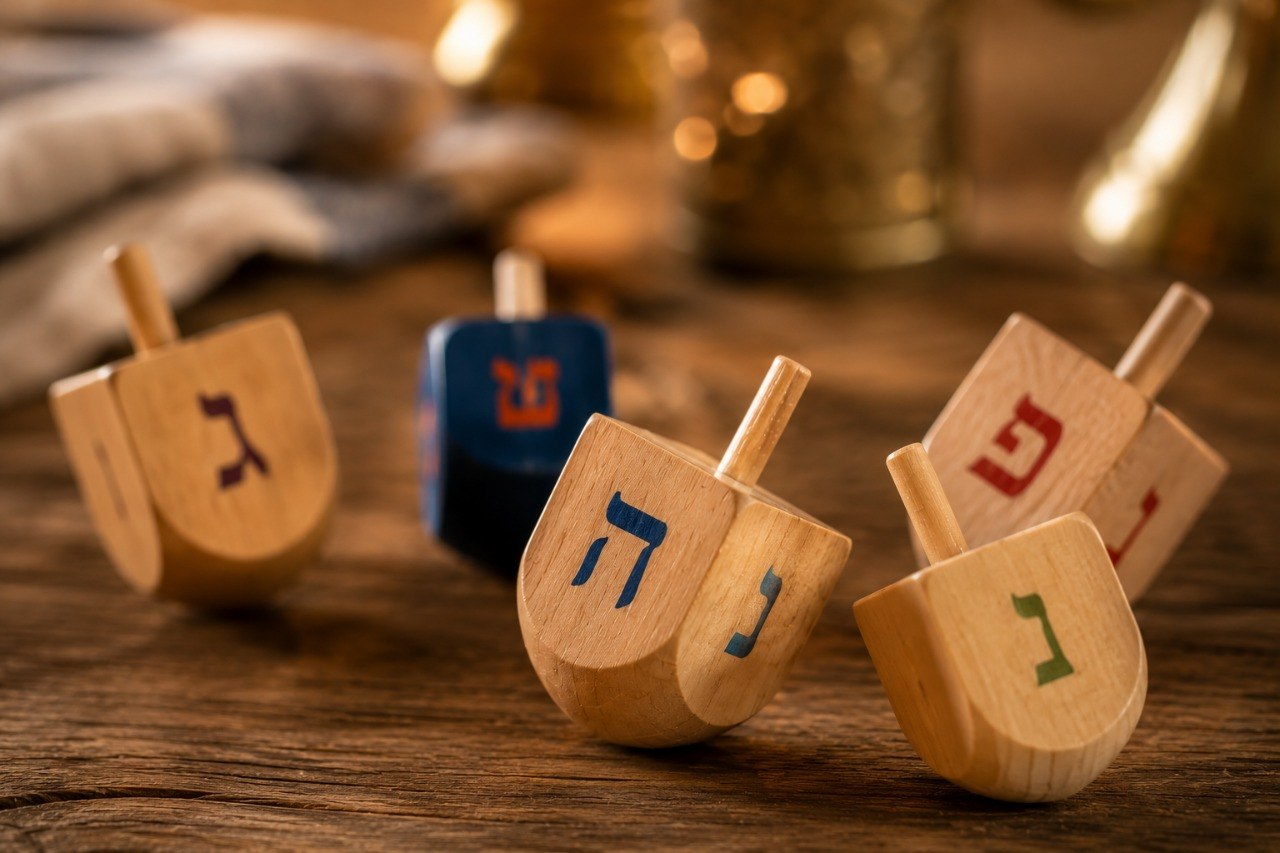 Hanukkah dreidel showing the four Hebrew letters Nun, Gimel, Hey, Shin
The dreidel (Hebrew: sevivon) is a four-sided spinning top bearing the Hebrew letters נ (Nun), ג (Gimel), ה (Hey), ש (Shin) — an acronym for Nes Gadol Haya Sham: "A great miracle happened there." In Israel, the final letter is פ (Pei) for "Po" — "here."
? How to Play Dreidel:
- Each player starts with an equal number of pieces (coins, chocolate gelt, or nuts) and puts one piece into the center pot.
- Players take turns spinning the dreidel. The letter face-up determines the action: — נ (Nun) — Nothing happens. Pass to the next player. — ג (Gimel) — Take the entire pot. Everyone adds one piece to refill it. — ה (Hey) — Take half the pot (round up if odd). — ש (Shin) — Put one piece into the pot.
- When a player runs out of pieces, they are out — or may borrow one from the pot.
- The game ends when one player wins everything, or when the players agree to stop.
One popular tradition holds that during the Greek persecution, when Torah study was forbidden, Jewish children would study in secret and pull out spinning tops to disguise their learning if soldiers approached.
Giving Hanukkah Gelt
Hanukkah gelt (Yiddish for "money") is the custom of giving coins or money to children during the festival. In Eastern European tradition, children would give coins to their Torah teachers during Hanukkah and receive coins in return; over time the practice expanded to gifts for children. In the modern era, foil-wrapped chocolate gelt coins have become a beloved feature of the holiday — served at the table, used in dreidel games, and packed into Hanukkah bags for children.
The Hanukkah Blessings — Full Text in Hebrew, Transliteration & English
Three blessings are recited on the first night; two on all subsequent nights. All blessings are said before kindling, while holding the lit shamash.
The blessings are recited each night before kindling the Hanukkah lights, while holding the lit shamash and before touching the candles. On the first night, all three are said. On nights two through eight, only the first two are recited.
Blessing One — On Kindling the Lights
(All eight nights)
בָּרוּךְ אַתָּה יְהוָה אֱלֹהֵינוּ מֶלֶךְ הָעוֹלָם אֲשֶׁר קִדְּשָׁנוּ בְּמִצְוֹתָיו וְצִוָּנוּ לְהַדְלִיק נֵר שֶׁל חֲנֻכָּה.
Transliteration: Baruch Atah Adonai, Eloheinu Melech HaOlam, asher kideshanu b'mitzvotav v'tzivanu l'hadlik ner shel Hanukkah
Blessed are You, Lord our God, King of the universe, who has sanctified us with His commandments and commanded us to kindle the Hanukkah light.
Blessing Two — For the Miracles
(All eight nights)
בָּרוּךְ אַתָּה יְהוָה אֱלֹהֵינוּ מֶלֶךְ הָעוֹלָם שֶׁעָשָׂה נִסִּים לַאֲבוֹתֵינוּ בַּיָּמִים הָהֵם בַּזְּמַן הַזֶּה.
Transliteration: Baruch Atah Adonai, Eloheinu Melech HaOlam, she'asah nissim la'avoteinu bayamim hahem bazman hazeh.
Blessed are You, Lord our God, King of the universe, who performed miracles for our ancestors in those days, at this season.
Blessing Three — Shehecheyanu
(First night only)
בָּרוּךְ אַתָּה יְהוָה אֱלֹהֵינוּ מֶלֶךְ הָעוֹלָם שֶׁהֶחֱיָנוּ וְקִיְּמָנוּ וְהִגִּיעָנוּ לַזְּמַן הַזֶּה.
Transliteration: Baruch Atah Adonai, Eloheinu Melech HaOlam, shehecheyanu v'kiyemanu v'higiyanu lazman hazeh
Blessed are You, Lord our God, King of the universe, who has kept us alive, sustained us, and brought us to this season.
HaNerot Halalu — Recited After Lighting
(From Tractate Soferim, chapter 20)
הַנֵּרוֹת הַלָּלוּ אֲנַחְנוּ מַדְלִיקִין עַל הַנִּסִּים וְעַל הַנִּפְלָאוֹת וְעַל הַתְּשׁוּעוֹת וְעַל הַמִּלְחָמוֹת שֶׁעָשִׂיתָ לַאֲבוֹתֵינוּ בַּיָּמִים הָהֵם בַּזְּמַן הַזֶּה עַל יְדֵי כֹּהֲנֶיךָ הַקְּדוֹשִׁים. וְכָל שְׁמוֹנַת יְמֵי חֲנֻכָּה הַנֵּרוֹת הַלָּלוּ קֹדֶשׁ הֵם, וְאֵין לָנוּ רְשׁוּת לְהִשְׁתַּמֵּשׁ בָּהֶם אֶלָּא לִרְאוֹתָם בִּלְבָד, כְּדֵי לְהוֹדוֹת וּלְהַלֵּל לְשִׁמְךָ הַגָּדוֹל עַל נִסֶּיךָ וְעַל נִפְלְאוֹתֶיךָ וְעַל יְשׁוּעוֹתֶיךָ.
We kindle these lights on account of the miracles, the wonders, the salvations, and the battles which You performed for our ancestors in those days, at this season, through Your holy priests. Throughout all eight days of Hanukkah these lights are sacred, and we are not permitted to make use of them, but only to look upon them — in order to give thanks and praise to Your great Name for Your miracles, Your wonders, and Your salvations.
The Hanukkah Menorah Explained
How Many Candles on a Menorah?
A hanukkiah holds nine candles or oil lights: eight of equal height (one for each night) plus the shamash, set apart — typically raised higher or offset to one side. This distinguishes it from the seven-branched menorah of the Temple. Over the eight nights, the total number of lights kindled (excluding the shamash) is 36 — 1+2+3+4+5+6+7+8.
What is the Shamash?
The shamash ("attendant") is the helper candle that lights the others and stands apart from the eight Hanukkah flames. Because the Hanukkah lights are sacred and may not be used for any practical benefit, the shamash serves as the functional light: any incidental use of illumination is attributed to it, not to the holy flames. It is always set in a visibly distinct position — usually raised above or offset from the eight.
How to Light the Menorah
How to Light the Menorah — Step by Step
What You'll Need
- A kosher Hanukkah menorah with 9 branches
- Hanukkah candles or oil cups
- Olive oil, if using oil
- Wicks, if using oil
- A shamash
- Matches or a lighter
- A safe place to set up the menorah
- A siddur or Hanukkah blessings sheet
- A tray or foil under the menorah for oil or wax drips
- Dreidels and sufganiyot for the atmosphere
Steps
1
Place candles right to left — add one new candle each night.
2
Light the shamash first.
3
Recite the blessings while holding the lit shamash, before touching the candles.
4
Light the candles left to right — newest candle first.
5
Return the shamash to its place in the hanukkiah.
6
Recite or sing HaNerot Halalu, then Maoz Tzur.
In full: candles are set up from right to left each night — the newest candle is placed to the left of the previous night's candles. The blessings are recited while holding the lit shamash and before kindling the Hanukkah lights. Then the candles are lit from left to right, beginning with the most recently added candle — so the newest miracle is honored first each night. This practice follows the ruling of Beit Hillel as codified in the Talmud (Shabbat 21b) and the Shulchan Aruch (OC 676:5).
When to Light — Timing Rules
The standard practice in most communities is to light at nightfall (when three stars appear); some light at sunset. Either way, candles must contain enough fuel to burn for at least thirty minutes after nightfall. If the ideal time is missed, candles may still be kindled with blessings later in the evening, as long as people are awake in the household.
Lighting on Friday Night & Shabbat
Hanukkah on Shabbat 2026:Friday (Night 1): Light Hanukkah candles FIRST, then Shabbat candles — both before sunset. Saturday night (Night 2): Light Hanukkah candles AFTER Shabbat ends (after Havdalah at home).
Friday, December 4 (Night 1): Hanukkah candles are lit before Shabbat candles, both before sunset. The Hanukkah lights must contain enough fuel to burn until at least thirty minutes after nightfall — longer than on a regular weeknight, since they are lit before sunset. See the candle-lighting table above for approximate city times.
Saturday night, December 5 (Night 2): Hanukkah candles are lit after Shabbat ends. At home, most follow the custom of reciting Havdalah first, then kindling the Hanukkah lights. In synagogue, the Hanukkah candles are typically lit before Havdalah.
The Story of Hanukkah
Historical Background — The Seleucid Empire & Antiochus IV
After Alexander the Great's death, his empire was divided among his generals. The Land of Israel came under Seleucid rule, centered in Syria. For a time, Jews lived freely according to their faith. This changed dramatically under Antiochus IV Epiphanes (reigned c. 175–164 BCE), who sought to impose Greek culture (Hellenization) throughout his domain. He outlawed core Jewish practice — Shabbat observance, circumcision, Torah study — under penalty of death, and defiled the Holy Temple by introducing idols and sacrificing forbidden animals on its altar. His title "Epiphanes" means "God manifest"; Jewish contemporaries reportedly called him "Epimanes" — "the madman."
The Maccabean Revolt
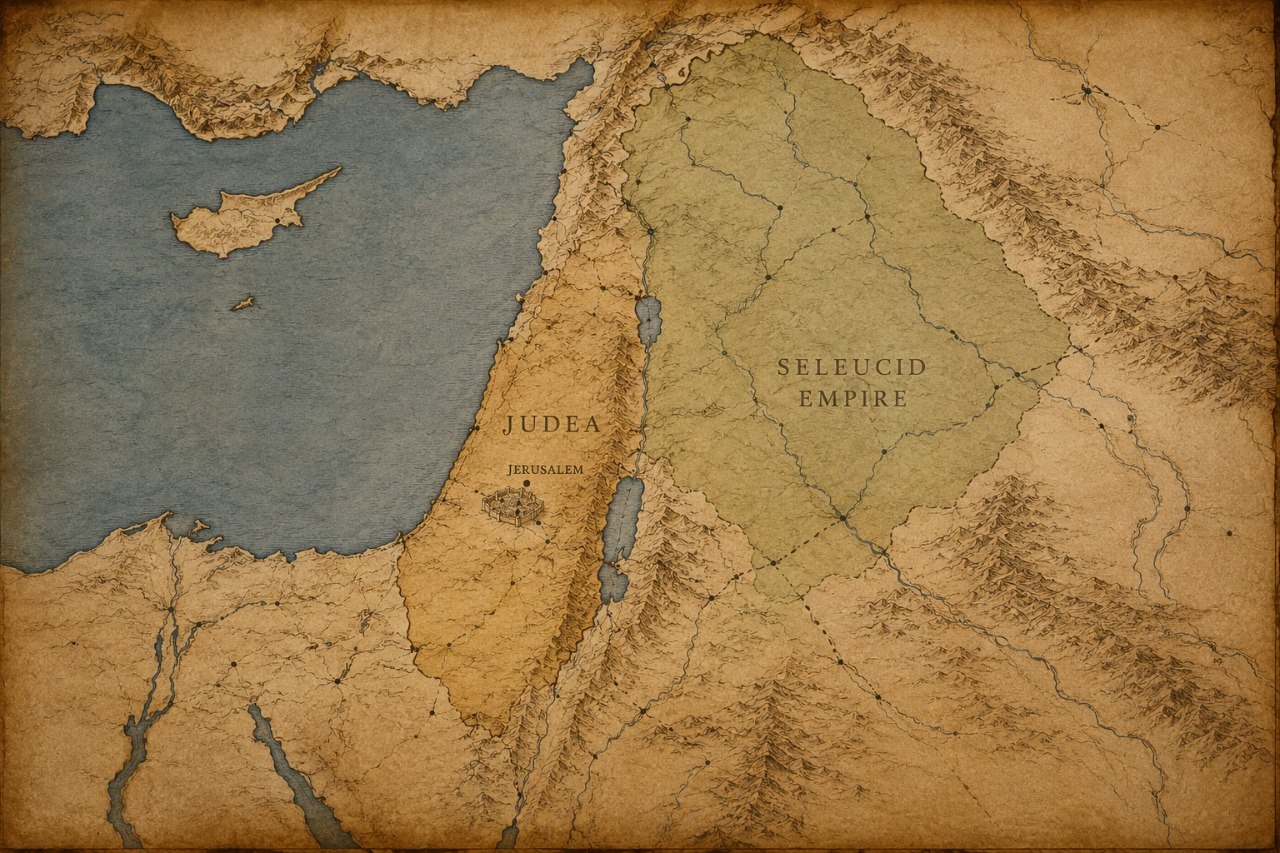 Map of Judea and the Seleucid Empire during the Maccabean Revolt
Resistance began in the village of Modi'in, where Mattathias (Matityahu) of the Hasmonean priestly family refused the royal decree to offer pagan sacrifice. He and his five sons fled to the hills and launched an armed rebellion. After Mattathias died, his son Judah (Yehuda) the Maccabee — "the Hammer" — led an outgunned guerrilla force against the Seleucid army. Against vast numerical and military odds, the Maccabees won a series of victories, recaptured Jerusalem, and cleansed the Temple of idolatry. This victory — "the many into the hands of the few, the mighty into the hands of the weak, the wicked into the hands of the righteous" — is the military miracle recalled in the Al HaNissim prayer.
The Miracle of the Oil
Upon reclaiming the Temple, the Maccabees sought to rekindle its golden menorah, which was meant to burn continuously with ritually pure olive oil. According to the Talmud (Shabbat 21b), they found only a single sealed cruse of pure oil bearing the seal of the High Priest — enough to burn for just one day. Miraculously, that oil burned for eight days, by which time new pure oil could be prepared. This is the miracle that gives Hanukkah its eight-day length and its identity as the Festival of Lights.
Rededication of the Second Temple
With the Temple recaptured and purified, the Maccabees cleansed it of idolatry, built a new altar, and rededicated it to the service of God. The very name "Hanukkah" — "dedication" — commemorates this rededication. The Sages of the following generation established the eight-day festival, beginning on the 25th of Kislev, to be observed for all generations with the kindling of lights and the recitation of praise and thanksgiving.
The Meaning of Hanukkah
The Talmud (Shabbat 21b) famously opens its discussion with the question: "Mai Hanukkah?" — "What is Hanukkah?" — and proceeds to answer not with the military victory, but with the miracle of the oil. The Sages chose to define the holiday through its spiritual miracle rather than its military triumph. While both are celebrated, the oil is the heart.
On the surface, Hanukkah commemorates a historical deliverance — the rescue of the Jewish people from religious persecution and the restoration of their freedom to worship. But the deeper miracle is spiritual: a small amount of pure, untouched holiness that, when kindled with faith, burns far beyond its natural capacity.
The dispute of Beit Shammai and Beit Hillel over how to light the menorah illuminates the holiday's deeper meaning. Beit Shammai held that one should light eight lights on the first night and decrease one per night. Beit Hillel held the opposite: start with one and increase. The halacha follows Beit Hillel — and the reason given is maalin bakodesh v'ein moridin: "in matters of holiness one always ascends, never descends." Hanukkah is built on the principle of increase, of growth, of moving forward. Each night adds light rather than diminishing it.
Pirsumei nisa — publicizing the miracle — is one of the central purposes of lighting the menorah in the window. The Jewish people do not celebrate their miracles privately. The Hanukkah lights are placed where the world can see them, declaring that God's intervention in history is a universal truth to be shared.
The holiday falls at the darkest time of the year in the Northern Hemisphere, near the winter solstice when nights are longest. Precisely when the world is at its darkest, the festival commands us to kindle light — and to increase it each night.
Finally, Hanukkah celebrates the survival of Jewish identity against assimilation. The Maccabees fought not just a military enemy but a cultural one — the pressure to abandon Jewish distinctiveness in favor of the surrounding Hellenistic civilization. Their victory was a victory for the right of a people to live according to its own values and traditions. This dimension of the holiday resonates powerfully in every generation.
Hanukkah Prayers — Al HaNissim & Hallel
Al HaNissim — Full Text in Hebrew & English
Al HaNissim ("For the miracles") is inserted into the Amidah (the standing prayer) and into Birkat HaMazon (Grace After Meals) on all eight days of Hanukkah. It is an ancient prayer from the Talmudic period, part of the standard liturgy in every siddur.
עַל הַנִּסִּים וְעַל הַפֻּרְקָן וְעַל הַגְּבוּרוֹת וְעַל הַתְּשׁוּעוֹת וְעַל הַמִּלְחָמוֹת שֶׁעָשִׂיתָ לַאֲבוֹתֵינוּ בַּיָּמִים הָהֵם בַּזְּמַן הַזֶּה.
בִּימֵי מַתִּתְיָהוּ בֶּן יוֹחָנָן כֹּהֵן גָּדוֹל חַשְׁמוֹנַאי וּבָנָיו, כְּשֶׁעָמְדָה מַלְכוּת יָוָן הָרְשָׁעָה עַל עַמְּךָ יִשְׂרָאֵל לְהַשְׁכִּיחָם תּוֹרָתֶךָ וּלְהַעֲבִירָם מֵחֻקֵּי רְצוֹנֶךָ. וְאַתָּה בְּרַחֲמֶיךָ הָרַבִּים עָמַדְתָּ לָהֶם בְּעֵת צָרָתָם, רַבְתָּ אֶת רִיבָם, דַּנְתָּ אֶת דִּינָם, נָקַמְתָּ אֶת נִקְמָתָם, מָסַרְתָּ גִּבּוֹרִים בְּיַד חַלָּשִׁים, וְרַבִּים בְּיַד מְעַטִּים, וּטְמֵאִים בְּיַד טְהוֹרִים, וּרְשָׁעִים בְּיַד צַדִּיקִים, וְזֵדִים בְּיַד עוֹסְקֵי תוֹרָתֶךָ. וּלְךָ עָשִׂיתָ שֵׁם גָּדוֹל וְקָדוֹשׁ בְּעוֹלָמֶךָ, וּלְעַמְּךָ יִשְׂרָאֵל עָשִׂיתָ תְּשׁוּעָה גְדוֹלָה וּפֻרְקָן כְּהַיּוֹם הַזֶּה. וְאַחַר כֵּן בָּאוּ בָנֶיךָ לִדְבִיר בֵּיתֶךָ, וּפִנּוּ אֶת הֵיכָלֶךָ, וְטִהֲרוּ אֶת מִקְדָּשֶׁךָ, וְהִדְלִיקוּ נֵרוֹת בְּחַצְרוֹת קָדְשֶׁךָ, וְקָבְעוּ שְׁמוֹנַת יְמֵי חֲנֻכָּה אֵלּוּ לְהוֹדוֹת וּלְהַלֵּל לְשִׁמְךָ הַגָּדוֹל.
For the miracles, for the redemption, for the mighty deeds, for the salvations, and for the battles which You performed for our ancestors in those days, at this season.
In the days of Mattathias son of Yochanan, the High Priest, the Hasmonean, and his sons — when the wicked Greek kingdom rose up against Your people Israel to make them forget Your Torah and to force them to transgress the statutes of Your will — You in Your great mercy stood up for them in their time of distress, You championed their cause, You judged their case, You avenged their wrong. You delivered the mighty into the hands of the weak, the many into the hands of the few, the impure into the hands of the pure, the wicked into the hands of the righteous, and the wanton sinners into the hands of those who engage in Your Torah. And You made for Yourself a great and holy name in Your world, and for Your people Israel You performed a great salvation and redemption as this very day. Thereafter Your children came to the innermost sanctuary of Your House, cleansed Your Temple, purified Your Sanctuary, kindled lights in Your holy courtyards, and designated these eight days of Hanukkah for giving thanks and praise to Your great Name.
Hallel
Full Hallel — Psalms 113–118, the psalms of praise — is recited each of the eight mornings of Hanukkah. This distinguishes Hanukkah from purely minor fast-days: the Sages considered its miracle significant enough to warrant complete Hallel on all eight days. Tachanun (penitential prayers) is omitted throughout the festival.
Hanukkah Traditional Foods
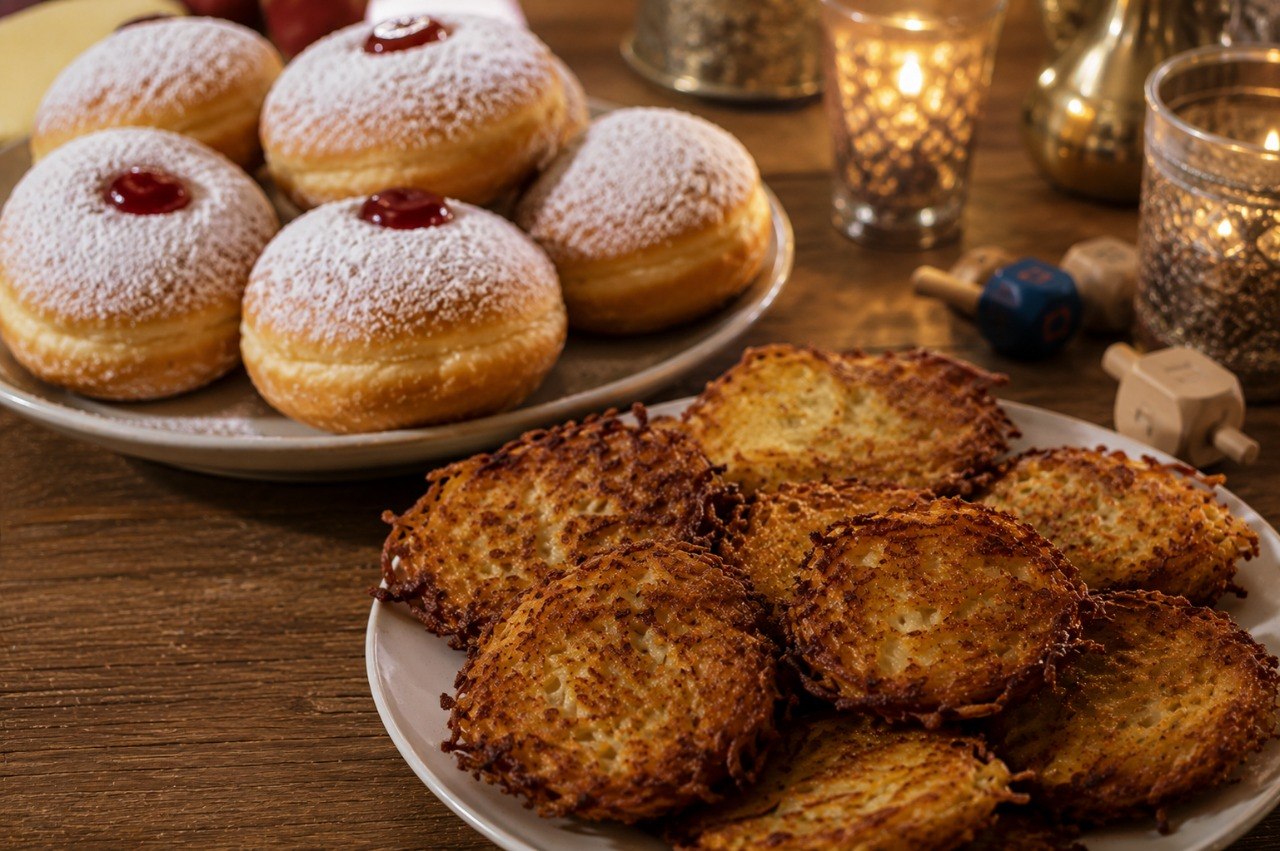 Traditional Hanukkah latkes / sufganiyot fried in oil
Because the miracle of Hanukkah centered on oil, it is customary to eat foods fried in oil. These have become some of the most beloved features of the holiday.
Latkes (Potato Pancakes)
Latkes are pan-fried pancakes made from grated potato, onion, egg, and flour — fried in oil until golden and crisp. They are the signature Hanukkah dish in Ashkenazi tradition, served with applesauce or sour cream. The potato version became standard only after potatoes spread through Eastern Europe in later centuries; earlier latkes were made from cheese, buckwheat, or other vegetables. [Internal link: Hidabroot Hanukkah latke recipe]
Sufganiyot (Jelly Doughnuts)
Sufganiyot are deep-fried, jelly-filled doughnuts dusted with powdered sugar — the iconic Hanukkah treat in Israel and in many Sephardic and Mizrahi communities. In the weeks before Hanukkah, Israeli bakeries fill their windows with sufganiyot in dozens of flavors. Like latkes, the frying connects the food directly to the miracle. [Internal link: Hidabroot Hanukkah sufganiyot recipe]
Why We Eat Foods Fried in Oil
The custom of eating fried foods on Hanukkah is a direct culinary echo of the miracle of the oil. Just as one small cruse of oil sustained the Temple menorah for eight days, oil-rich foods recall and celebrate that miracle at the family table. The practice is a longstanding minhag (custom) rather than formal law, but it is observed almost universally and is one of the most cherished ways families mark the festival.
Dairy Foods & the Story of Judith
A traditional Hanukkah custom is eating dairy foods, connected to the story of Judith (Yehudit). According to tradition, Judith fed salty cheese to an enemy general besieging her town; when he drank wine to quench his thirst and fell into a deep sleep, she killed him, breaking the siege and inspiring the Jewish forces to victory. In her honor, some have the custom of eating cheese and dairy dishes during Hanukkah — a custom noted by the Rema in his glosses to the Shulchan Aruch (OC 670:2).
The Ultimate Hanukkah Recipe Collection
Hanukkah Songs & Music
Maoz Tzur — Rock of Ages
Maoz Tzur ("Rock of Ages, Stronghold of My Salvation") is the best-known traditional Hanukkah hymn, sung after the candles are kindled in Ashkenazi homes. It is a medieval Hebrew liturgical poem (piyyut) of six stanzas, composed in 13th-century Germany. The author is traditionally identified as Mordechai — his name is embedded as an acrostic in the opening letters of the first five stanzas (מ-ר-ד-כ-י).
The six stanzas survey God's deliverances of the Jewish people across history:
- Stanza 1 — An opening hymn of praise, declaring God the stronghold of salvation and pledging to dedicate the Temple in His honor.
- Stanza 2 — The Egyptian exile and Exodus, recalling the redemption from Pharaoh's enslavement.
- Stanza 3 — The Babylonian exile and return under Zerubavel, recalling the destruction of the First Temple and restoration.
- Stanza 4 — The Purim story: the threatened annihilation by Haman and the salvation through Mordechai and Esther.
- Stanza 5 — The Hanukkah story: the defilement of the Temple by the Greeks, the Hasmonean victory, and the rededication of the altar.
- Stanza 6 — A messianic plea for the final redemption and restoration of the Temple service.
The familiar Ashkenazi melody has been sung in essentially the same form since at least the 15th century; its precise origin is debated. Distinct Sephardic, Yemenite, and Chasidic melodies also exist. The full Hebrew text and translation are available at Sefaria.org and [Internal link: Hidabroot Maoz Tzur].
Other Hanukkah Songs
Beyond Maoz Tzur and HaNerot Halalu, the Hanukkah musical tradition includes songs in Hebrew, Yiddish, Ladino, and English. In Sephardic and Mizrahi communities, specific piyyutim for Hanukkah — some dating to the medieval period — are sung at candle-lighting and on Shabbat Hanukkah. In modern Israel, Hanukkah children's songs are among the most familiar seasonal compositions, taught in schools and sung at family gatherings. The combination of candlelight, song, and festive food gives Hanukkah evenings their characteristic warmth.
Hanukkah Gift Ideas
While gift-giving is not the core of Hanukkah — the traditional custom is Hanukkah gelt (coins for children) — the practice of exchanging gifts has become common in many communities, particularly in North America. Some ideas that align naturally with the spirit of the holiday:
Traditional / Judaica: A quality hanukkiah — from simple aluminum to hand-crafted silver or ceramic — makes a lasting gift. A set of Hanukkah candles, a dreidel collection, a decorative gelt dish, or a Hanukkah storybook for children are all classic choices.
Books & Learning: Jewish books — Torah commentaries, history, biography, children's stories about the Maccabees — are among the most traditional Hanukkah gifts, continuing the spirit of Jewish learning that the Maccabees fought to protect.
Experiences: A subscription to a Jewish learning platform [Internal link: Hidabroot], tickets to a community Hanukkah event, or a family cooking session for making latkes and sufganiyot together.
For children: Chocolate gelt bags, dreidel sets, Jewish-themed games or puzzles, and books are perennial favorites. The Hanukkah tradition of giving to children is about marking their connection to the holiday — not replicating the gift culture of the surrounding season.
Hanukkah in America Today
In the United States, Hanukkah is among the most widely recognized Jewish observances — owing in part to its timing during the winter holiday season. Families gather each evening to light the menorah, exchange gelt and gifts, play dreidel, and eat latkes and sufganiyot.
The National Menorah, erected on the Ellipse near the White House in Washington, D.C., has been lit since 1979 through the efforts of American Friends of Lubavitch (Chabad). Parallel public lightings take place in Times Square in New York City, Grant Park in Chicago, the Gateway Arch in St. Louis, and in hundreds of other locations nationwide.
Because Hanukkah carries no prohibition on work, schools and offices remain open throughout the eight days — the holiday unfolds in the home each evening. Many communities hold Hanukkah concerts, latke parties, communal candle-lighting events, and educational programs throughout the eight nights. In 2026, with the first night falling on Erev Shabbat, many community events will be centered around the Friday night lighting.
Hanukkah for First-Time Observers
The core is simple. The central mitzvah is lighting the menorah each night and reciting the blessings. Everything else — songs, food, dreidel, gelt — is joyful custom built around that core.
You do not need a lot to get started. A basic hanukkiah, a box of Hanukkah candles, and the blessings printed from this page are all you need for the first night.
The lighting sequence matters, but is not complicated. Place candles right to left (adding one per night), light the shamash, say the blessings while holding the lit shamash, then light candles left to right. After lighting, recite or read HaNerot Halalu.
The food is open to everyone. Latkes and sufganiyot are universally beloved — preparing them together is one of the best ways to enter the spirit of the holiday.
Shabbat and Hanukkah 2026. In 2026, the first night falls on Friday evening (Erev Shabbat). Hanukkah candles are lit before Shabbat candles on Friday, and the second night's candles are lit only after Shabbat ends Saturday night. See the full candle-lighting section above.
Resources. Hidabroot's Hanukkah content library — [Internal link: Hidabroot Hanukkah] — offers shiurim, videos, and guides for every level.
Hanukkah for Kids & Families
Hanukkah is among the most child-friendly Jewish holidays. Its customs are concrete, sensory, and immediately engaging — children remember the flicker of the menorah, the spinning dreidel, the smell of frying latkes, and the taste of chocolate gelt long after they have forgotten textbook definitions.
Practical ideas for families:
- Light the menorah together every night. Let children place the candles right to left, and involve even young children in saying "Amen" after the blessings.
- Make latkes as a family. Grating, mixing, and frying together is one of the most memorable Hanukkah activities and connects directly to the miracle of the oil.
- Play dreidel with chocolate gelt. A short game before bed each night builds Hanukkah tradition into the week.
- Tell the story. The Hanukkah story — brave fighters, a miracle of light, oil that refused to run out — is one of the most compelling narratives in Jewish history and accessible to children of all ages.
- Hidabroot's Olam HaYeladim offers animated Hanukkah stories, songs, and activities for children. [Internal link: Olam HaYeladim Hanukkah]
For the youngest children, three ideas are enough: the candles mean something special happened long ago; we add a light each night because the miracle grew; and the oil in the story was small but did something enormous — just like us.
Hanukkah vs. Christmas — Understanding Each Holiday
Although Hanukkah and Christmas often coincide on the calendar, they are independent holidays with entirely different origins, meanings, and religious significance.
Hanukkah is a Jewish holiday of historical deliverance and spiritual light. It commemorates the Maccabean victory and the miracle of the oil in the 2nd century BCE. Its themes — the few against the many, religious freedom, the persistence of light — are entirely its own.
Hanukkah is not "the Jewish Christmas." The two holidays have no religious or historical connection. Their calendar proximity, especially in North America, has led to cultural overlap — but that overlap is incidental rather than intrinsic.
Hanukkah is a relatively minor holiday in the traditional Jewish calendar. In religious terms, it ranks far below Rosh Hashanah, Yom Kippur, Passover, Shavuot, and Sukkot. Its high public profile in North America reflects its calendar proximity to Christmas, not its intrinsic weight in Jewish law and practice.
Gift-giving is traditional but not the heart of the holiday. The original custom is Hanukkah gelt — coins given to children. The central mitzvah remains the lighting of the menorah.
The dates do not always overlap. Because Hanukkah follows the Hebrew calendar, it can fall well before Christmas — as in 2029, when it begins December 1 — or during the same week. The overlap is coincidence, not connection.
Watch: Hanukkah Video Library
Sources & References
Classical & Historical Sources:
- Babylonian Talmud, Shabbat 21b — the miracle of the oil; "Mai Hanukkah?"; the dispute of Hillel and Shammai; maalin bakodesh v'ein moridin.
- Al HaNissim prayer — ancient liturgical text, Talmudic period, in the Siddur.
- HaNerot Halalu — Tractate Soferim, chapter 20.
- 1 Maccabees and 2 Maccabees — historical narrative of the revolt (preserved in the Apocrypha).
- Josephus, Antiquities of the Jews, Book 12 — historical account of the Maccabean period.
- Rambam (Maimonides), Mishneh Torah, Hilchot Megillah V'Chanukah, chapters 3–4.
- Shulchan Aruch, Orach Chayim 670–685, with the glosses of the Rema; OC 670:2 (dairy/Judith); OC 676:5 (lighting left to right).
Contemporary References:
- Chabad.org — Hanukkah history, menorah lighting, blessings, Shabbat timing, yearly dates.
- My Jewish Learning (myjewishlearning.com) — Hanukkah customs, foods, history.
- Orthodox Union (OU.org) — practical halacha on candle lighting and the Shabbat/Hanukkah interaction.
- Sefaria (sefaria.org) — primary texts: Talmud Shabbat 21b, Al HaNissim, HaNerot Halalu, Maoz Tzur, Books of Maccabees.
- Hebcal (hebcal.com) — calendrical data for Hanukkah dates 2026–2030 and candle-lighting calculations.
- History.com — historical background on Antiochus IV and the Maccabean Revolt.
- Encyclopaedia Judaica — entries on Hanukkah, the Hasmoneans, Maoz Tzur, HaNerot Halalu.
For practical halachic guidance on individual situations — consult a qualified Orthodox rabbi.
Questions & Answers
+What is Hanukkah?
+When is Hanukkah 2026?
+How do you spell it — Hanukkah or Chanukah?
+What are the Hanukkah blessings?
+How many candles are on a Hanukkah menorah?
+Why is Hanukkah eight days long?
+How do you light the menorah?
+What time do you light Hanukkah candles?
+What foods are eaten on Hanukkah?
+How do you play dreidel?
+What is Hanukkah gelt?
+Is Hanukkah a major Jewish holiday?
+Do Jews work during Hanukkah?
+Is Hanukkah the same as Christmas?
+What is Al HaNissim?
+What is the shamash?
+What is Maoz Tzur?

