

World News
Iranian President Reportedly Submits Resignation Letter To Khamenei
Iran International reports Masoud Pezeshkian told Mojtaba Khamenei that key decisions have shifted to an IRGC faction, exposing a reported rift at the top of the regime
 Shutterstock
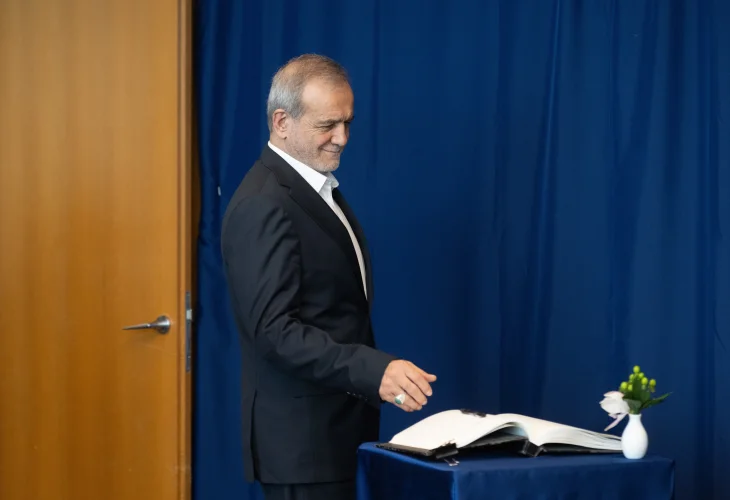
Iranian President Masoud Pezeshkian has reportedly submitted a resignation letter to Supreme Leader Mojtaba Khamenei, according to a report published Sunday by the opposition-linked outlet Iran International. The report, which has not been confirmed by Iranian state media or major international wire services, claims Pezeshkian asked to leave office after concluding that his government no longer plays a meaningful role in major state decisions.
According to the report, Pezeshkian told Khamenei that the country's official governing structures have effectively been bypassed and that key centers of power are now controlled by a faction within the Islamic Revolutionary Guard Corps (IRGC). If accurate, the claim would represent one of the most public indications yet of tensions between Iran's elected government and powerful security institutions.
While Iran's president serves as the country's chief executive and is responsible for managing the government and economy, he is not the ultimate decision-maker on issues such as war, national security, the nuclear program, or the IRGC. Those powers belong primarily to Supreme Leader Mojtaba Khamenei and the security establishment. If Pezeshkian's reported claims are accurate, they suggest that even the limited authority traditionally exercised by Iran's elected government may be shrinking further.
According to information cited by Iran International, Pezeshkian wrote that the president and government had effectively been excluded from sensitive decision-making processes. He reportedly warned that the management of the state had moved outside official channels and argued that the resulting situation left him unable to fulfill his legal responsibilities. For that reason, he reportedly requested to resign immediately.
The report follows months of speculation regarding growing tensions inside Iran's leadership. In March, reports emerged claiming that Pezeshkian had been considering resignation due to mounting frustration with the direction of the country and the growing influence of security institutions. Sources cited in those earlier reports claimed the president believed that “the whole system is collapsing.”
Those reports surfaced after a series of high-profile security developments and leadership disputes that reportedly deepened divisions within the regime. Some opposition-linked reports at the time described unusual anger by Pezeshkian toward elements of the IRGC and claimed that the elected government was increasingly being sidelined from major decisions.
Even if the reported resignation letter is genuine, it would not automatically remove Pezeshkian from office. Under Iran's constitutional system, a president's resignation must be accepted by the supreme leader before it takes effect. If Khamenei were to approve the request, the country's first vice president would assume interim responsibilities and a process leading to a new presidential election would begin.
The practical consequences, however, may be more limited than the political drama suggests. Many analysts view the presidency as secondary to the supreme leader, the IRGC, and other powerful unelected institutions that shape Iran's strategic decisions.
In practice, the reported resignation would not by itself change who holds real power in Iran. But if accepted, it would transform what appears to be an internal power struggle into a formal constitutional crisis and could leave the IRGC with even greater influence over day-to-day decision-making.

