

In Search of God
Does DNA Explain Life? A Professor Challenges a Common Assumption
How does a single fertilized cell become a fully developed human being? One professor argues that DNA may not tell the whole story.
- Yehosef Yavetz
- | Updated
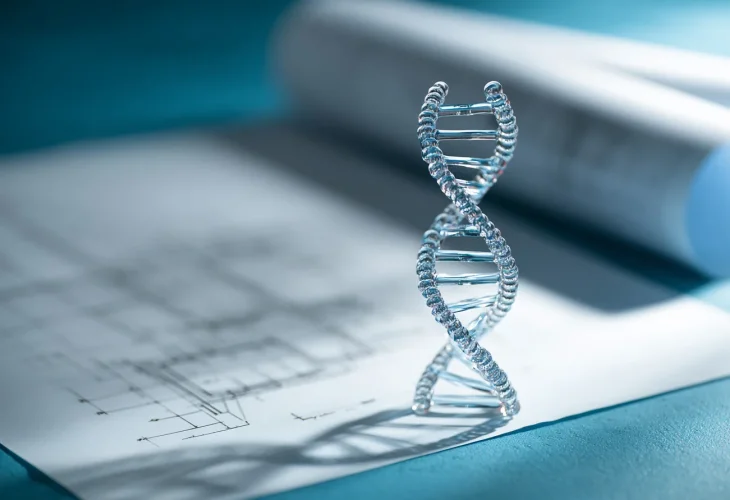
How do animals and human beings develop into such remarkably complex and sophisticated living creatures?
Most people would answer that the process begins with DNA. From the very first cell of an embryo, genetic information provides the instructions needed to build and operate the body. According to the conventional view, DNA contains the blueprint that guides development from a single fertilized cell to a fully formed living being.
But does DNA truly explain everything?
Professor Granville Sewell, professor emeritus of mathematics at the University of Texas at El Paso, argues that the answer may be more complicated than many assume.
A Mathematician Examines the Mystery of Life
Professor Sewell has spent much of his career studying complex systems, numerical analysis, and the mathematical challenges involved in designing automated processes. He has authored four books in his field and taught at several major research institutions, including Oak Ridge and Purdue University.
His work led him to consider what may be the most remarkable "automated system" of all: the development of life itself.
In his article, The Paradox of Biological Reproduction, Sewell examines the materialist approach to genetics, which views DNA and genetic information as the primary explanation for reproduction and biological development.
According to Sewell, careful observation of how living organisms develop raises questions that are difficult to answer through genetics alone.
The Biological Reproduction Paradox
At the center of Sewell's argument is a fundamental question:
How does the information contained in the DNA of a fertilized egg direct the construction of a fully developed organism with extraordinary precision, while also managing error correction and countless developmental processes along the way?
According to the article, DNA clearly plays a crucial role, but Sewell argues that genetic information alone does not fully explain the complexity of the final result.
The challenge, he says, is understanding how a relatively limited set of genetic instructions can guide the formation of highly complex biological systems with such reliability.
Is DNA the Entire Story?
Sewell cites the work of biologist Dr. Richard Sternberg, who argues that the information present in a mature organism appears to exceed the information directly contained within the genome of the original cell.
According to Sternberg, development seems to involve more than simply reading genetic instructions. The process also includes mechanisms that monitor development, correct errors, and coordinate the formation of tissues and organs.
As a result, he argues that DNA may not represent the entire informational picture behind biological development.
The article suggests that additional sources of information or organization may be involved throughout the developmental process itself.
The Blueprint Analogy
To illustrate the point, Sewell compares DNA to architectural plans for a building.
Blueprints are essential. They contain valuable information and instructions. However, a blueprint does not construct a building by itself.
Builders must read the plans, interpret them, make decisions, monitor progress, and correct mistakes along the way.
Similarly, Sewell argues that DNA functions as a kind of biological blueprint. While it contains instructions, the existence of instructions alone does not necessarily explain how those instructions are interpreted, implemented, monitored, and corrected throughout development.
In his view, the common statement that "genes explain everything" may oversimplify an extraordinarily complex process.
Beyond Genetics
The article does not deny the importance of genetics. Modern science has demonstrated countless connections between specific genes and particular biological traits, conditions, and processes.
However, Sewell argues that these discoveries should not lead to the conclusion that a living organism is nothing more than its genes.
Rather, he suggests that biological development involves layers of complexity that remain only partially understood.
A Continuing Mystery
Few scientific discoveries have transformed our understanding of life as dramatically as DNA. Yet despite remarkable advances in genetics, many questions about the development of living organisms remain open.
According to Sewell, DNA provides an essential part of the story, but perhaps not the entire story.
As research continues, scientists are still working to understand the full range of processes that transform a single cell into a living, breathing, thinking human being.
For now, one thing remains clear: the formation of life is far more intricate and awe inspiring than a simple sequence of genetic letters alone.

