

Israel News
Rubio Helped Netanyahu Secure Trump’s Approval For Iran Strike
Trump publicly urged restraint, but reports say Netanyahu argued that failing to respond would reward Iran and weaken U.S.-led talks
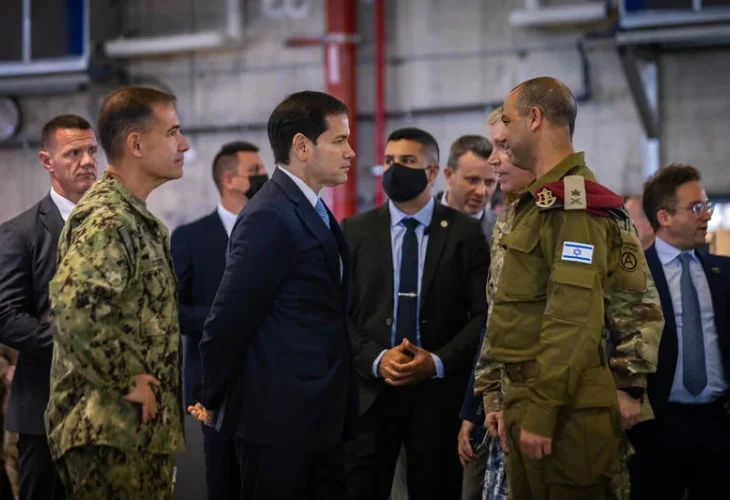 Marco Rubio (OLIVIER FITOUSSI/POOL)
President Donald Trump publicly pressed Prime Minister Benjamin Netanyahu not to retaliate after Iran fired missiles at Israel, but later approved a limited Israeli strike after Secretary of State Marco Rubio backed Israel’s position in behind-the-scenes talks, according to a report by Danny Zaken in Israel Hayom.
The report points to a tense gap between Trump’s public message and the private coordination that followed. Netanyahu reportedly argued that failing to respond would reward Iran, while Rubio supported Israel’s claim that Iran could not be allowed to gain from firing directly at Israeli territory.
The escalation began Sunday night, after Israel struck Hezbollah-linked targets in Beirut’s Dahiyeh district. Iran responded by firing ballistic missiles at Israel, in what Israeli officials viewed as an attempt to drive a wedge between the two allies.
Trump then made a series of public remarks that raised concern in Israel. He said, “I am going to call Bibi right now and tell him not to retaliate. Each of them had their fun. Israel had its strike, and Iran had its strike. We don’t need another one.”
But after that call, the picture shifted. Israel Hayom reported that Netanyahu argued to Trump that failing to respond would hand Iran an achievement and could harden its position in negotiations with the U.S.
According to the report, Israel told the US that Iran was using the missile and launcher force it still had left to gain leverage. Netanyahu also pointed to the recent U.S. response to Iranian attacks in the Gulf, arguing that the US itself had responded forcefully when attacked.
Rubio reportedly backed the Israeli argument and recalled his earlier statement that “Only stupid countries don’t shoot back when you’re shot at.”
The result was U.S. approval for a strike that was powerful but limited. Israel Hayom reported that the targets and boundaries of the operation were coordinated with the US, and that the approval effectively came from Trump himself.
Channel 13 reported that Netanyahu had considered a broader strike on Iranian energy facilities, but Trump blocked that move and told him: “Strike, and close the event.”
The military coordination also continued. IDF Chief of Staff Lt. Gen. Eyal Zamir had signaled before the attack that Israel was prepared, saying, “We are ready to respond and are waiting only for the green light.”
Zamir also spoke several times with Adm. Brad Cooper, commander of U.S. Central Command, ahead of the possibility of renewed escalation. According to Israel Hayom, the Israeli strikes were coordinated with CENTCOM, though the U.S. did not take part in the attack.
The U.S. also provided Israel with information about launches from Iran, while Israel carried out the interceptions itself. This contradicted a U.S. report that Trump had ordered defensive assistance withheld if Israel attacked.
The report also said Iran’s missile fire was connected to the Lebanon front. Trump has tried to keep the Lebanon talks separate from the confrontation with Iran, as the U.S. pushes for an agreement between Israel and Lebanon. Direct talks are expected to resume in about two weeks, with a draft framework agreement on the agenda.
Netanyahu reportedly warned Trump that Iran was trying to sabotage that process by forcing Israel to stop striking Hezbollah. Iranian statements also tied the missile fire to Lebanon, with the IRGC claiming it targeted Ramat David Airbase in response to Israeli strikes in southern Lebanon and Dahiyeh.
After the Israeli strike and further Iranian fire, Israel conveyed that it would not respond again if Iran stopped firing. Iran then issued a similar message, while claiming achievements from its missile attacks.
Netanyahu warned that Israel’s restraint was conditional. “If Iran makes the mistake of resuming attacks on us, we will respond with overwhelming force,” he said.
The immediate test is now whether Iran tries again to interfere with the Lebanon track. Israel is expected to continue acting against Hezbollah, while Trump is seeking to advance another agreement under U.S. mediation.

