

Interesting
Manhattan of the Desert: Yemen's Towering Mud-Brick Wonder
Hidden in Yemen's Hadramaut Valley, Shibam is a living city where ancient skyscrapers, narrow alleyways, and centuries of history still thrive.
- Yehosef Yaavetz
- | Updated
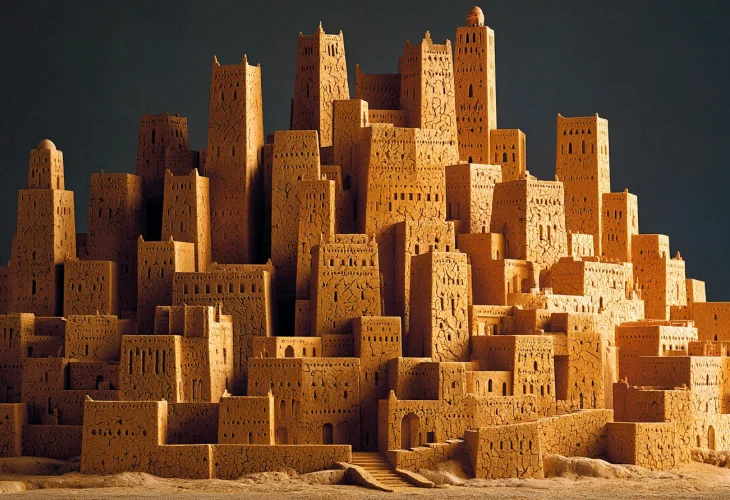
At first glance, it looks like the skyline of a modern city. Tower after tower rises from the horizon, packed tightly together in an astonishing display of urban density.
But this isn't New York.
It's Yemen.
In the heart of the Arabian desert stands Shibam, a remarkable city often called the "Manhattan of the Desert." Its towering mud-brick buildings have dominated the landscape for centuries, creating one of the most extraordinary skylines in the world.
The World's First Skyscraper City
Shibam is located in the Wadi Hadramaut valley in eastern Yemen, perched on a rocky outcrop surrounded by desert.
The city has existed for roughly 1,700 years and even served as the capital of the ancient Kingdom of Hadramaut during the fourth century CE.
However, the city gained its distinctive appearance beginning in the 16th century. After devastating floods damaged large parts of the settlement, residents rebuilt upward rather than outward, creating a dense cluster of multi-story mud-brick towers.
Long before anyone dreamed of Manhattan, Shibam had already become what many consider the world's first skyscraper city.
Hundreds of buildings, some reaching 11 stories and more than 100 feet high, stand side by side within a compact walled area. Built entirely from sun-dried mud bricks, the towers create a dramatic skyline unlike anything else on earth.
It was this unique sight that inspired British explorer Freya Stark to nickname Shibam the "Manhattan of the Desert" during her travels in the 1930s.
Built for Trade and Protection
Shibam developed along one of the Arabian Peninsula's most important trade routes.
For centuries, caravans carrying incense, spices, and valuable goods passed through the region, making the city a major commercial hub.
As trade expanded, so did the need for security.
Rather than spreading across the desert, residents built upward inside fortified walls. The tall towers provided protection from attacks while also allowing inhabitants to monitor the surrounding landscape from a distance.
The result was a vertical city that functioned as a giant fortress, offering both safety and efficient use of limited space.
A City Built From Earth
One of Shibam's most remarkable features is its construction.
The towers are made primarily from locally sourced earth mixed with straw and water. These materials were formed into mud bricks and left to dry in the sun before being stacked into towering structures.
The builders carefully designed the buildings so that the walls became thinner as they rose higher, helping maintain stability while reducing weight.
Despite their simple materials, the towers proved remarkably effective. The thick earthen walls provide natural insulation, helping keep interiors cool during scorching desert days and warmer during chilly nights.
Life Inside the Towers
The historic city occupies only about 250 by 350 meters, leaving little room for expansion.
As a result, nearly every available space was used efficiently.
The streets are narrow, sometimes barely wide enough for two donkeys to pass side by side. Above them hang wooden windows, balconies, and occasional connecting bridges between buildings.
The dense layout creates natural shade throughout much of the day, helping keep the city cooler in the intense desert heat.
Inside the towers, floors were traditionally organized according to function.
Lower levels were used for storage, livestock, and supplies. Middle floors served as living quarters, while the upper levels, which enjoyed better airflow and views, were reserved for family gatherings and receiving guests.
A City That Requires Constant Care
Unlike modern skyscrapers made of steel and concrete, Shibam's towers require ongoing maintenance to survive.
After rainstorms and seasonal weather changes, residents traditionally climb onto rooftops and repair cracks with fresh layers of mud plaster.
Without this constant attention, the buildings gradually deteriorate and can eventually collapse.
For centuries, this cycle of maintenance allowed the city to endure.
A UNESCO World Heritage Site in Danger
In 1982, UNESCO recognized Shibam's extraordinary significance by designating its old city as a World Heritage Site.
The organization described it as one of the world's oldest and finest examples of urban planning based on vertical construction.
Today, however, the city faces serious challenges.
Major flooding in 2008 damaged foundations and caused some buildings to collapse. Years of conflict, economic hardship, and limited resources have made preservation increasingly difficult.
As a result, UNESCO added Shibam to its list of World Heritage Sites in Danger.
Many of the towers now stand in a delicate balance between preservation and decay.
A Living City
Despite these challenges, Shibam is far from an abandoned historical site.
People still live within its ancient walls.
Children play in the narrow alleyways. Laundry hangs between buildings. Shops continue to operate. Daily life unfolds much as it has for generations.
That may be what makes Shibam so extraordinary.
It is not simply a monument to the past. It is a living city that continues to tell the story of human ingenuity, resilience, and adaptation in one of the harshest environments on earth.
Standing amid the desert sands, Shibam remains a breathtaking reminder that long before modern architects reached for the sky, people were already building upward in remarkable ways.

