

World News
“Hand of God”: How U.S. Apache Crew Was Rescued Near Strait of Hormuz
Two aviators spent about two hours in the water before a U.S. Navy drone boat reached them in a first-of-its-kind sea rescue
 Shutterstock
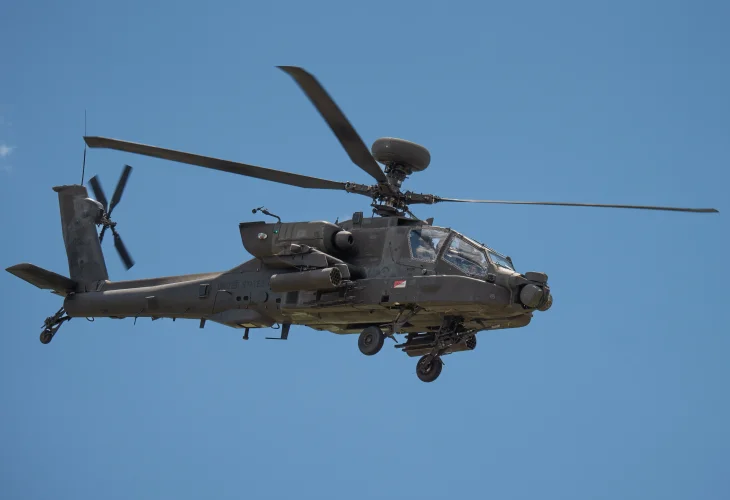
New details reveal how two U.S. Apache crew members survived a crash near the Strait of Hormuz, spending about two hours in the water before a U.S. Navy unmanned surface vessel reached them and helped move them to safety in what officials described as an apparent first-of-its-kind drone boat rescue at sea.
The AH-64 Apache was patrolling regional waters when it went down near Oman. The attack helicopter has two crew members and does not have ejection seats, leaving the aviators to escape the aircraft and survive in the water until rescue forces could reach them.
U.S. Central Command said the soldiers were rescued within approximately two hours and were in stable condition. The cause of the incident remains under investigation.
The rescue operation quickly expanded across several U.S. military elements. American drones and fighter jets provided air cover, while naval assets moved toward the downed crew. The rescue also involved U.S. 5th Fleet’s Task Force 59, the Navy unit that operates unmanned and artificial intelligence-enabled systems in the region.
The key asset was a U.S. Navy Corsair unmanned surface vessel, a remotely operated drone boat assigned to Task Force 59. Capt. Tim Hawkins, a CENTCOM spokesman, said the vessel was the one that assisted in the rescue of the Apache crew off Oman’s coast.
The drone boat did not only locate the aviators. According to U.S. reporting on the operation, it picked them up from the water and transported them to another location, where they could be lifted out by a rescue helicopter.
“The drone picked them up and transported them to another location on the water where they were hoisted up to a helicopter for further transport,” Hawkins said. The crew had gone from a downed helicopter, to the open water, to the deck of an unmanned vessel, and then into the air again by helicopter hoist.
“When it comes to search and rescue, you utilize the best asset that is the closest and the quickest, and that was the case in this instance,” Hawkins said.
A senior U.S. official described the survival and rescue of the two aviators as a “hand of God” moment. Hawkins said U.S. forces had trained for similar incidents, but the actual rescue did not unfold exactly like a drill.
“We’ve practiced this scenario in exercises, but not quite necessarily like this,” he said.
The rescue also showed why the U.S. military has been expanding its use of unmanned boats in the Gulf. The Corsair is a 24-foot drone boat built to travel long distances at sea. In this case, it was not used to watch or track a target, but to reach two crew members in the water and help get them out alive.
President Donald Trump said Iran shot down the Apache while it was patrolling over the Strait of Hormuz. “There were two pilots involved, both are safe and uninjured,” he said. “Nevertheless, the United States must, of necessity, respond to this attack.”
Iran did not claim responsibility for downing the helicopter. Iranian Foreign Minister Abbas Araghchi said foreign forces near Iranian territory are at constant risk from “human errors, plain accidents, or potentially being caught in crossfire,” and said the best way to reduce the risk was for them to leave the area.
For U.S. forces in the region, the incident showed how quickly a routine patrol near the Strait of Hormuz can become a major rescue operation. Within hours, the story had moved from a downed Apache to a new kind of sea rescue, carried out by an unmanned vessel under military air cover.

